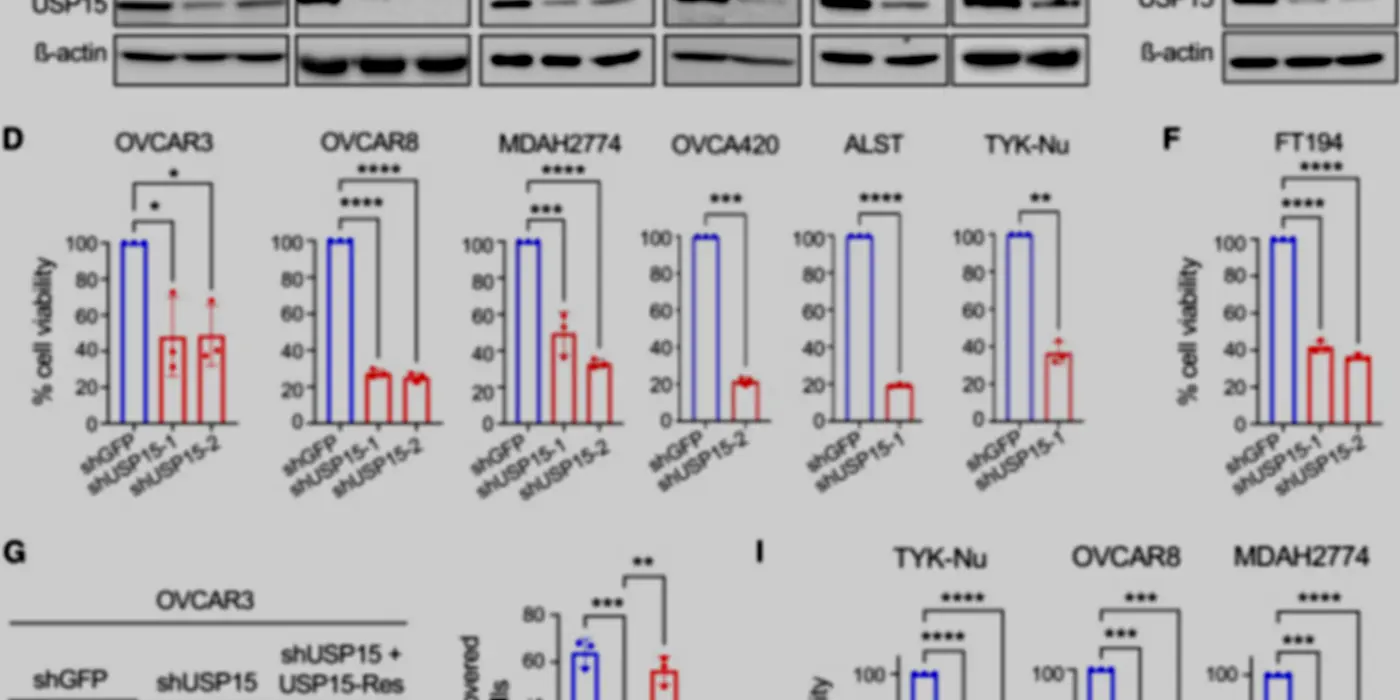
Enzyme USP15 Limits Ovarian Cancer Cells And Boosts Chemotherapy
Ovarian cancer is devastating, five-year survival rate under 30%, when detected after it has spread. New basic research may improve that.
Ovarian cancer is devastating, five-year survival rate under 30%, when detected after it has spread. New basic research may improve that.


A team of researchers say long held beliefs about how stars are formed have been just a myth, and they say this astronomy myth got busted using a set of galaxies found with CSIRO's Parkes radio telescope.When interstellar gas collapses to form stars, the stars range from massive to minute. Since the 1950s many astronomers have believed that in a family of new-born stars the ratio of massive stars to lighter ones was always about the same — for every star 20 times more massive than the Sun or larger, you'd get 500 stars the mass of the Sun or less.

A small molecule known as 125B11 but also called Fatostatin and reportedly having both anti-fat and anti-cancer abilities is also a literal turnoff for fat-making genes, according to a new report in the journal Chemistry and Biology. The chemical blocks transcription factor known SREBP, a master controller of fat synthesis. That action in mice that are genetically prone to obesity causes the animals to become leaner. It also lowers the amount of fat in their livers, along with their blood sugar and cholesterol levels.Fatostatin or its analogs may also serve a tool for gaining further insights into the regulation of SREBP and fat metabolism
If you studied the basics of human anatomy, you probably know that females are born with their entire lifetime's supply of eggs and once they're gone, they're gone. New findings by researchers at Fred Hutchinson Cancer Research Center say that is not always true.The good news; during starvation, ovulation stops and when normal food conditions resume, so do the eggs, basically turning back the reproductive clock. The bad news; it only works in in nematode worms.
Informed consent is tricky business because there are disagreements about what informed consent can mean outside the country of the company conducting the trial and people will grant a lot of consent if they believe a treatment can help them, which can lead to exploitation.One item that is not a topic of heavy debate is financial interest disclosures. Everyone seems to agree they are important but there are no comprehensive guidelines governing it.
Circadian rhythms are 24-hour cycles in various biological processes like core body temperature, melatonin synthesis and sleep–wake behavior. They are synchronized most strongly by the light–dark cycle in the environment.Bright light is known to increase alertness at night, but it has never been completely clear whether this light-induced alertness can arise from neural pathways other than those involved in the circadian system. Research described in the BMC Neuroscience (open access!) says the circadian system is not the only pathway involved in determining alertness at night. showed that red light, which does not stimulate the circadian system, is just as effective at increasing night-time alertness as blue light, which does.
Obesity has increased dramatically in the last two decades, yet so have awareness campaigns saying appearance does not matter. The cultural miasma is hardest on its youngest members and even kids aged 10 and 11 are concerned about their image, according to new research. A study of 4254 Canadian schoolchildren has shown a direct association between Body Mass Index (BMI) and satisfaction with their body shape. The research in BMC Public Health, says girls are happiest when thinnest but boys have it even worse - they are unhappy when they are too skinny or too fat.

Researchers from NIST and the University of Maryland have found what they say is a simple method of sandwiching organic molecules between silicon and metal, two materials fundamental to electronic components - perhaps overcoming one of the principal obstacles in creating switches made from individual molecules, the ultimate in miniaturization for the electronics industry.
Worried that your cold revenge plans won't come to fruition before you shake off that mortal coil? A new Web site, www.DeathRiskRankings.com, developed by researchers and students at Carnegie Mellon University, says they can help you plan your schedule accordingly. The tool allows users to query publicly available data from the United States and Europe, and compare mortality risks by gender, age, cause of death and geographic region.

Birds have a wide variety of vibrant plumages and have evolved various chemical and physical mechanisms to produce these beautiful colors over millions of years. When did feathers first get iridescence, the quality of changing color depending on the angle of observation, such as the rainbow of colors seen in an oil slick? We may be closer to an answer. A team of paleontologists and ornithologists has pushed the date back and discovered evidence of vivid iridescent colors in feather fossils more than 40 million years old. It's the first evidence of a preserved color-producing nanostructure in a fossilized feather, according to their article in Biology Letters.
Kudzu has overgrown almost 10 million acres in the southeastern United States but imagine that instead of being a nuisance it could sprout into a dietary supplement. Scientists in Alabama and Iowa are reporting the first evidence that root extracts from kudzu show promise as a dietary supplement for a high-risk condition, metabolic syndrome, that affects almost 50 million people in the United States alone. J. Michael Wyss and colleagues note in the new study that people with metabolic syndrome have obesity, high blood pressure, high blood cholesterol, and problems with their body's ability to use insulin. Those disorders mean a high risk for heart attacks, strokes, and other diseases. Scientists have been seeking natural substances that can treat the metabolic syndrome.
If you listened to the media, a bailout of GM was good for investors. A few months later, the stock was wiped out. But if you paid attention to Ford Motor Company while the media ignored them, who said a bailout was a terrific idea for its competitors and then refused government money, you may have made 300% on that stock in the last 5 months.The media being bad arbiters of quality economic advice is nothing new - they have never claimed to be otherwise because they report what they are told. Yet the tone of advocacy the media often takes today, especially in its more popular personality-driven news shows, might lead you to believe they know what they are talking about.
Little LEGO pieces shaped like pegs can re-create microscopic activity taking place inside lab-on-a-chip devices, also known as microfluidic arrays, at a scale scientists can more easily observe.Microfluidic arrays are commonly used to sort tiny samples by size, shape or composition, but the minuscule forces work at such a small magnitude, they are difficult to measure. To solve this small problem, the Johns Hopkins engineers decided to think big. Like LEGO big.