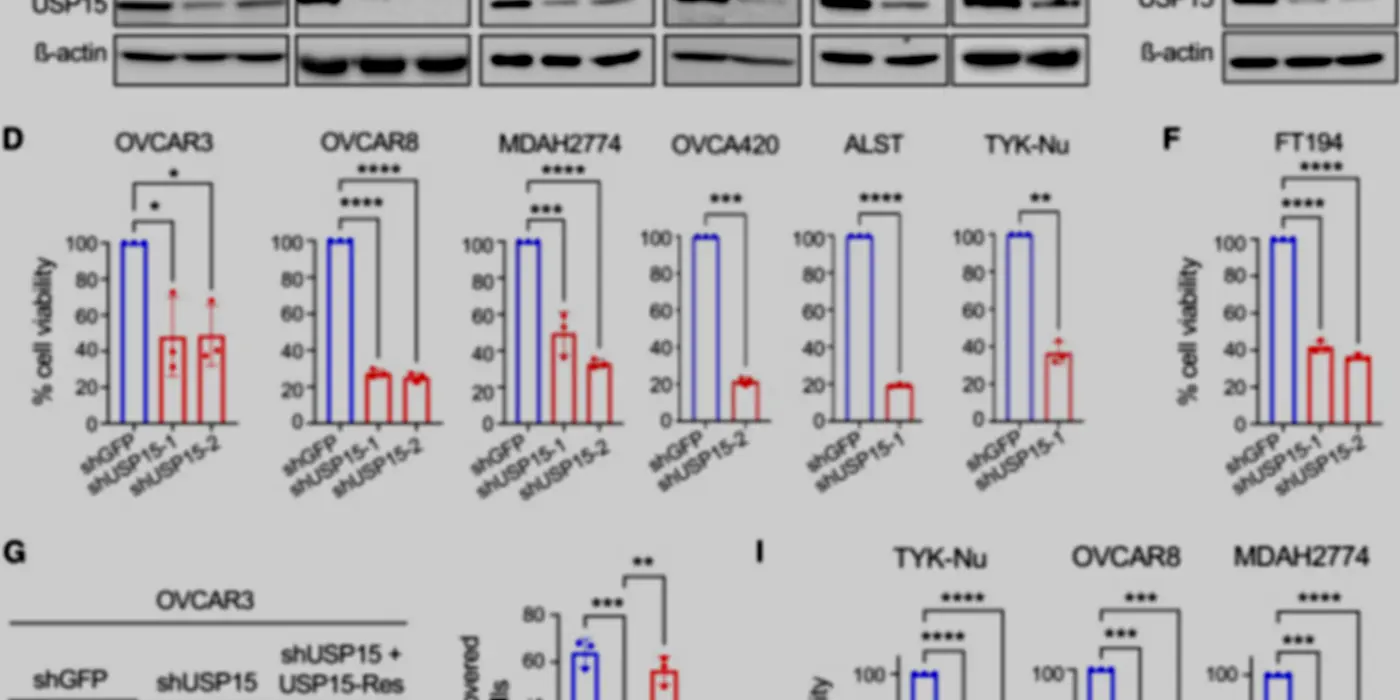
Enzyme USP15 Limits Ovarian Cancer Cells And Boosts Chemotherapy
Ovarian cancer is devastating, five-year survival rate under 30%, when detected after it has spread. New basic research may improve that.
Ovarian cancer is devastating, five-year survival rate under 30%, when detected after it has spread. New basic research may improve that.


Protein S, a well-known anticoagulant protein, also contributes to the formation and function of healthy blood vessels, say researchers at the Salk Institute for Biological Studies. They found that mice lacking protein S suffered massive blood clots, but also had defective blood vessels that allow blood cells to leak into the surrounding tissue.There are more than 200 known human mutations and polymorphisms in the gene coding for protein S, which was arbitrarily named after Seattle, the city of its discovery. The resulting deficiencies predispose carriers to deep venous thrombosis, strokes at an early age, recurrent miscarriages, and pre-eclampsia, and are associated with several autoimmune diseases, most prominently systemic lupus erythematosus.

The magic of brain imaging has allowed researchers to correlate a thicker cortex in Tetris players with increased brain efficiency due to ... playing Tetris. The researchers from Mind Research Network in Albuquerque writing in BMC Research Notes used brain imaging and Tetris to investigate whether practice makes the brain efficient because it increases gray matter.

A new method for 'recycling' hydrogen-containing fuel materials could open the door to economically viable hydrogen-based vehicles, according to research in an article appearing today in Angewandte Chemie. Hydrogen has long been considered an ideal fuel for transportation; it is abundant and can be used to run a fuel cell, which is much more efficient than internal combustion engines, and that also eliminates the formation of gaseous byproducts that are detrimental to the environment.

Numerous studies have outlined the benefits of omega-3 fatty acids but recommendations on how much you should get by people not trying to sell you something are less common. A team of French scientists say they have found the dose of DHA - docosahexaenoic acid, found in cold water fatty fish and fish oil supplements - that is "just right" for preventing cardiovascular disease in healthy men.
Every week you probably see papers ( here and elsewhere) reporting the discovery of new genetic variants that affect the risk of coronary artery disease and heart attacks. It's an exciting time and the findings will undoubtedly lead to new biological insights into the mechanisms that cause heart attacks, which in turn may result in new types of treatments, but how much value is there to it individually now? Is 'personalized medicine' for heart attacks on the way?
Functional magnetic resonance imaging (fMRI) is a technique widely used tdoay in studying the human brain but its actual value in correlation is unclear. No one knows exactly how fMRI signals are generated at brain cell level but it is crucially important to interpreting these imaging signals.Scientists from the Academy of Finland's Neuroscience Research Programme (NEURO) say they have discovered that astrocytes, support cells in brain tissue, play a key role in the generation of fMRI signals.

Do you long to hear the dulcet sounds of the salpinx, barbiton, aulos or the syrinx? Of course not, because no one has heard them in centuries. Most people have never even heard of them.But you will soon have the chance to experience musical instruments familiar to ancient civilizations but long since forgotten.Ancient instruments probably got lost because they were too difficult to build or too difficult to play. The ASTRA (Ancient instruments Sound/Timbre Reconstruction Application) team is tasked with bringing them back to life and already have successfully reconstructed the sound of an earlier instrument called the 'epigonion'.
People sometimes think the space between stars is 'empty' but that's not the case. That area is filled with patches of low-density gas and when a relatively dense clump of gas gets near a star, the resulting flow produces a drag force on any orbiting dust particles. The force only affects the smallest particles -- those about one micrometer across, or about the size of particles in smoke. This explains the otherwise difficult to understand shapes of those dust-filled disks, according to a team led by John Debes at NASA's Goddard Space Flight Center in Greenbelt, Md.
Fish and some amphibians possess a unique sensory capability that allows them to 'feel' objects around them without physical contact and see in the dark.Colloquially this is called a 'sixth sense' but scientifically it is called a lateral-line system.A team in the physics department of the Technische Universitaet Muenchen say they are able to explore the fundamental basis for this sensory system. The goal of that would not be to solve M. Night Shyamalan movies faster but rather, through biomimetic engineering, better equip robots to orient themselves in their environments.
A new study in the Journal of Child Psychology and Psychiatry says nearly 15 percent of preschoolers have high levels of depression and anxiety. Their investigation also said depressed pre-schoolers were more likely to have mothers with a history of depression. So is that actual depression or learned social behavior that seems like depression?Being a kid is not easy, of course, despite what parents think. But is finding pre-school depression in high numbers due to better diagnosis or, in the cases of rampant ADD prescriptions in the 1990s, a new field looking for patients? If it's better diagnosis, finding it earlier may be a help.
Researchers writing in, ironically, the journal Addiction have associated abstaining from alcohol with an increased risk of depression.Doesn't make sense, right? Excessive alcohol consumption has been linked to poor physical and mental health but they cite evidence saying that levels of alcohol consumption that are too low may also be associated with poor mental health possibly - obviously, abstainers may have other issues or even be reformed heavy drinkers.
In 1935 one of the founders of modern genetics, J. B. S. Haldane, studied men in London with the blood disease hemophilia and estimated that there would be a one in 50,000 incidence of mutations causing hemophilia in the gene affected – the equivalent of a mutation rate of perhaps one in 25 million nucleotides across the genome.
Others have measured rates at a few further specific genes or compared DNA from humans and chimpanzees to produce general estimates of the mutation rate expressed more directly in nucleotides of DNA.
16 scientists report today the first direct measurement of the general rate of genetic mutation at individual DNA letters in humans and show that those early estimates were spot on.