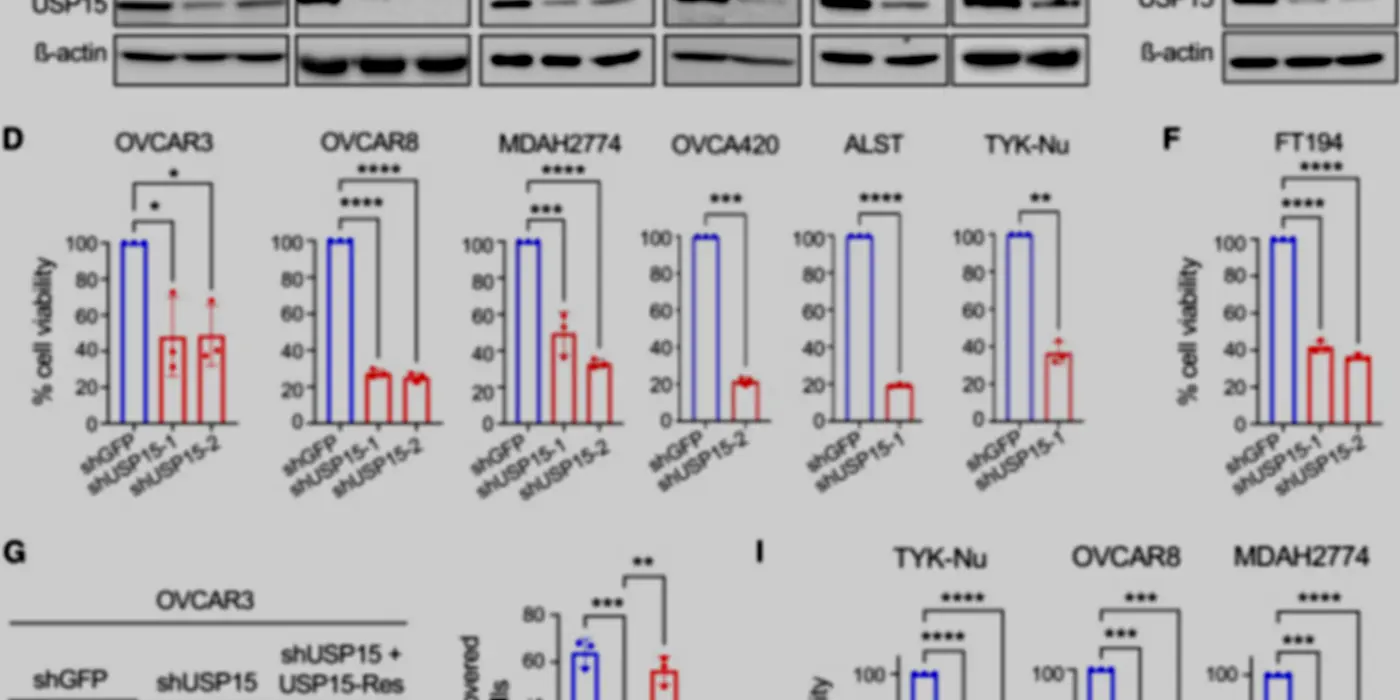
Enzyme USP15 Limits Ovarian Cancer Cells And Boosts Chemotherapy
Ovarian cancer is devastating, five-year survival rate under 30%, when detected after it has spread. New basic research may improve that.
Ovarian cancer is devastating, five-year survival rate under 30%, when detected after it has spread. New basic research may improve that.


Members of the Research Group Baubotanik at the Institute of Theory of Modern Architecture and Design (University of Stuttgart) have been focusing on the idea of living plant constructions - that's right, towers made from trees.Recently their first “baubotanical” tower made of living trees was completed - though it isn't quite mature yet. Their prototype 'building' is located in the south of Germany and is nearly 9 meters high with a base area of approximately 8 square meters.It's basically the Keep On The Borderlands, except green.

Australian scientists believe northern hemisphere pollution in Asia, Europe and North America is to blame for southern hemisphere rainfall changes. The new research announced at the international Water in a Changing Climate conference in Melbourne, 24-28 August, used a climate model that includes a treatment of tiny particles, aerosols, and said that the build up of these particles in the northern hemisphere affects their simulation of recent climate change in the southern hemisphere, including rainfall in Australia.
Want to drive the politically correct segment of academia into a tailspin? Tell them there's a group of people hurting animals and watch the outrage. Then tell them they are religious and watch it grow. But then tell them they are a South American religion and it's part of their native heritage. Hilarity ensues. Candomblé is a religion practiced by the "povo de santo" (people of saint) primarily in South America. They say it is inspired by older African beliefs. It definitely makes much use of animal sacrifice. It believes in the 'soul' of nature so anthropologists label it a form of Animism.
Is there an "Air Supply" in the bat world? Not really, though they seem to have love songs, say researchers at Texas A&M University and the University of Texas at Austin So let's look at the mysterious love sounds made by the winged creatures.
Women hedge and issue disclaimers and ask questions when they communicate, all traits that can suggest uncertainty and lack of confidence, but men do the same on gender-specific topics, according to new research from the University of California - Davis.In his study, Nicholas Palomares, assistant professor of communication at UC Davis, asked nearly 300 UC Davis undergraduates, about half female and half male, to write e-mails explaining how to change a flat tire or buy make-up, among other gender-stereotyped and gender-neutral topics. Students were given the name and gender of the person they were e-mailing.
UC Santa Barbara scientists have revealed what they call a potential new drug delivery system - a biological mechanism for delivery of nanoparticles into tissue.They developed a peptide, a small piece of protein that can carry "cargo" for delivery into the cell, whose cargo could be a nanoparticle, or even a cell.Riding on the peptide, the cargo gets out of the blood vessel and penetrates the tissue.
The so-called SHOX gene (short stature homeobox gene) is responsible for the normal growth of bones and is often mutated in short-stature patients. Short stature is considered when final height of an individual is no more than 160 cm (men) or 150 cm (women). Researchers in Heidelberg have now discovered that sequences of genetic material on the X and Y chromosome that regulate this gene are also crucial for growth in children.
Is music more than the sum of its parts? We're going to find out if the right words and musical notes can lead to Frankenstein-ish success.
The North Sea was once isolated from surrounding oceans and its change to a more fresh water state led to a significant reduction in the diversity of life, say a team of German and British scientists who have used fossilized shark teeth to reconstruct the climate of the North Sea during the Palaeogene period, between 40 and 60 million years ago. The Palaeogene was a time when greenhouse conditions prevailed and mammals began to diversify in the wake of the mass extinction event that saw the demise of the dinosaurs, along with 65% of all species.
Men, you aren't right a lot, as women will tell you, but here's one thing you got correct - women are complicated.Even more complex than you think. Women don't just have one standard for attractiveness, they have a few, and sometimes they even compete. And it's equal to fertility and health on the 'women choose based on reproduction potential' mythology restated by the psychologists in the article.
If you have a Facebook page (we do) or any social media account, you may post varying amounts of personal information you want to share online with family, friends and colleagues - but a new study presented recently in Barcelona at the Workshop on Online Social Networks, part of the annual conference of the Association for Computing Machinery's Special Interest Group on Data Communications, has found that the practices of many popular social networking sites typically make that personal information available to companies that track Web users' browsing habits and allow them to link anonymous browsing habits to specific people.
Proteins are essential for healthy cells and all biological activities - misfolded and/or damaged proteins are common to human neurodegenerative diseases and age-associated diseases.A big question is, when during a lifespan do proteins start to misbehave?A new Northwestern University study says that protein damage can be detected much earlier than previously believed, long before individuals exhibit symptoms. Importantly, the results also suggest that if we intervene early enough, the damage could be delayed.