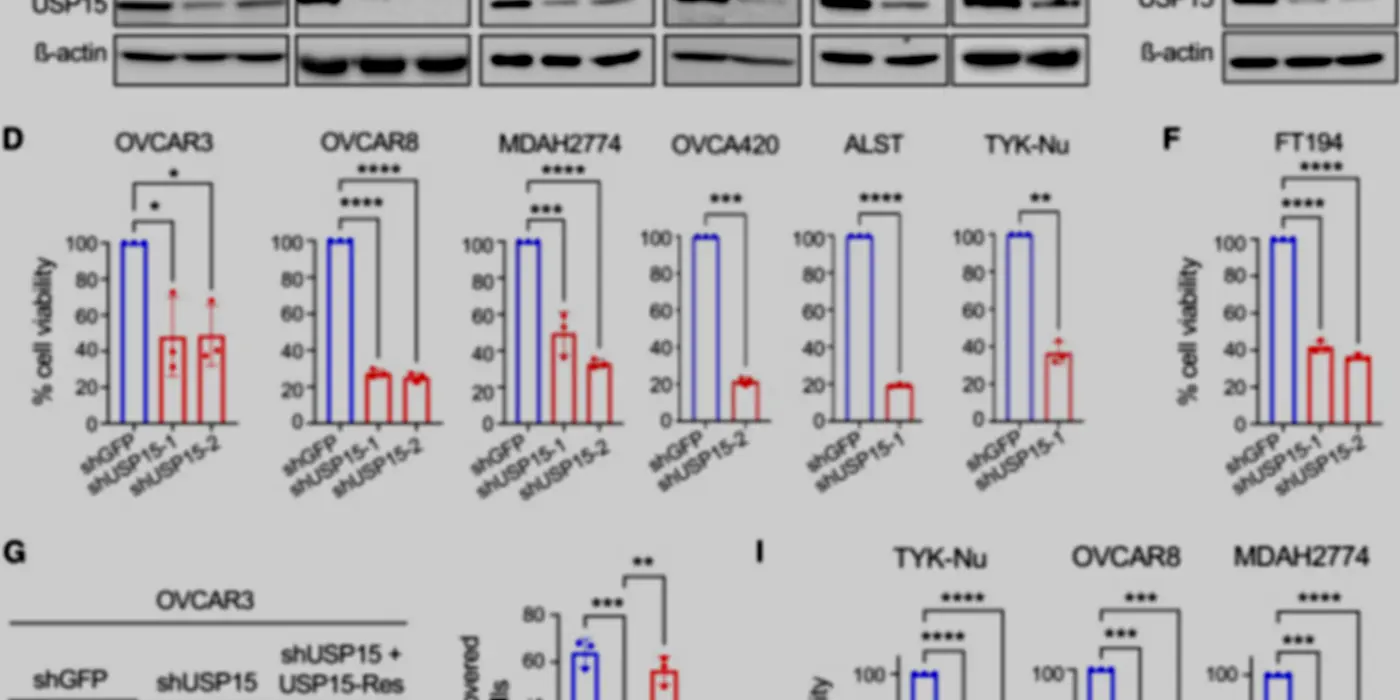
Enzyme USP15 Limits Ovarian Cancer Cells And Boosts Chemotherapy
Ovarian cancer is devastating, five-year survival rate under 30%, when detected after it has spread. New basic research may improve that.
Ovarian cancer is devastating, five-year survival rate under 30%, when detected after it has spread. New basic research may improve that.


The human papillomavirus (HPV) vaccine is a contentious debate. A large pharmaceutical company with budget to spend can't usually find a friend in science but even with vague benefit it's difficult to argue against protecting children or opening debate about the value of all vaccines by being critical of one.
The Commonwealth Fund, a private foundation devoted to health care reform, has issued a report saying that President Obama's proposed health care plan would help more than 13 million uninsured young adults ages 19-29 gain coverage.

Now that people have finally realized ethanol is a government-run, unscientific boondoggle, efforts are under way to make legitimate biofuels efficient enough for mass usage.Microalgae are monocellular, plant-like organisms that use photosynthesis and convert carbon dioxide (CO2) into biomass. From this biomass, both potential resources and active substances as well as fuels like biodiesel may be produced. While growing, algae take up the amount of CO2 that is later released again when they are used for energy production. Hence, energy from algae could potentially be produced in a CO2-neutral manner contrary to fossil fuels or current biofuels.
As kids, we all liked to imagine scenes where big dinosaurs squared off against each other for gigantic battles - if you're young, imagination is like a Transformers movie, but without $100 million for special effects. Those battles rarely happened, if at all, goes a new hypothesis. Dinosaurs became chickens in evolution (well, maybe) but they were already chickens at heart, say paleontologists at Ludwig-Maximilians-Universität (LMU) in Munich.
Usain Bolt, sprinter from Jamaica, currently holds the world record in the 100 meter sprint with a time of 9.69 seconds. Whenever new records are set, people ask 'what is the limit on human performance?'So how fast can a human run? Two econometricians from Tilburg University in the Netherlands, Professor of Statistics John Einmahl and former student Sander Smeets, say have calculated the ultimate records for the 100-meter sprint. The good news; there is still room for improvement in both the men's and women's times in the near future.

Uncompressed hydrogen will require a tank the size of a bus to take your car 300 miles but compressed hydrogen can be ... explosive ... unless the materials for storage get a lot better.Engineers in the Department of Energy's Pacific Northwest National Laboratory have a different idea entirely: they want to pack hydrogen into a larger molecule.There are obstacles. A gas flows easily out of a tank but getting hydrogen out of a molecule requires a catalyst. New details about one such catalyst in the Journal of the American Chemical Society may be a step toward better hydrogen energy applications such as fuel cells.
It's easy for Arizona residents to hope for widespread solar power usage - they don't have to think about the thousands of miles of new power lines on land that will be grabbed under eminent domain.And you'd think hockey stick analogies regarding climate issues would be bad, since the most famous one turned out to be made up.But University of Arizona postdoctoral electrochemist Erin Ratcliff can't resist. She says solar power is ready to take off. "We're right at the magic moment when the hockey stick starts to take off, when you go from flat to hockey stick. We're right there. It's exciting to read the literature and hope that, yes, we will take off. It will be exciting to look back and say 'I was there for that.'"

HD 87643, a member of the exotic class of B[e] stars, is in a very rich field of stars towards the Carina (the Keel) arm of the Milky Way. It recently became part of a set of observations that provide astronomers with the best ever picture of a B[e] star. B[e] stars are stars of spectral type B, with emission lines in their spectra, hence the "e". They are surrounded by a large amount of dust.

Scientists at Imperial College London have created detailed 3D computer models of two fossilized specimens of ancient creatures called Cryptomartus hindi and Eophrynus prestvicii that lived around 300 million years ago and are closely related to modern-day spiders. The study reveals some of the physical traits that helped them to hunt for prey and evade predators. The researchers created their images by using a CT scanning device, which enabled them to take 3,000 x-rays of each fossil. These x-rays were then compiled into precise 3D models, using custom-designed software.

Betelgeuse, the second brightest star in the constellation of Orion (the Hunter), is a red supergiant, one of the biggest stars known, and almost 1,000 times larger than our Sun.To put that in perspective, if Betelgeuse were at the center of our Solar System it would extend out almost to the orbit of Jupiter, engulfing Mercury, Venus, Earth, Mars and the main asteroid belt.
The world's environment ministers, government officials, diplomats and campaigners are preparing for the biggest poker game of their lives - the COP15 conference in Copenhagen in December 2009. It's one of the most complicated political deals the world has ever seen but third world countries are holding the cards.In Environmental Research Letters, the paper 'Tripping Points: Barriers and Bargaining Chips on the Road to Copenhagen' lays bare the main tripping points – those political barriers and bargaining chips – which need to be overcome for countries to reach a consensus on how to address global climate change.
Organic solar cells that can be produced easily and inexpensively are the perfect solution to future 'personalized' power generation. Major obstacles remain, such as coaxing these carbon-based materials to reliably form the proper structure at the nanoscale level - tinier than 2-millionths of an inch - and be efficient in converting light to electricity, transforming at least 10 percent of the sunlight that they absorb into usable electricity.