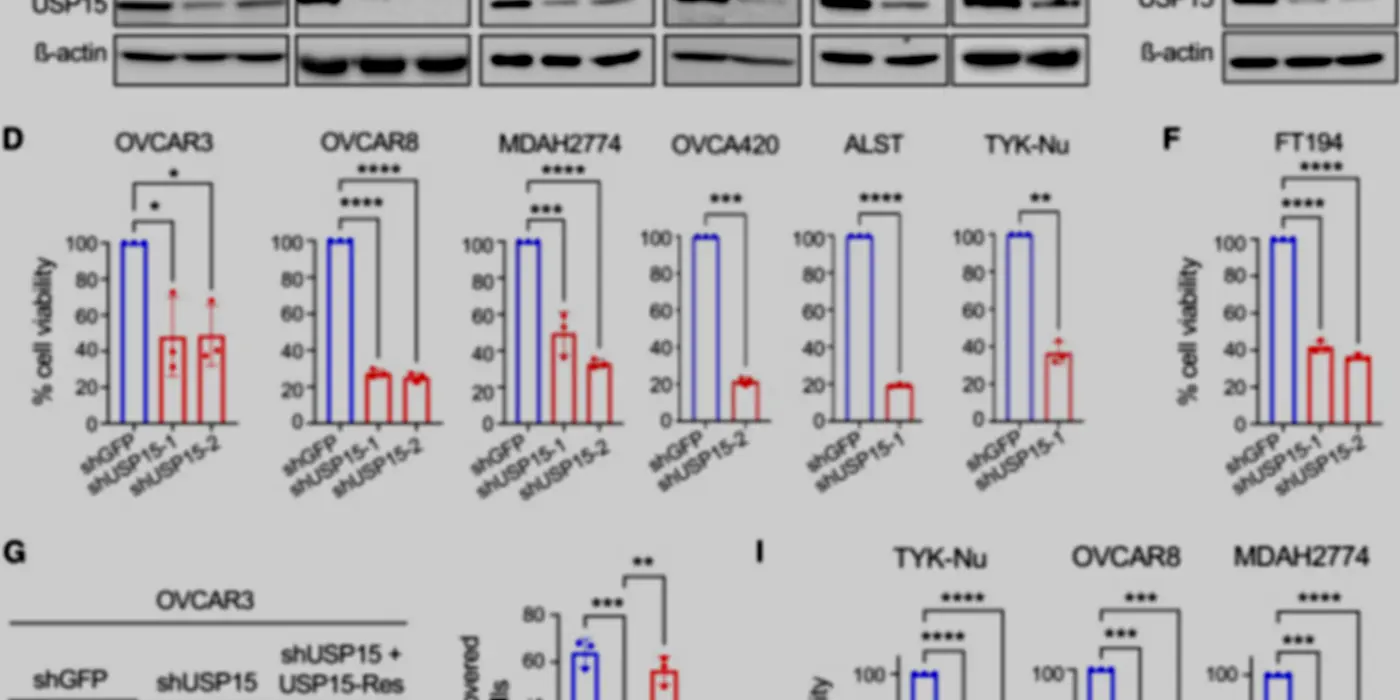
Enzyme USP15 Limits Ovarian Cancer Cells And Boosts Chemotherapy
Ovarian cancer is devastating, five-year survival rate under 30%, when detected after it has spread. New basic research may improve that.
Ovarian cancer is devastating, five-year survival rate under 30%, when detected after it has spread. New basic research may improve that.


Differences in growth factor (GF) signaling may cause the poor prognosis in some breast cancer cases. A new study, published in the open access journal BMC Medical Genomics, suggests that some estrogen receptor-positive breast cancers respond poorly to tamoxifen because of increased GF signaling.
Now there's a new reason for the weight-conscious to drink fat free milk at breakfast time, suggests a new study published in the July issue of the American Journal of Clinical Nutrition. Researchers in Australia found that drinking fat free milk in the morning helped increase satiety, or a feeling of fullness, and led to decreased calorie intake at the next meal, as compared with a fruit drink. The milk drinkers ate about 50 fewer calories (or nearly 9% less food) at lunch.
The Earth's mantle, situated under the Earth's crust, is a key area for understanding geological processes but we only come into contact with Earth's circulating layers in the event of earthquakes and volcanic eruptions. It's important to learn more about the characteristics of the Earth's mantle and these characteristics can be portrayed using seismic waves but the techniques used for this purpose still have various shortcomings. Dutch-sponsored research Ebru Bozdag demonstrated this during her doctoral research.
We do lots of things without thinking about it, like driving to work while we talk on the phone. We have a kind of 'autopilot' that kicks in for things we have practiced and it allows us to do other things simultaneously.For people with schizophrenia it's a little different. Dutch researcher Tamar van Raalten investigated whether a disruption to the automation process, learning by repetition to do something on automatic pilot, explains why people with schizophrenia can process less information. She established that it is not the automation process but the processing of new information that causes problems.
Scientists at VIB, the Flanders Institute for Biotechnology, have successfully introduced genes coding for a variant of the Charcot-Marie-Tooth (CMT) disease, into fruit flies. CMT is one of the most common hereditary disorders of the peripheral nervous system. VIB research – directed by Albena Jordanova, Patrick Callaerts and Vincent Timmerman - shows that the flies recapitulate several symptoms of the human disease.
A Ph.D. thesis at the University of the Basque Country has analyzed the role played by a number of emotional variables, such as the way in which negative emotions are controlled or attitudes to emotional expression, and to use these variables as tools to predict the possibility of suffering an eating disorder.
A baffling report says health workers fail to understand the importance of sex for Tanzanian children. Yes, children.Community health organizations working on AIDS prevention projects in Tanzania, frequently fail to understand how children in Tanzania deal with sex, says Miranda van Reeuwijk, who followed groups of children in Tanzania between 2004 and 2008. van Reeuwijk followed the children in order to help change this situation and says the children mainly view sex as something from which they can personally benefit, but frequently hide their relationships from parents and health workers. They are more scared of their strict parents than of HIV.
Melatonin can slow down the effects of aging, according to a team at laboratoire Arago in Banyuls sur Mer (CNRS / Université Pierre et Marie Curie) who say that a treatment based on melatonin can delay the first signs of aging in a small mammal. Better known as the ‘time-keeping' hormone, melatonin is naturally secreted by the body during the night. It is therefore a kind of biological signal for nightfall, allowing an organism to synchronize itself with the day/night rhythm.

The largest artificial underground cav in Israel has been exposed in the Jordan Valley in the course of a survey carried out by the University of Haifa's Department of Archaeology. Prof. Adam Zertal, who headed the excavating team, reckons that this cave was originally a large quarry during the Roman and Byzantine era and was one of its kind. Various engravings were uncovered in the cave, including cross markings, and it is assumed that this could have been an early monastery."It is probably the site of "Galgala" from the historical Madaba Map," Prof. Zertal says.
A toxic molecule implicated in cell damage and disease may also be essential for bird migration, according to the University of Illinois. They propose the molecule superoxide as a key player in the mysterious process that allows birds to 'see' Earth's magnetic field.
Where we are born not only determines how we speak apparently how we taste food and drink, according to Andy Taylor, a researcher in flavor technology at The University of Nottingham and Greg Tucker, a food psychologist. The taste preferences of the UK's major regions have been analyzed by the pair and Taylor of the Flavour Research Group said, "Taste is determined by our genetic make-up and influenced by our upbringing and experience with flavours. Just as with spoken dialects, where accent is placed on different syllables and vowel formations, people from different regions have developed enhanced sensitivities to certain taste sensation and seek foods that trigger these."

At the quantum level, the atoms that make up matter and the photons that make up light behave in seemingly bizarre ways.Particles can exist in "superposition," in more than one state at the same time (don't look!), a situation that permitted Schrödinger's famed cat to be simultaneously alive and dead. Matter can also be entangled', what Albert Einstein called "spooky action at a distance" in such a way that one thing influences another, regardless of how far apart the two are.