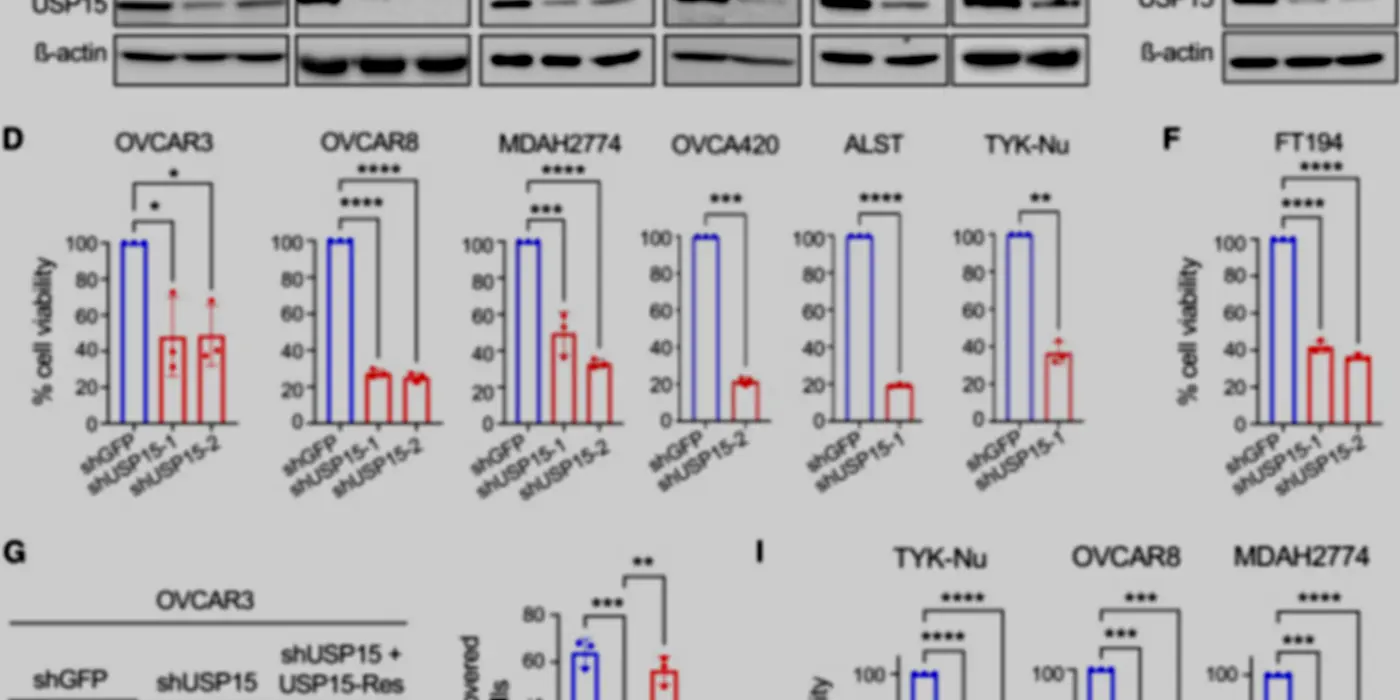
Enzyme USP15 Limits Ovarian Cancer Cells And Boosts Chemotherapy
Ovarian cancer is devastating, five-year survival rate under 30%, when detected after it has spread. New basic research may improve that.
Ovarian cancer is devastating, five-year survival rate under 30%, when detected after it has spread. New basic research may improve that.


Why do some species have parents working together to raise young? In humans, it is the norm but in nature it is rare.Birds, like humans, have offspring raised by two parents and bird biologists at the University of Bath want to know more about why. The study, published in the Journal of Evolutionary Biology, analyzed more than 50 previous studies of birds to understand why and how they share their parental duties.

Even among giants Messier 87, with two to three billion times the mass of our sun, stands out, completely dominating the Virgo cluster.A supermassive black hole exists in the center of Messier 87 and gigantic plasma flows shoot out from the vicinity of the black hole at close to light speed. Scientists have now observed, simultaneously in gamma and radio frequencies, this active galactic core region and in doing so discovered that the elementary particles are accelerated to extremely high energy levels in closest proximity to the black hole.
Mars, Incorporated, the global brand dealing primarily with chocolate, other candy and pet food (1), wants to discuss its cocoa sustainability program as part of a summer-long sustainability exhibition on Mainau Island - a botanical island famed locally for its flora and fauna and located in the middle of Lake Constance, Germany, one of Germany's most popular tourist destinations.
The exhibition, which opens today, follows on from the annual Lindau Nobel Laureate Meeting in Germany last week, in which Mars was a sponsor.

Robots, lacking families and pensions, will rush into scenarios where humans fear to tread, like rescue missions following natural disasters. So they need our support. RoboCup Rescue is a new effort to promote research and development in the field of rescue robotics. Robots for search and rescue missions, the efficient co-ordination of rescue services or decision-support systems are all the practical result of rescue robotics research. Two RoboCup leagues give an insight into digitally supported rescue possibilities: Rescue Simulation and Real Rescue.Rescue Robot at RoboCup 2009. Photo: TU Graz
Six groups of scientists from the Departments of Biology and Chemistry at the University of York and the Astbury Centre for Structural and Molecular Biology, Faculty of Biological Sciences, at the University of Leeds have set out discover how a group of proteins that are highly effective at killing bacteria could hold the key to developing new types of antibiotics.Researchers from the Universities of York and Leeds have been awarded £3.3m from the Biotechnology and Biological Sciences Research Council (BBSRC) to find out how a family of proteins known as colicins force their way into bacterial cells before destroying them.
Have a really smart kid who loves big trucks but you can't stand loud, growling voices with too much reverb in stadiums? You're in luck. MANTRA (The Manufacturing Technology Transporter) is a specially modified monster truck that is packed with the latest machinery and simulators rather than baseball caps and flannel shirts.The 14 meter long MANTRA truck will take to the road with a dedicated team to demonstrate the manufacturing and assembly line technology of the future and help to inspire young people to take up careers in engineering.
Paperless office? An optimistic pipe dream. We use more paper documents than at any time in history despite the prevalence of the Internet and digital technology. Part of the reason is lousy copy protection of scanned documents and storing them online.But a new approach to archiving scanned documents that makes the text searchable and adds a watermark to images for copy protection and validation reported in the inaugural issue of the International Journal of Reasoning-based Intelligent Systems may herald some forward progress.
If you read internet science in 2006, you'd have thought former president George W. Bush's limitations of use of embryonic stem cell lines had killed science. In reality, embryonic stem cell research only received $15 million in US funding when the restrictions were imposed and it grew to billions per year during his presidency so some of that rhetoric was designed simply to engage in cultural spin and mobilize votes for Democrats.With a Democrat president and a bulletproof majority in the Senate, culturally-inclined science bloggers can now instead focus on religion and maybe the few Republicans still out there and the rest of us can tackle serious issues, like how to educate people on stem cell research so they can make informed policy decisions.

Astronomers have unveiled a new atlas of the inner regions of the Milky Way - that's our home galaxy, if you're from someplace else - and it's peppered with thousands of previously undiscovered dense knots of cold cosmic dust, the potential birthplaces of new stars. Using observations from the APEX telescope in Chile, this survey is the largest map of cold dust so far.This new guide for astronomers, known as the APEX Telescope Large Area Survey of the Galaxy (ATLASGAL) shows the Milky Way in submillimetre-wavelength light (between infrared light and radio waves. Images of the cosmos at these wavelengths are vital for studying the birthplaces of new stars and the structure of the crowded galactic core.
Do friends wear the same clothes or see the same movies because they have similar tastes, part of the reason they became friends or, once a friendship is established, do individuals influence each other to adopt like behaviors? Social scientists don't know for sure and are still trying to understand the role social influence plays in the spreading of trends because the real world doesn't keep track of how people acquire new items or preferences. But the virtual world of "Second Life" does. Researchers from the University of Michigan have tried to use this information to study how "gestures" make their way through this online community. Gestures are code snippets that Second Life avatars must acquire in order to make motions such as dancing, waving or chanting.

L'Oréal and New Scientist today announced the results of a poll revealing the most inspirational female scientists of all time. Nuclear physicist and chemist Marie Curie topped the poll which was created to celebrate 10 years of the L'Oréal-UNESCO For Women In Science program, with around a quarter (25.1%) of the vote. Voted for by more than 800 members of the scientific community and visitors to http://www.NewScientist.com, the poll highlights the absence of modern role models on the list; Astrophysicist Dame Susan Jocelyn Bell Burnell (4.7%), responsible for the discovery of radiopulsars, and Jane Goodall, the primatologist (2.7 per cent) were the only scientists in the top ten to have research published in recent years, polled 4th and 10th, respectively.

A new printable battery that can be produced cost-effectively on a large scale has been developed by a research team led by Prof. Dr. Reinhard Baumann of the Fraunhofer Research Institution for Electronic Nano Systems ENAS in Chemnitz together with colleagues from TU Chemnitz and Menippos GmbH.Like your t-shirt, the batteries are printed using a silk-screen method.They are also different from conventional batteries in that these printable versions weigh less than one gram, are less than a millimeter thick and can even be integrated into bank cards.