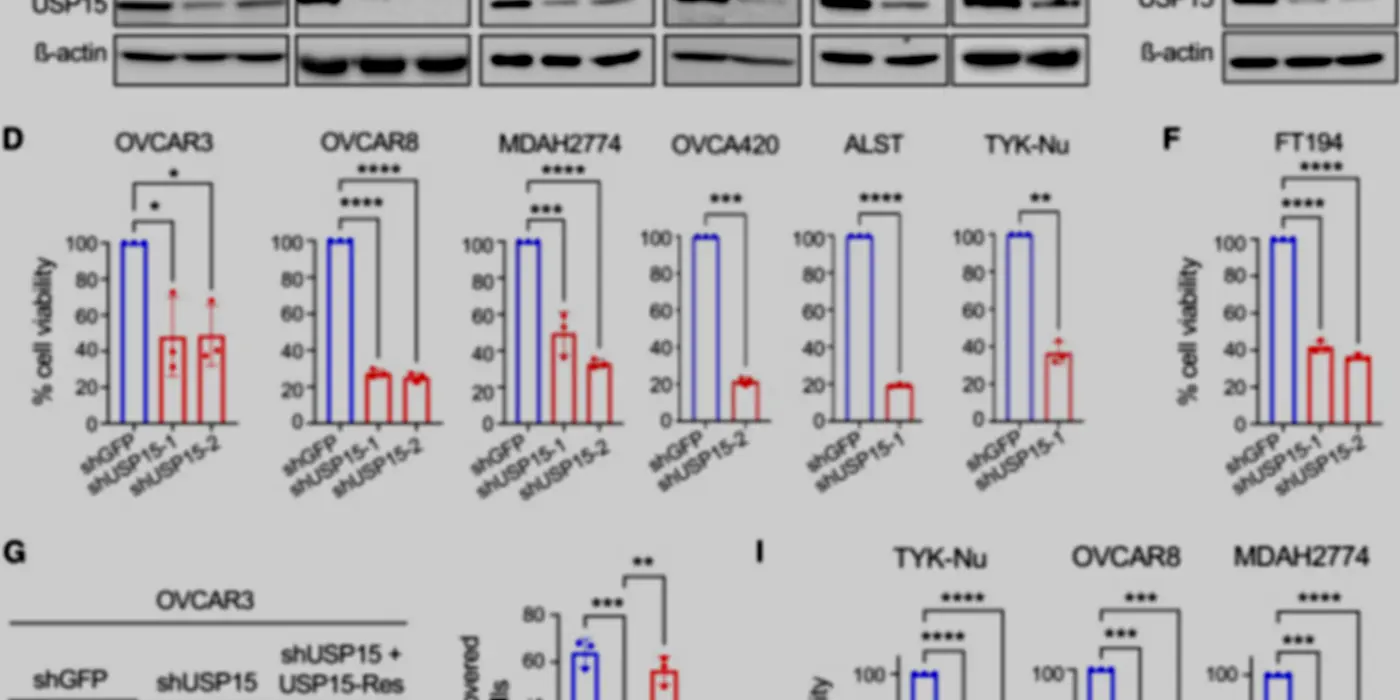
Enzyme USP15 Limits Ovarian Cancer Cells And Boosts Chemotherapy
Ovarian cancer is devastating, five-year survival rate under 30%, when detected after it has spread. New basic research may improve that.
Ovarian cancer is devastating, five-year survival rate under 30%, when detected after it has spread. New basic research may improve that.


The Amazon River has been around for 11 million years ago and in its shape for the last 2.4 million years ago, according to a study on two boreholes drilled in proximity of the mouth of the Amazon River by Petrobras, the national oil company of Brazil.Until recently the Amazon Fan, a sediment column of around 10 kilometres in thickness, proved a hard nut to crack, and scientific drilling expeditions such as Ocean Drilling Program could only reach a fraction of it. Recent exploration efforts by Petrobras lifted the veil, and sedimentological and paleontological analysis on samples from two boreholes, one of which 4.5 kilometres below sea floor, now permit an insight into the history of both Amazon River and Fan.

In the 1980s, a popular hypothesis was that any number of people were suffering from trauma they knew nothing about; dissociative amnesia, or repressed memories.At issue is how to prove whether memories of trauma, such as childhood sexual abuse, could be repressed and then resurface later in life. Overzealous therapists and willing victims led to any number of false allegations and the resulting damage to families can't be overstated. Even a hint of child abuse is guilt in the minds of many.

Physicists at the National Institute of Standards and Technology (NIST) have devised a viable way to manipulate a single 'bit' in a quantum processor without disturbing the information stored in its neighbors, using polarized light to create "effective" magnetic fields.A great challenge in creating a working quantum computer is maintaining control over the carriers of information, the "switches" in a quantum processor while isolating them from the environment. These quantum bits, or "qubits," have the uncanny ability to exist in both "on" and "off" positions simultaneously, giving quantum computers the power to solve problems conventional computers find intractable – such as breaking complex cryptographic codes.

The mystery of a rare bat's unusually large nose has been solved, according to an article in Physical Review Letters.The adult Bourret's horseshoe bat, known scientifically as the Rhinolophus paradoxolophus meaning paradoxical crest, has a nose roughly 9 millimeters in length but the typical horseshoe bat's nose is half that long, said Rolf Mueller, an associate professor with the Virginia Tech mechanical engineering department and director for the Bio-inspired Technology (BIT) Laboratory in Danville, Va. "This nose is so much larger than anything else," among other bats of the region, he said.

Severe chronic obstructive pulmonary disease (COPD) is associated with lower cognitive function in older adults, according to research from Mount Sinai School of Medicine.Researchers compared cognitive performance in over 4,150 adults with and without COPD and found that individuals with severe COPD had significantly lower cognitive function than those without, even after controlling for confounding factors such as comorbidities.

Researchers have used genetific modification (GM) to bring salt-tolerant plants a little closer to reality.The research team – based at the University of Adelaide's Waite Campus in Australia – has used a new GM technique to contain salt in parts of the plant where it does less damage.Salinity affects agriculture worldwide, which means the results of this research could impact on world food production and security.The work has been led by researchers from the Australian Centre for Plant Functional Genomics and the University of Adelaide's School of Agriculture, Food and Wine, in collaboration with scientists from the Department of Plant Sciences at the University of Cambridge, UK.
A new monkey has been discovered in a remote region of the Amazon in Brazil, according to the Wildlife Conservation Society (WCS) .The monkey is related to saddleback tamarins, which include several species of monkeys known for their distinctively marked backs. The newly described distinct subspecies was first seen by scientists on a 2007 expedition into the state of Amazonas in northwestern Brazil.
Though New Orleans residents were told to evacuate days before the arrival of Hurricane Katrina, no one could have predicted the real extent of the devastation that would follow. Researchers from Tel Aviv University say they may be ableto make just such a prediction in the future. They say a reliable way to help predict the intensity of the next big flood can use common cell phone towers across the United States. Their model, which analyzes cell phone signals, adds a critical component to weather forecasting never before available.
Scientists at Burnham Institute for Medical Research (Burnham) say they have discovered that specialized complex sugar molecules (glycans) that anchor cells into place act as tumor suppressors in breast and prostate cancers.Glycans play a critical role in cell adhesion in normal cells and their decrease or loss leads to increased cell migration by invasive cancer cells and metastasis but an increase in expression of the enzyme that produces these glycans, β3GnT1, resulted in a significant reduction in tumor activity.
If you were born at a time when social security numbers were not required, you can probably recognize other people from your home state if you see or hear their numbers. You may have thought there was a smarter system in place by now.Not so, and it's actually easy to glean a social security number, say project lead Alessandro Acquisti, associate professor of information technology and public policy at Carnegie Mellon's H. John Heinz III College, and Ralph Gross, a post-doctoral researcher, who have shown that public information readily gleaned from governmental sources, commercial data bases, or online social networks can be used to routinely predict most — and sometimes all — of an individual's nine-digit Social Security number.
Parasites don't get a lot of respect these days but we may have to reconsider that. In spite of their nasty reputation, they may have given us the joy of sex.What's so great about sex?If you don't know, this article cannot help and even from an evolutionary perspective the answer is not as obvious as one might think.

Two studies published in Science Express show the analysis of gamma-rays from two dozen pulsars, including 16 discovered by NASA's Fermi Gamma-ray Space Telescope. Fermi is the first spacecraft able to identify pulsars by their gamma-ray emissions alone.A pulsar is the rapidly spinning and highly magnetized core left behind when a massive star explodes. Most of the currently cataloged pulsars, some 1800 of them, were found through their periodic radio emissions; pulses caused by narrow, lighthouse-like radio beams emanating from the pulsar's magnetic poles, according to current theory.