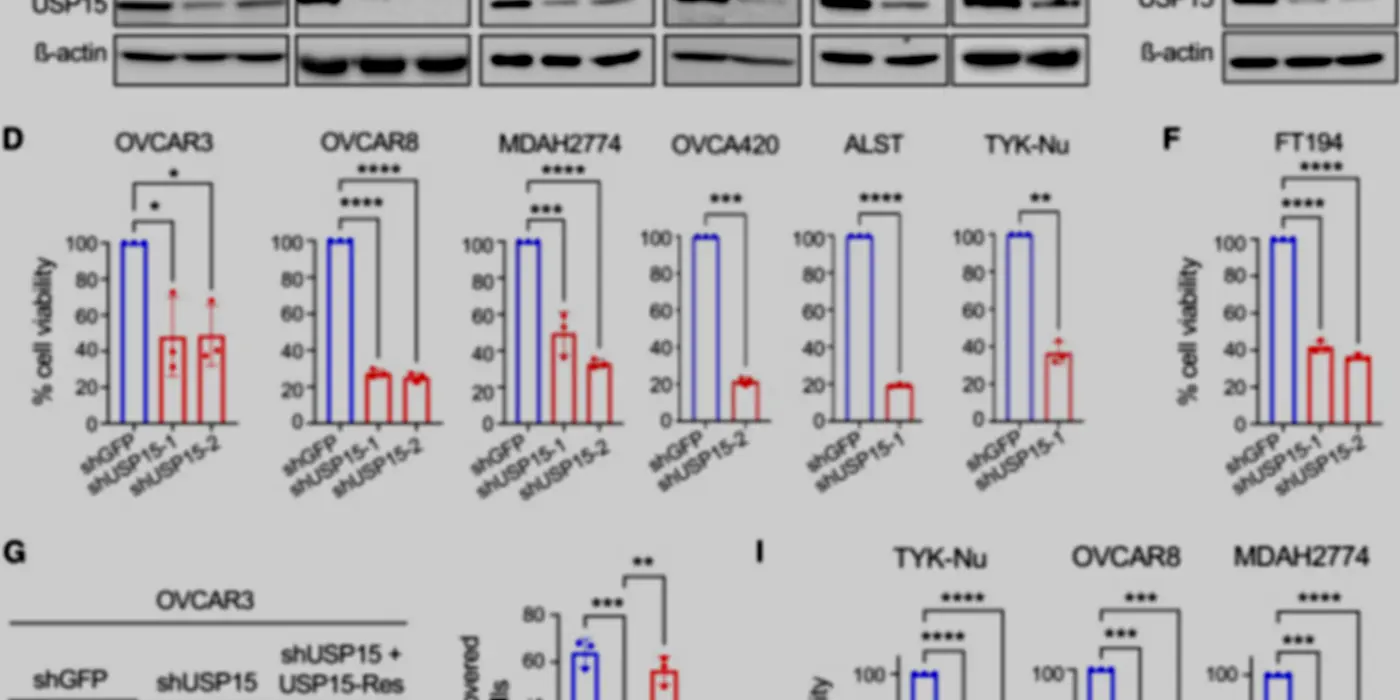
Enzyme USP15 Limits Ovarian Cancer Cells And Boosts Chemotherapy
Ovarian cancer is devastating, five-year survival rate under 30%, when detected after it has spread. New basic research may improve that.
Ovarian cancer is devastating, five-year survival rate under 30%, when detected after it has spread. New basic research may improve that.


A preliminary study on the use of stem cells obtained from a patient's own adipose tissue in the treatment of multiple sclerosis (MS) has shown promising results. The three case studies, described in BioMed Central's open access Journal of Translational Medicine support further clinical evaluation of stromal vascular fraction (SVF) cells in MS and other autoimmune conditions.
The calming neurological effects of nicotine have been demonstrated in a group of non-smokers during anger provocation. Researchers writing in Behavioral and Brain Functions suggest that nicotine may alter the activity of brain areas that are involved in the inhibition of negative emotions such as anger.

In the 19th century, the Rosetta Stone allowed scholars to translate symbols left by an ancient civilization and decipher the meaning of Egyptian hieroglyphics. But many mysteries remain about the symbols found on other ancient artifact, including those of a people that inhabited the Indus valley on the present-day border between Pakistan and India. Some experts question whether the symbols represent a language at all, or are merely pictograms that bear no relation to the language spoken by their creators.
The Wildlife Conservation Society announced at the International Coral Reef Initiative (ICRI), which is meeting this week in Phuket, Thailand, results showing that some coral reefs off East Africa are unusually resilient to climate change due to improved fisheries management and a combination of geophysical factors. The study published in Aquatic Conservation: Marine and Freshwater Ecosystems provides additional evidence that globally important "super reefs" exist in the triangle from Northern Madagascar across to northern Mozambique to southern Kenya, they say, and should be a high priority for future conservation action.

A research team from Northeastern University and the National Institute of Standards and Technology (NIST) has discovered that a residue of a process used to build arrays of titania nanotubes (that wasn’t even previously noticed), plays an important role in improving the performance of the nanotubes in solar cells that produce hydrogen gas from water. Their results indicate that by controlling the deposition of potassium on the surface of the nanotubes, engineers can achieve significant energy savings in a promising new alternate energy system.

A trove of Benjamin Franklin letters has turned up in the British Library. Discovered by University of California, San Diego professor Alan Houston, the letters are copies of correspondence that hasn't been seen in more than 250 years. All dating from the spring and summer of 1755, the 47 letters by, to and about Franklin are in the hand of one Thomas Birch, a contemporary of Franklin's who was a prodigious – almost inveterate – compiler and transcriber of historical documents. They are being published for the first time in the April issue of the William and Mary Quarterly.

The circadian clock coordinates physiological and behavioral processes on a 24-hour rhythm, allowing animals to anticipate changes in their environment and prepare accordingly.Scientists already know that some genes are controlled by the clock and are turned on only one time during each 24-hour cycle but now researchers at the University of Pennsylvania School of Medicine and the Salk Institute for Biological Studies have found that some genes are switched on once every 12 or 8 hours.
Genome sequencing is getting better and faster. Two months ago we had the first draft of the neanderthal genome and now scientists from the University of Maryland have published their assembly of the Bos taurus - the domestic cow. Sure that's not as exciting to the wider population but it's important to the genetics community.
A process called ‘dark gulping’ may solve the mystery of the how supermassive black holes were able to form when the Universe was less than a billion years old.Dr Curtis Saxton will be presenting the study at the European Week of Astronomy and Space Science at the University of Hertfordshire in Hatfield.

Researchers writing in Nature magazine say the fossil skeleton of a newly discovered carnivorous animal, Puijila darwini, is a "missing link" in the evolution of the group that today includes seals, sea lions, and the walrus. Modern seals, sea lions, and walruses all have flippers—limb adaptations for swimming in water. These adaptations evolved over time, as some terrestrial animals moved to a semi-aquatic lifestyle. Until now, the morphological evidence for this transition from land to water was weak. Skeletal illustration of Puijila darwini. Credit: Mark A. Klingler/Carnegie Museum of Natural History

Using information from a suite of telescopes, astronomers have discovered a mysterious, giant object that existed at a time when the universe was only about 800 million years old. Objects such as this one are dubbed extended Lyman-Alpha blobs; they are huge bodies of gas that may be precursors to galaxies. This blob was named Himiko for a legendary, mysterious Japanese queen. It stretches for 55 thousand light years, a record for that early point in time. That length is comparable to the radius of the Milky Way's disk.

An international team of astronomers has used the world's biggest radio telescope to look deep into the brightest galaxies that NASA's Fermi Gamma-ray Space Telescope can see. The study solidifies the link between an active galaxy's gamma-ray emissions and its powerful radio-emitting jets. "Now we know for sure that the fastest, most compact, and brightest jets we see with radio telescopes are the ones that are able to kick light up to the highest energies," said Yuri Kovalev, a team member at the Max Planck Institute for Radio Astronomy in Bonn, Germany.