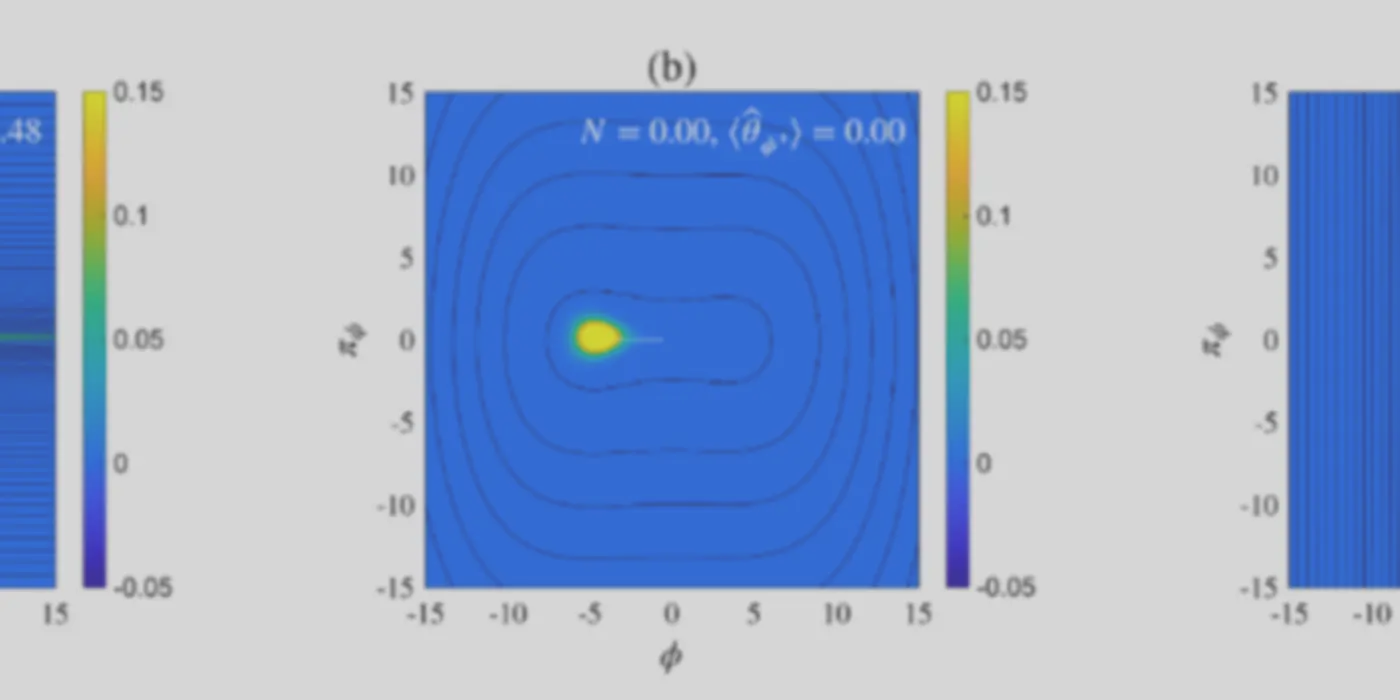
Sorry Higgs, There May Be A New Contender For Low Energy States
If we're trapped in a false vacuum, there's still hope to break free of cosmic lockdown
If we're trapped in a false vacuum, there's still hope to break free of cosmic lockdown


Researchers at the Swedish medical university Karolinska Institutet have shown for the first time that the active training of the working memory brings about visible changes in the number of dopamine receptors in the human brain. The study, which is published in the prestigious scientific journal Science, was conducted with the help of PET scanning and provides deeper insight into the complex interplay between cognition and the brain's biological structure."Brain biochemistry doesn't just underpin our mental activity; our mental activity and thinking process can also affect the biochemistry," says Professor Torkel Klingberg, who led the study. "This hasn't been demonstrated in humans before, and opens up a floodgate of fascinating questions."

Sensors able to identify individuals’ brain patterns and heart rhythms could become part of security systems which also use more traditional forms of biometric recognition, thanks to pioneering work being done by European researchers. Since 9/11, the need to secure important facilities from terrorist attack has become a top priority around the world. And one of the keys to this is making sure the right people are allowed into sensitive areas and the wrong people are kept out.A range of technologies and systems have been deployed in the past few years, but the more successful they are the more obtrusive they tend to be, causing disruptions and delays.

Want to learn how to survive in exteme environments? A marine bacterium living 8,000 feet below the ocean's surface can show you the way. The bacterium Nautilia profundicola, a microbe that survives near deep-sea hydrothermal vents, was found in a fleece-like lining on the backs of Pompeii worms, a type of tubeworm that lives at hydrothermal vents, and in bacterial mats on the surfaces of the vents' chimney structures.One gene, called rgy, allows the bacterium to manufacture a protein called reverse gyrase when it encounters extremely hot fluids from the Earth's interior released from the sea floor.

Scientists can easily explain the structural order that makes steel and aluminium out of molten metal and they have discovered the molecular changes that take place as water turns to ice, but glass blowers have been plying their trade since the first century BC and we have only just begun to understand what makes molten glass solid.One hundred and fifty years after the construction of Crystal Palace at the Great Exhibition, scientists at The University of Nottingham and the University of California, Berkeley in collaboration with the University of Bath, have presented an explanation of how atoms behave as glass cools and hardens. Their research has just been published online in Science Express, in advance of publication in Science.

Electronic implants that dispense medicines automatically or via a wireless medical network are on the horizon and Australian and US researchers warn of the security risks that will follow.With the advent of personalized medicine, advances in diagnostics and the miniaturization of sensors and control systems for delivering drugs automatically, the Remote Intelligent Drug Delivery System (RIDDS) may soon be a reality. Such devices, implanted under the skin, would remove the inconvenience of manual drug delivery. By connecting a RIDDS to a wireless medical control center wirelessly patients with physical disabilities, learning difficulties, or who are otherwise unable to give themselves medication could benefit.
According to popular stereotype, young teenagers are shortsighted, leaving them prone to poor judgment and risky decision-making when it comes to issues like taking drugs and having sex and a new study confirms that. Teens 16 and younger do think about the future less than adults but the reasons may have less to do with impulsivity and more to do with a desire to do something exciting.The study, by scientists at Temple University, the University of California, Los Angeles, Georgetown University, the University of California, Irvine, and the University of Colorado, is published in the the journal Child Development.
Losing weight is good for all overweight people but for sufferers of obstructive sleep apnea (OSA), a new study shows that losing weight is perhaps the single most effective way to reduce OSA symptoms and associated disorders. The study is in the American Journal of Respiratory and Critical Care Medicine.
We may be a long way off from using genetics to reliably gauge our risks for specific diseases, say researchers at the University of Pittsburgh Graduate School of Public Health. Yet, many companies currently offer personalized genetic testing for diseases like cancer, heart disease and diabetes, and tout the ability of DNA testing to predict future health risks.
Molecular and cellular biologists have made tremendous scientific advances by dissecting apart the functions of individual genes, proteins, and pathways. Researchers at the University of Wisconsin-Madison College of Engineering are looking to expand that understanding by putting the pieces back together, mathematically.

In honor of the bicentennial of Charles Darwin's birthday on February 12, 2009, Mike White at Adaptive Complexity decided to engage in a massive undertaking; 30 days of science in Show Me The Science month. Nothing new, you might think, because we do science 365 days a year and some people who are just bloggers post 5 things every day.

An unusual spiral galaxy in the Coma galaxy cluster has been imaged using data obtained by the Advanced Camera for Surveys on the Hubble Space Telescope. It reveals fine details of the galaxy, NGC 4921, and an extraordinary rich background of more remote galaxies stretching back to the early Universe. The Coma galaxy cluster, in the northern constellation of Coma Berenices, the hair of Queen Berenice, is one of the closest, very rich collections of galaxies in the nearby Universe. The cluster, also known as Abell 1656, is about 320 million light-years from Earth and contains more than 1000 members. The brightest galaxies, including NGC 4921 shown here, were discovered back in the late 18th century by William Herschel.
One testament to the pervasive nature of evolution is that so many varied groups, even ones in opposition to each other, found an endorsement in his work. Proponents of eugenics, slavery and even Hitler could rationalize their views saying it was just evoluti0n while abolitionists saw just the opposite.