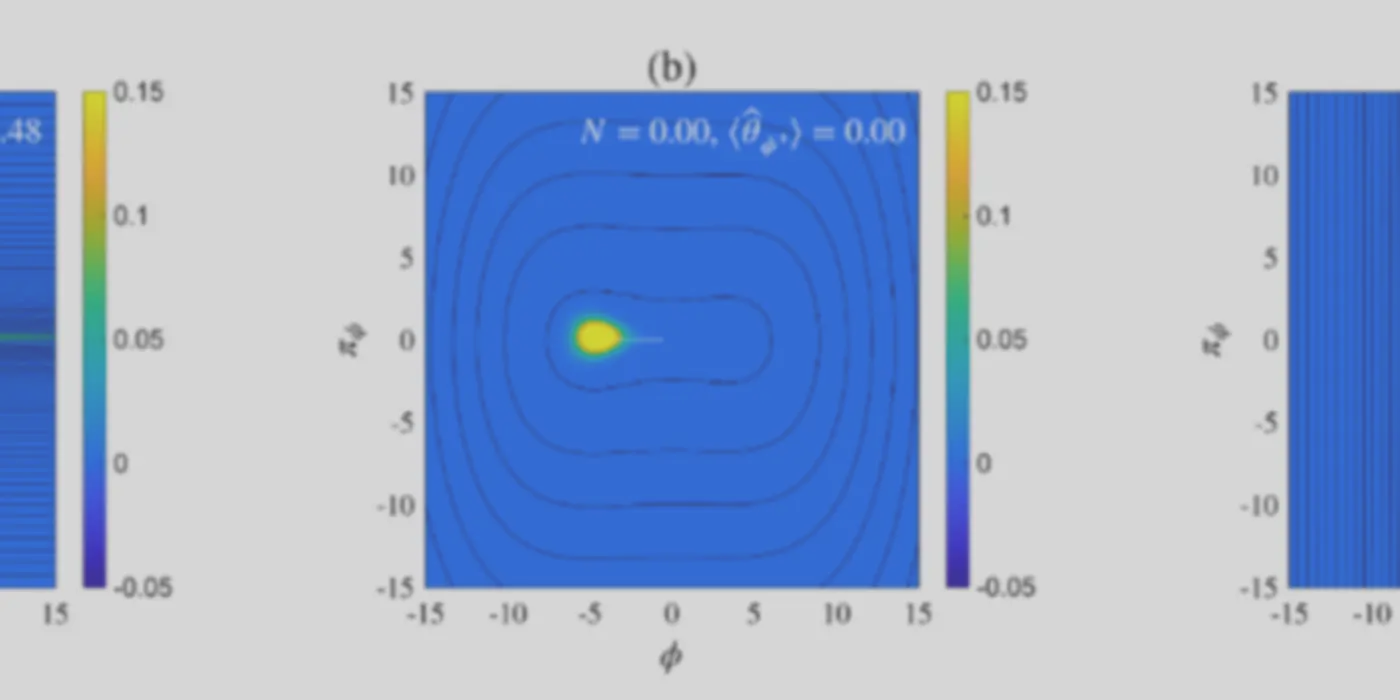
Sorry Higgs, There May Be A New Contender For Low Energy States
If we're trapped in a false vacuum, there's still hope to break free of cosmic lockdown
If we're trapped in a false vacuum, there's still hope to break free of cosmic lockdown


Deep inside the Frasassi cave system in Italy and more than 1,600 feet below the Earth's surface, divers found filamentous ropes of microbes growing in the cold water, according to a team of Penn State researchers. The Frasassi cave system is located north of Rome and south of Venice in the Marche region. These limestone caves are like New Mexico's Carlsbad Caverns and Lechuguilla Cave, but in those caves, sulfur entered the caves from oil and gas reserves, while in Italy, the sulfur source is a thick gypsum layer below. Having sulfur in the environment allows sulfur-using organisms to grow.

In small towns in the Midwestern United States, people who eat out often at buffets and cafeterias and who perceive their community to be unpleasant for physical activity are more likely to be obese, says a studt in Preventive Medicine.Thirty percent of U.S. adults are obese, which increases their risk for health conditions such as hypertension, type 2 diabetes, heart disease and stroke. Rural adults have higher levels of obesity and are less active in their leisure time than urban and suburban U.S. adults, says Ross Brownson, Ph.D., senior author of the study and a professor at the George Warren Brown School of Social Work at Washington University in St. Louis..
When most people think of climate change, they think of it as another term for global warming. But climate change replaced global warming as a term because the warming has never been global and it wasn't just warming that impacted human civilization - it was cooling too.

Over the last several years, scientists have built a very convincing case that Mars hosted water, at least early in its history. Recent observations from the Mars Phoenix lander and other spacecraft show that the planet still holds vast deposits of water as ice at its poles and in soil-covered glaciers in the mid-latitudes.What is less known is how much water occupied the red planet and what happened to it during its geological march to the present. Mostly, evidence has pointed to a period when clay-rich minerals were formed by water, followed by a drier time, when salt-rich, acidic water affected much of the planet. Assuming that happened, the thinking goes, it would have been difficult for life, if it did exist, to have survived and for scientists to find traces of it.
Nicolaus Copernicus's 1543 book, "On the Revolutions of the Heavenly Spheres", moved Earth from being the center of the Universe to just another planet orbiting the Sun. Since then, astronomers have extended the idea and formed the Copernican Principle, which says that our place in the Universe as a whole is completely ordinary, completely random and kind of a downer. Although the Copernican Principle is a pillar of modern cosmology, finding conclusive evidence that our neighborhood of the Universe really isn't special has proven difficult.That's right, it's darn hard for Nihilists out there but University of British Columbia researchers are trying to help.
Researchers at The University of British Columbia have discovered why the brain loses its capacity to re-grow connections and repair itself, knowledge that could lead to therapeutics that “rejuvenate” the brain. The study, published today in The EMBO Journal, identified a set of proteins - calpain and cortactin - which regulate and control the sprouting of neurons, a mechanism known as neural plasticity.Neurons, or nerve cells, process and transmit information by electrochemical signalling and are the core components of the brain and spinal cord. During development, growing neurons are relatively plastic and can sprout new connections, however their plasticity levels drop rapidly as they mature and become integrated into neuronal networks.
A study published today in Anticancer Research demonstrates that an ingredient used in a common cough suppressant may be useful in treating advanced prostate cancer. Researchers found that noscapine, which has been used in cough medication for nearly 50 years, reduced tumor growth in mice by 60% and limited the spread of tumors by 65% without causing harmful side effects.
For the first time, researchers at the UCLA Henry Samueli School of Engineering and Applied Science have successfully pushed nature beyond its limits by genetically modifying Escherichia coli, a bacterium often associated with food poisoning, to produce unusually long-chain alcohols essential in the creation of biofuels. "Previously, we were able to synthesize long-chain alcohols containing five carbon atoms," said James Liao, UCLA professor of chemical and biomolecular engineering. "We stopped at five carbons at the time because that was what could be naturally achieved. Alcohols were never synthesized beyond five carbons. Now, we've figured out a way to engineer proteins for a whole new pathway in E. coli to produce longer-chain alcohols with up to eight carbon atoms."

New research in Science suggests that some meat-eating dinosaurs were super dads - three types of dinosaurs were sole care givers for their mate's eggs. They also may have had multiple mates and watched all their eggs at once.The dinosaurs in the study were close ancestors of birds, and their fossils were found on top of unusually large clutches, said David Varricchio, a Montana State Universitypaleontologist and lead author of the paper. It's possible, he said, that the males mated with several females who laid their eggs in one large clutch. When the females left, the males incubated and protected the eggs on their own.
If you're man, and you give to charity at all, it is more likely to go to a needy person in your neighborhood but if you're a woman you are more likely to be charitable and you will also give to someone local or someone in a foreign country, says new research by Texas A&M University marketing professor Karen Winterich .Winterich, who teaches marketing at Texas A&M's Mays Business School, says she can predict charitable behavior to different groups by an individual based on just two factors: gender and moral identity. (Moral identity does not measure how moral a person actually is, but rather how important it is to that person to be caring, kind, fair, honest, etc.)
65 million years of evolution divergence and being rodents is too much difference, says Stanford immunologist Mark Davis, PhD , so we need to do more research on humans and less on mice. Apparently, the fabled laboratory mouse — from which we have learned so much about how the immune system works — can teach us only so much about how we humans get sick.Davis, director of the Stanford Institute for Immunity, Transplantation and Infection, proposes that the current mouse-centered, small-laboratory approach be supplemented by a broad, industrial-scale "systems biology" approach akin to the one that unraveled the human genome.

The festive season has arrived for astronomers at the European Southern Observatory (ESO) in the form of this dramatic new image. It shows the swirling gas around the region known as NGC 2264 — an area of sky that includes the sparkling blue baubles of the Christmas Tree star cluster.NGC 2264 lies about 2600 light-years from Earth in the obscure constellation of Monoceros, the Unicorn, not far from the more familiar figure of Orion, the Hunter. The image shows a region of space about 30 light-years across.