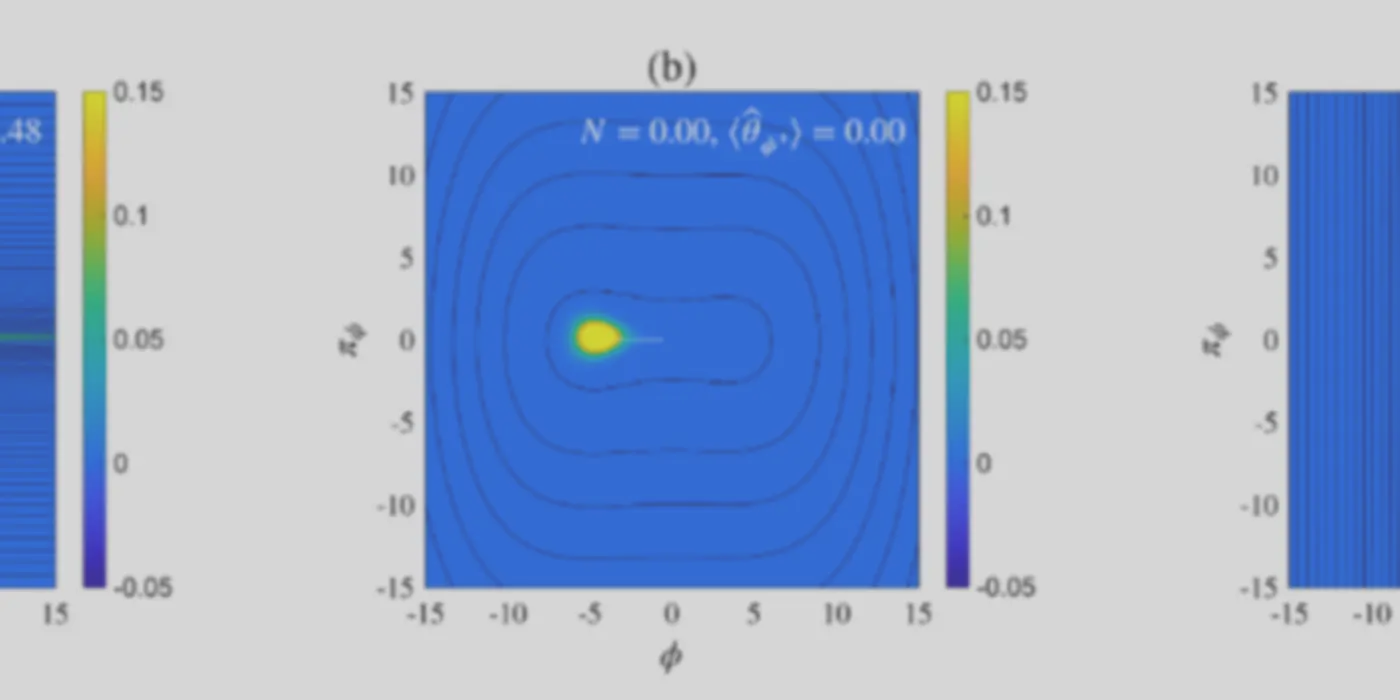
Sorry Higgs, There May Be A New Contender For Low Energy States
If we're trapped in a false vacuum, there's still hope to break free of cosmic lockdown
If we're trapped in a false vacuum, there's still hope to break free of cosmic lockdown


Since its discovery in the 18th century, cocaine has been a scourge of western society. Strongly stimulating human reward centers in low doses, cocaine is extremely addictive and can be fatal in high doses. But this potent compound did not evolve to ensnare humans in addiction, it is a powerful insect neurotoxin, protecting coca bushes from munching insects - without rewarding them.

An ice core drilled at the Belukha glacier in the Siberian Altai by a Swiss-Russian research team under the leadership of the Paul Scherrer Institute (PSI) in 2001 has now provided new findings in climate research. Oxygen isotopes in the ice were used to reconstruct the temperatures in the Altai over the past 750 years. The scientists discovered a strong link between regional temperatures and the solar activity in the period 1250-1850, concluding that the sun was an important driver of preindustrial temperature changes in the Altai.
A study headed by researchers from the University of Barcelona (UB) shows that caffeine has a greater effect on men than women, and that these effects start just 10 minutes after it is drunk. In addition, contrary to what was previously thought, it has also been shown that decaffeinated coffee also produces an increased state of alertness. “Numerous studies have demonstrated the stimulant effects of caffeine, but none of these have looked at their effects in terms of the consumer’s gender,” Ana Adan, lead author of the study and a researcher in the Psychiatry and Clinical Psychobiology Department of the UB, tells SINC.

The CoRoT satellite, a space mission led by the French Space Agency CNES with the participation of Austria, Belgium, Brazil, Germany, Spain and the European Space Agency, ESA (RSSD and Science programme, that includes an Italian contribution), has recently observed a star analogous to the young Sun at an age of approximately 500 million years, named CoRoTExo-2a.
Laws banning marriage between first cousins are based on outdated assumptions about a high degree of genetic risk for offspring and should be repealed, according to a population genetics expert.In an opinion article published in the US open-access journal PLoS Biology, University of Otago Department of Zoology Professor Hamish Spencer and Professor Diane Paul, a Research Associate at Harvard's Museum of Comparative Zoology, argue that laws against cousin marriage are ill-advised."Neither the scientific nor social assumptions behind such legislation stand up to close scrutiny," says Professor Spencer. For example, a 2002 expert review of studies regarding birth defects in offspring of cousins found that the risk was much smaller than generally assumed, he says.
In 3.5 billion years, life on earth went from single microscopic cells to giant sequoias and blue whales. Scientists have now documented quantitatively that the increase in maximum size of organisms was not gradual, but happened in two distinct bursts "tied to the geological evolution of the planet," said Michal Kowalewski, professor of geosciences at Virginia Tech.

Over the last 60 years, ever-smaller generations of transistors have driven exponential growth in computing power. Could molecules, each turned into miniscule computer components, trigger even greater growth in computing over the next 60?Atomic-scale computing, in which computer processes are carried out in a single molecule or using a surface atomic-scale circuit, holds vast promise for the microelectronics industry. It allows computers to continue to increase in processing power through the development of components in the nano- and pico scale. In theory, atomic-scale computing could put computers more powerful than today’s supercomputers in everyone’s pocket.
The heat created by human activities does not even amount to 1/10,000th of the heat that the Earth receives from the sun, say a group of researchers, and it may not be possible to get people to agree to burn fewer fossil fuels but covering parts of the Earth would offset that.This radical plan to curb global warming and so reverse the climate change caused by burning of fossil fuels since the industrial revolution would involve covering parts of the world's deserts with reflective sheeting and they write about it in the January issue of the International Journal of Global Environmental Issues.

A groundbreaking study of popularity by a Michigan State University scientist has found that genes elicit not only specific behaviors but also the social consequences of those behaviors. According to the investigation by behavioral geneticist S. Alexandra Burt, male college students who had a gene associated with rule-breaking behavior were rated most popular by a group of previously unacquainted peers.It's not unusual for adolescent rule-breakers to be well-liked – previous research has made that link – but Burt is the first to provide meaningful evidence for the role of a specific gene in this process. The study appears in the latest issue of the Journal of Personality and Social Psychology.
Scientists report that human gene mutations expressed in yeast cells can predict the severity of Batten Disease, a fatal nervous system disorder that begins during childhood. The new study published in Disease Models&Mechanisms (DMM) describes how the extent of changes in mutated cells paralleled the severity of symptoms seen in humans.
Researchers in Nevada are reporting that waste coffee grounds can provide a cheap, abundant, and environmentally friendly source of biodiesel fuel for powering cars and trucks. Their study appears in the current online issue of ACS' Journal of Agricultural and Food Chemistry, a bi-weekly publication.In the new study, Mano Misra, Susanta Mohapatra, and Narasimharao Kondamudi note that the major barrier to wider use of biodiesel fuel is lack of a low-cost, high quality source, or feedstock, for producing that new energy source. Spent coffee grounds contain between 11 and 20 percent oil by weight. That's about as much as traditional biodiesel feedstocks such as rapeseed, palm, and soybean oil.

Researchers say they have discovered an entirely new mechanism for making common electronic materials emit laser beams. The finding could lead to lasers that operate more efficiently and at higher temperatures than existing devices, and find applications in environmental monitoring and medical diagnostics.