Sorry Higgs, There May Be A New Contender For Low Energy States
If we're trapped in a false vacuum, there's still hope to break free of cosmic lockdown
If we're trapped in a false vacuum, there's still hope to break free of cosmic lockdown


Scientists in Madagascar, at the American Museum of Natural History in New York and the Vienna Natural History Museum and at the University of Massachusetts Amherst now have a nearly complete skeleton of a rare species of extinct lemur to study thanks to a century-long discovery and reconstruction effort. Laurie R. Godfrey, professor of anthropology at UMass Amherst and lemur expert, played a key role in the process in which contemporary researchers were able to match newly found bones with those discovered in a cave in Madagascar in 1899 to construct much of the skeleton of a rare species of extinct lemur.“It’s remarkable that we were able to reunite bits of the original skeleton,” Godfrey says. “This is a very big gift to science from many people.”

An article published electronically in the scientific journal Acta Paediatrica describes how heart rate and sleep in boys are affected by violent video games. Researchers from Stockholm University, Uppsala University and Karolinska Institutet in Sweden have worked together with this study.
A recently discovered female pelvis is changing minds about the head size of an ancient human ancestor, Homo erectus, and consequently revising notions about how smart they may have been. The Pleistocene adult female Homo erectus pelvis was from the Busidima Formation of Gona, Afar, Ethiopia., not far from the site that yielded the 3.2 million year old remains of the famed Australopithecus afarensi "Lucy," and the pelvis indicates that Homo erectus, which lived in Africa roughly 2 million years ago, had a larger birth canal than originally suspected and could have given birth to babies with bigger brains.

An unusual microorganism discovered in the open ocean may force scientists to rethink their understanding of how carbon and nitrogen cycle through ocean ecosystems.A research team led by Jonathan Zehr, a marine scientist at the University of California, Santa Cruz, characterized the new microbe by analyzing its genetic material, even though researchers have not been able to grow it in the laboratory. Zehr said the newly described organism seems to be an atypical member of the cyanobacteria, a group of photosynthetic bacteria formerly known as blue-green algae.
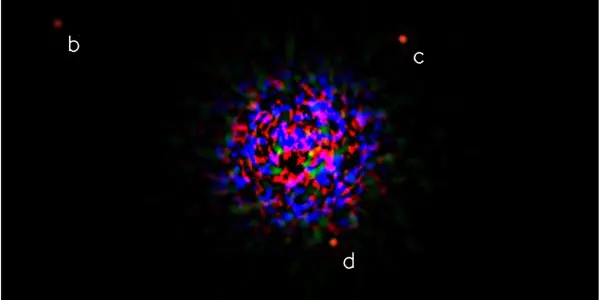
Astronomers have taken snapshots of a multi-planet solar system much like ours orbiting another star, for the first time.The new solar system orbits a dusty young star named HR 8799, which is 140 light years away and about 1.5 times the size of our sun. Three planets, roughly 10, 10 and 7 times the mass of Jupiter, orbit the star. The size of the planets decreases with distance from the parent star, much like the giant planets do in our system.And there may be more planets out there, but scientists say they just haven't seen them yet.
It has all the hallmarks of a Cretaceous melodrama. A dinosaur sits on her nest of a dozen eggs on a sandy river beach. Water levels rise, and the mother is faced with a dilemma: Stay or abandon her unhatched offspring to the flood and scramble to safety?Seventy-seven million years later, scientific detective work conducted by University of Calgary and Royal Tyrrell Museum researchers used this unique fossil nest and eggs to learn more about how nest building, brooding and eggs evolved. But there is a big unresolved question: Who was the egg-layer?
Scientists may have overcome a major hurdle to calculating how much carbon dioxide (CO2) is absorbed and released by plants, vital information for understanding how the biosphere responds to stress and for determining the amount of carbon that can be safely emitted by human activities. The problem is that ecosystems simultaneously take up and release CO2. The key finding is that the compound carbonyl sulfide, which plants consume in tandem with CO2, can be used to quantify gas flow into the plants during photosynthesis. The research is published in the November 14, issue of Science.
Evolution isn't just for living organisms. Scientists at the Carnegie Institution have found that the mineral kingdom co-evolved with life, and that up to two thirds of the more than 4,000 known types of minerals on Earth can be directly or indirectly linked to biological activity. The finding, published in American Mineralogist*, could aid scientists in the search for life on other planets.
One of the hallmarks of the brain of an individual with Alzheimer disease is the accumulation of amyloid-beta peptide (A-beta), something that is believed to be toxic to many brain cells (specifically neurons) and to therefore contribute to the underlying cause of disease.Berislav Zlokovic and colleagues, at the University of Rochester Medical School, have now generated data in mice that mechanistically links a genetic risk factor for Alzheimer disease with accumulation of A-beta in the brain.
There may be less than 20,000 rhinoceros in the world, with one species perhaps already extinct and another with possibly only four animals remaining in the wild. As the populations of these animals age and become infirm, successful breeding becomes increasingly difficult. In an article scheduled for publication in Theriogenology, researchers from the Leibniz Institute for Zoo and Wildlife Research, Berlin, Zoo Budapest and the University of Veterinary Medicine, Vienna, report on the first live birth of a rhinoceros resulting from artificial insemination (AI) with frozen and thawed semen.

Estimated to be no more than three times Jupiter's mass, the planet, called Fomalhaut b, orbits the bright southern star Fomalhaut, located 25 light-years away in the constellation Piscis Austrinus (the Southern Fish). Fomalhaut has been a candidate for planet hunting ever since an excess of dust was discovered around the star in the early 1980s by the US- UK-Dutch Infrared Astronomy Satellite (IRAS).In 2004, the coronagraph in the High Resolution Camera on Hubble's Advanced Camera for Surveys produced the first-ever resolved visible light image of a large dust belt surrounding Fomalhaut. It clearly showed that this structure is in fact a ring of protoplanetary debris approximately 34.5 billion kilometres across with a sharp inner edge.
In the future, polymethyl methacrylate (PMMA) could be made from natural raw materials such as sugars, alcohols or fatty acids.PMMA is a synthetic plastic developed in 1928 and today produced in great quantities. While PMMA is often known colloquially as acrylic glass, as it is mainly used as a shatterproof, lightweight alternative to glass - for example, in protective goggles or vehicle lights. PMMA has many applications, including prosthetics, paints and adhesives.