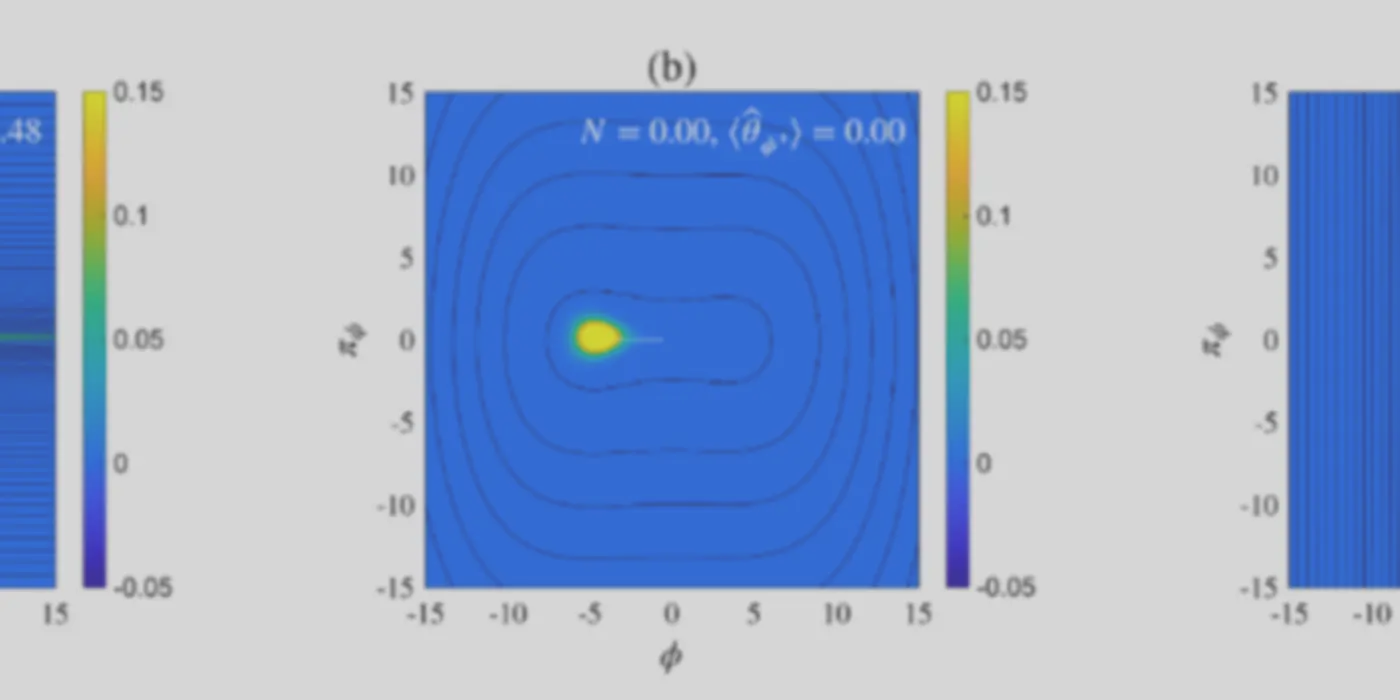
Sorry Higgs, There May Be A New Contender For Low Energy States
If we're trapped in a false vacuum, there's still hope to break free of cosmic lockdown
If we're trapped in a false vacuum, there's still hope to break free of cosmic lockdown


Fenfluramine, the appetite suppressant drug banned in the US in 1997 due to fears over its links to heart conditions, has been shown to have serious long-term effects. In a report published today in BMC Medicine, researchers have shown that people who stopped using fenfluramine eleven years ago had damaged heart valves up to seven years later.

Dark matter is believed to account for 85 per cent of the Universe’s mass but has never been detected. Scientists inferred its existence from gravitational effects of objects in space more than 75 years ago and it has become quite prominent in physics, for something that's never been seen or verified.The international Virgo Consortium say they can change that and have used a massive computer simulation showing the evolution of a galaxy like the Milky Way to “see” gamma-rays given off by dark matter. They say their findings, published in Nature, could help NASA’s Fermi Telescope in its search for the dark matter and open a new chapter in our understanding of the Universe.
MIT engineers have outfitted cells with tiny “backpacks” that could allow them to deliver chemotherapy agents, diagnose tumors or become building blocks for tissue engineering. Michael Rubner, director of MIT’s Center for Materials Science and Engineering and senior author of a paper on the work that appeared online in Nano Letters on Nov. 5, said he believes this is the first time anyone has attached such a synthetic patch to a cell. The polymer backpacks allow researchers to use cells to ferry tiny cargoes and manipulate their movements using magnetic fields. Since each patch covers only a small portion of the cell surface, it does not interfere with the cell’s normal functions or prevent it from interacting with the external environment.
A new study published in the journal of Minerva Cardioangiologica says that Pycnogenol, pine bark extract from the French maritime pine tree, reduces jetlag in passengers by nearly 50 percent. The two-part study, consisting of a brain CT scan and a scoring system, showed Pycnogenol lowered symptoms of jetlag such as fatigue, headaches, insomnia and brain edema (swelling) in both healthy individuals and hypertensive patients. Passengers also experienced minimal lower leg edema, a common condition associated with long flights.
Research by the University of Warwick shows how death gave birth to the modern cult of celebrity as the sudden rise in the popularity of obituaries of unusual people in the 1700s provided people with the 18th Century equivalent of a celebrity gossip magazine.

The skeleton of a 12,000 year-old Natufian Shaman has been discovered in northern Israel by archaeologists at the Hebrew University of Jerusalem. The burial is described as being accompanied by "exceptional" grave offerings - including 50 complete tortoise shells, the pelvis of a leopard and a human foot. The shaman burial is thought to be one of the earliest known from the archaeological record and the only shaman grave in the whole region.
A VHF radio interferometer system that was designed by Zhang GuangShu, et al of Cold and Arid Regions Environmental and Engineering Research Institute at Chinese Academy of Sciences was used to observe a cloud-to-ground lightning flash containing 19 strokes , revealing new characteristics of lightning.The system in this study has five antennas that form an array in orthogonal directions, and an interactive graphic analysis procedure is used to remove the fringe ambiguities. The system error, which comes from frequency conversion, is reduced by phase detection through direct high frequency amplifying. By using the system, the whole progression process in time and space of a lightning flash can be continuously reconstructed at microsecond orders.

Yesterday, following a fifth orbit-raising maneuver, the Chandrayaan-1 spacecraft successfully settled into a trajectory that will take it to the Moon. After launch on 22 October, the spacecraft was first injected into an elliptical 7-hr orbit around Earth, between 255 km and 22 860 km above our planet. After five engine firings, Chandrayaan-1 spiralled outwards in increasingly elongated ellipses around Earth, until it reached its lunar transfer orbit on 4 November at 00:26 CET (04:56 Indian standard time). In the fifth and last orbit-raising maneuver, the spacecraft’s 440 Newton liquid-fuel propelled engine was fired for about two and a half minutes. The lunar transfer orbit’s farthest point from Earth is about 380 000 km.

It took less than a decade for native rats to become extinct on the Indian Ocean's previously uninhabited Christmas Island once Eurasian black rats jumped ship onto the island at the turn of the 20th century. But this story is more than the typical tale of direct competition: according to new genetic research published in PLoS One, black rats carried a pathogen that exterminated two endemic species, Rattus macleari and R. nativitatis. This study is the first to demonstrate extinction in a mammal because of disease, supporting the hypothesis proposed a decade ago that "hyperdisease conditions"—unusually rapid mortality from which a species never recovers—can lead to extinction.
Any time science terms become colloquial, it leads to problems. How often does someone make a speculation and call it a 'theory'? Cars supposedly 'evolve' if their advertising is true. And 'junk DNA' means 'useless' if you ask many outside biology. But 'junk' DNA does not mean 'no value' and a new paper published in Genome Research on Nov. 4 reaffirm that. Scientists at the Genome Institute of Singapore (GIS) report that what was previously believed to be "junk" DNA is one of the important ingredients distinguishing humans from other species.
It seems that our brain can correct speech errors in the same way that it controls other forms of behavior, say Niels Schiller and Lesya Ganushchak, Netherlands Organisation for Scientific Research (NWO) researchers in Leiden who made this discovery while studying how the brain reacts to verbal errors. This research can contribute to improvements in the treatment of people who have problems with speaking or in understanding language.
The Instituto Madrileño de Estudios Avanzados en Nanociencia (IMDEA Nanoscience) and the University of Hamburg have collaborated on the development of composite materials based on semiconductor nanoparticles and carbon nanotubes as functional materials for efficient light emitting diodes and photovoltaic devices. Semiconductor nanocrystals, also called quantum dots, exhibit outstanding optical properties compared to organic dyes commonly used in research today.