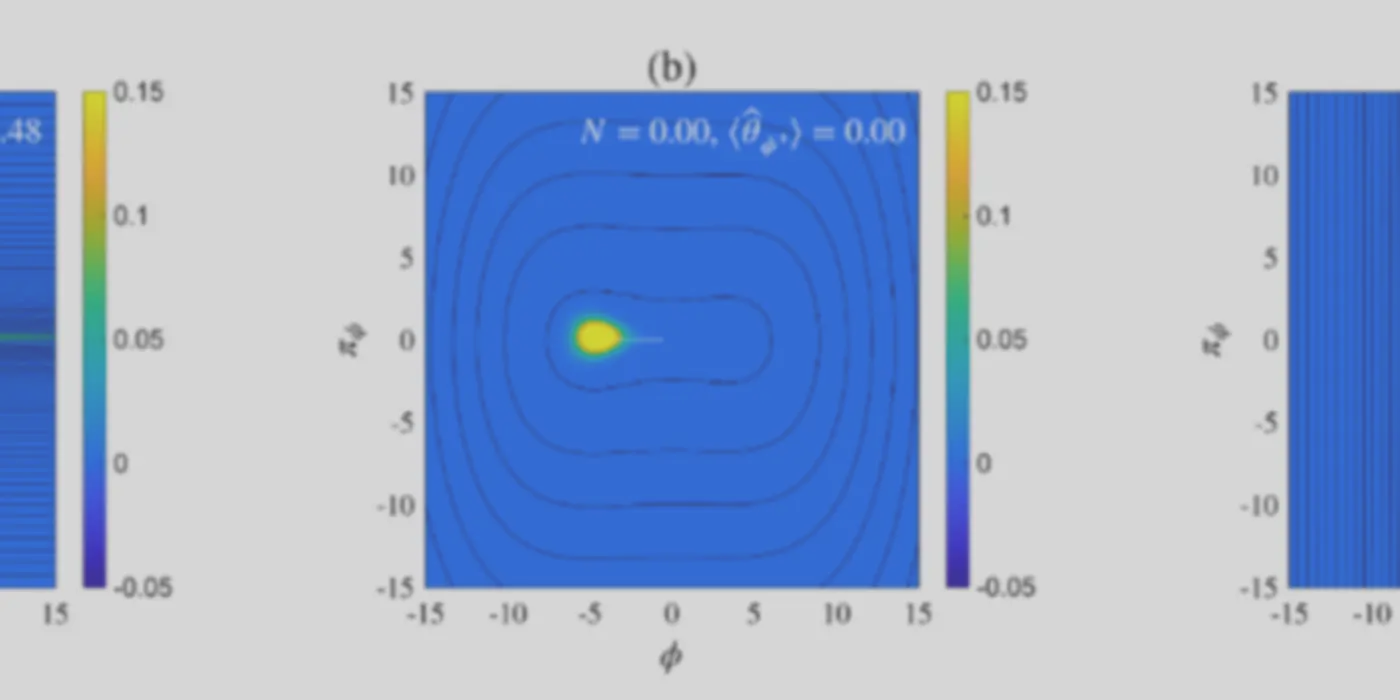
Sorry Higgs, There May Be A New Contender For Low Energy States
If we're trapped in a false vacuum, there's still hope to break free of cosmic lockdown
If we're trapped in a false vacuum, there's still hope to break free of cosmic lockdown


Another piece of the jigsaw in understanding how neutron stars work has been put in place following the discovery by scientists of the origin of the high energy emission from rotation-powered pulsars.
Pulsar systems containing neutron stars accelerate particles to immense energies, typically one hundred times more than the most powerful accelerators on Earth. Scientists are still uncertain exactly how these systems work and where the particles are accelerated.
Now a team of researchers from the UK and Italy, led by Professor Tony Dean of the University of Southampton, has detected polarized gamma-ray emission from the vicinity of the Crab Nebula - one of the most dramatic sights in deep space. By using spectroscopic imaging and measuring the polarization - or the alignment - of the waves of high energy radiation in the gamma-ray band, they have shown that these energetic photons originate close to the pulsar.

If you live in Melbourne, Australia or even Sydney and are concerned that climate change will make your great cities ripe for a cane toad invasion, fear no more.
Yes, that is one of the many doomsday scenarios out there about climate change, but according to research recently published in Ecography by Dr Michael Kearney from the University of Melbourne and collaborators from Australia and the USA, the cane toad’s march will grind to a halt once it is physically too cold for the toads to hop.
Don't be too disappointed. There is still a chance that the LHC will doom the world, likely in December 2012, but it will not be cane toads coming out of black holes to subjugate us, it will be Mayans.
Worldwide, there are between 50 and 70 volcanoes that erupt each year but due to the long gaps between eruptions it is difficult to pin down what triggers volcano behavior.
A team from Durham University and the University of Leeds, studied crystal formations from a volcano in Santorini, Greece, to calculate the timescale between the trigger of volcanic activity and the volcano’s eruption.
These crystals from the lava were able to tell them about the triggers for the volcano, they say, and could help civil defense agencies better prepare in the future.

Engineers at Georgia Tech have used skin cells to create artificial bones that mimic the ability of natural bone to blend into other tissues such as tendons or ligaments. The artificial bones display a gradual change from bone to softer tissue rather than the sudden shift of previously developed artificial tissue, providing better integration with the body and allowing them to handle weight more successfully.
"One of the biggest challenges in regenerative medicine is to have a graded continuous interface, because anatomically that's how the majority of tissues appear and there are studies that strongly suggest that the graded interface provides better integration and load transfer," said Andres Garcia, professor in the George W. Woodruff School of Mechanical Engineering at the Georgia Institute of Technology.

Researchers at the Ruhr University in Bochum (RUB) say they have discovered the secret of electron heating in low temperature plasmas.
The Bochum researchers at the Center of Excellence “Plasma Science and Technology” (CPST) at the Ruhr University say this is the answer to a question which has been puzzling scientists for decades; why the electrons in such plasmas are so hot.
The answer: the non-linear behavior of the boundary sheath causes the electric current flowing in the plasma to oscillate. This results in an increase of the electrical current, and thus in the heating of the plasma. This previously unknown mechanism called “non-linear electron resonance heating” is the subject of a report by researchers in Physical Review Letters.
Johns Hopkins researchers say they have discovered the earliest form of human blood stem cells and deciphered the mechanism by which these embryonic stem cells replicate and grow. They also found a surprising biological marker that pinpoints these stem cells, which serve as the progenitors for red blood cells and lymphocytes.
The research reported today used federally approved embryonic stem cell lines.
The biochemical marker, angiotensin-converting enzyme (ACE), is well known for its role in the regulation of blood pressure, blood vessel growth, and inflammation. ACE inhibitors are already widely used to treat hypertension and congestive heart failure, and the findings are, the researchers say, likely to hold promise for developing new treatments for heart diseases, anemias, leukemia and other blood cancers, and autoimmune diseases because they show for the first time that ACE plays a fundamental role in the very early growth and development of human blood cells.
Radiation from the atomic bomb blasts in Hiroshima and Nagasaki, Japan, in 1945 likely rearranged chromosomes in some survivors who later developed papillary thyroid cancer as adults, according to Japanese researchers.
Writing in Cancer Research, the scientists report that subjects who lived close to the blast sites, were comparably young at the time, and developed the cancer quickly once they reached adulthood, were likely to have a chromosomal rearrangement known as RET/PTC that is not very frequent in adults who develop the disease.
Women with depression may be much more likely than men to get relief from a commonly used, inexpensive antidepressant drug called citalopram, available both as a generic drug and under the brand name Celexa, a new national study finds. But many members of both sexes may find that it helps ease their depression symptoms.
The persistence of a gender difference in response to the drug — even after the researchers accounted for many complicating factors — suggests that there's a real biological difference in the way the medication affects women compared with men. The reasons for that difference are still unclear, but further studies are now examining hormonal variations that may play a role.
Researchers from the University of Michigan Depression Center and their colleagues from around the country tested the drug's ability to help depression patients achieve remission, or total relief from their symptoms, in a multi-year study called STAR*D.
Mosquito traps that reek like latrines are so 2007, thanks to a University of California, Davis research team led by chemical ecologist Walter Leal that have discovered a low-cost, easy-to-prepare attractant that lures blood-fed mosquitoes without making humans hold their noses.
The synthetic mixture, containing compounds trimethylamine and nonanal in low doses, is just as enticing to Culex mosquitoes as the current attractants, Leal said, but this one is odorless to humans.
The research could play a key role in surveillance and control programs for Culex species, which transmit such diseases as West Nile virus, encephalitis and lymphatic filariasis.
Andrew Scholey, Ph.D., professor of Behavioral and Brain Sciences, Swinburne University in Melbourne, Australia has led a research study on the effects of chewing gum on stress relief and focus and concentration. The study found that chewing gum helped relieve anxiety, improve alertness and reduce stress among individuals in a laboratory setting.
The study examined whether chewing gum is capable of reducing induced anxiety and/or acute psychological stress while participants performed a battery of 'multi-tasking' activities. The use of chewing gum was associated with higher alertness, reduced anxiety and stress, and improvement in overall performance on multi-tasking activities.

Shedding some genetically induced excess baggage may have helped the tiny Indostomus paradoxus fish thrive in freshwater and outsize its marine ancestors, according to a University of British Columbia study published in Science Express.
Measuring three to 10 centimetres long, stickleback fish originated in the ocean but began populating freshwater lakes and streams following the last ice age. Over the past 20,000 years - a relatively short time span in evolutionary terms - freshwater sticklebacks have lost their bony lateral plates, or "armour," in these new environments.
"Scientists have identified a mutant form of a gene, or allele, that prohibits the growth of armour," says UBC Zoology PhD candidate Rowan Barrett. Found in fewer than one per cent of marine sticklebacks, this allele is very common in freshwater populations.
All drugs used to treat psychosis are linked to an increased risk of stroke, and dementia sufferers are at double the risk, according to a study published on bmj.com today.
Previous research has shown that second generation (atypical) antipsychotic drugs can increase the chances of patients having a stroke. But the risk of stroke associated with first generation (typical) antipsychotics, and whether the risk differs in people with and without dementia, is not known.
Concerns about an increased risk of stroke among people taking atypical antipsychotic drugs were first raised in 2002, particularly in people with dementia. In 2004, the UK's Committee on Safety of Medicines recommended that these drugs should not be used in people with dementia, despite a lack of clear evidence.