You Feel Colder As You Age: The Science Reason Why
Older people report feeling colder, enough that it is clearly happening, but why has been a mystery. Until now.
Older people report feeling colder, enough that it is clearly happening, but why has been a mystery. Until now.


The advantage of using two eyes to see the world around us has long been associated solely with our capacity to see in 3-D. Now, a new study from a scientist at Rensselaer Polytechnic Institute has uncovered a truly eye-opening advantage to binocular vision: our ability to see through things.
Most animals — fish, insects, reptiles, birds, rabbits, and horses, for example — exist in non-cluttered environments like fields or plains, and they have eyes located on either side of their head. These sideways-facing eyes allow an animal to see in front of and behind itself, an ability also known as panoramic vision.
Humans and other large mammals — primates and large carnivores like tigers, for example — exist in cluttered environments like forests or jungles, and their eyes have evolved to point in the same direction. While animals with forward-facing eyes lose the ability to see what's behind them, they gain 'X-ray vision', according to Mark Changizi, assistant professor of cognitive science at Rensselaer, who says eyes facing the same direction have been selected for maximizing our ability to see in leafy environments like forests.

Researchers conducting a study in mice have discovered that the brain must create new nerve cells for either exercise or antidepressants to reduce depression-like behavior. In addition, the researchers found that antidepressants and exercise use the same biochemical pathway to exert their effects.
These results might help explain some unknown mechanisms of antidepressants and provide a new direction for developing drugs to treat depression, said Dr. Luis Parada, chairman of developmental biology and senior author of a study in the Aug. 14 issue of the journal Neuron.
Transplantation of insulin-producing cell islets, so-called islets of langerhans is an appealing strategy for treatment of type 1 diabetes. But it turns out that these are short-lived, and the procedure needs to be repeated.
Now researchers at Linköping University and Uppsala University in Sweden can show that accumulation of protein aggregatess, amyloid, in the transplanted cells may be causing their death.
Until now it was not known why this insulin production ceases. The discovery now being published in The New England Journal of Medicine may change the course of diabetes research.

Just when you think modern technology reveals all, Mother Nature throws out a few surprises. According to a Wildlife Conservation Society(WCS) report, two surprisingly large populations of globally threatened primates have been found in Cambodia.
The report counted 42,000 black-shanked douc langurs along with 2,500 yellow-cheeked crested gibbons in Cambodia's Seima Biodiversity Conservation Area, an estimate that represents the largest known populations for both species in the world.
The two primate species are found in much lower numbers at other sites in Cambodia and in Vietnam. Prior to the recent discovery in the Seima Biodiversity Conservation Area, the largest known populations were believed to be in adjacent Vietnam, where black-shanked douc langurs and yellow-cheeked crested gibbons hover at 600 and 200 respectively. The total population of the two species remains unknown.
You may be wondering how something can be endangered if the population is unknown. Science has no answer for that.
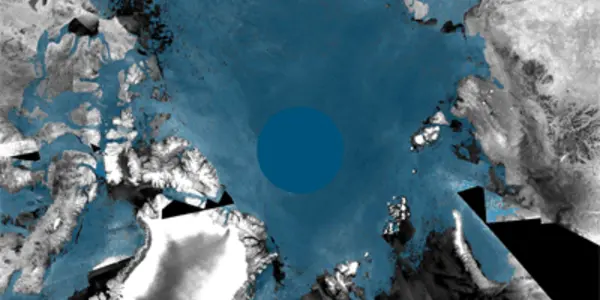
Observations of ice coverage in the Arctic from space began 30 years ago so it's inflammatory to talk about record lows in such a short period of time but two consecutive years near this 'record' still merit some concern.
Because the extent of ice cover is usually at its lowest about mid-September, this year's minimum could still fall and set another record low.
Envisat observations from mid-August depict that a new record of low sea-ice coverage could be reached in a matter of weeks. The animation above is a series of mosaics of the Arctic Ocean created from images acquired between early June and mid-August 2008 from the Advanced Synthetic Aperture Radar (ASAR) instrument aboard Envisat. The dark grey colour represents ice-free areas while blue represents areas covered with sea ice.

Are male Jamaican anole lizards masking some deep insecurity? Overcompensating for small body parts?
Nothing quite that dramatic, though the reason they begin and end the day with displays of reptilian strength, like push-ups, head bobs and extensions of a colorful neck flap, or dewlap, was unknown until recently.
The answer? Nothing more than wanting to defend their territory, according to a new study.
"Anoles are highly visual species, so in that sense it is not surprising that they would use visual displays to mark territory," said Terry J. Ord, a postdoctoral researcher at UC Davis and at Harvard University's Museum of Comparative Zoology. The lizards are the first animals known to mark dawn and dusk through visual displays, rather than the much better known chirping, tweeting, and other sounding off by birds, frogs, geckos and primates.

The geysers of Yellowstone National Park owe their existence to the "Yellowstone hotspot", a region of molten rock buried deep beneath Yellowstone, geologists have found, but how hot is this "hotspot," and what's causing it?
In an effort to find out, Derek Schutt of Colorado State University and Ken Dueker of the University of Wyoming took the hotspot's temperature. They published results in the August, 2008, issue of the journal Geology.
"Yellowstone is located atop of one of the few large volcanic hotspots on Earth," said Schutt. "But though the hot material is a volcanic plume, it's cooler than others of its kind, such as one in Hawaii."

A 75-million-year-old fossil of a pregnant turtle and a nest of fossilized eggs that were discovered in the badlands of southeastern Alberta by scientists and staff from the University of Calgary and the Royal Tyrrell Museum of Palaeontology are yielding new ideas on the evolution of egg-laying and reproduction in turtles and tortoises.
It is the first time the fossil of a pregnant turtle has been found and the description of this discovery was published today in the British journal Biology Letters.
The mother carrying the eggs was found in 1999 by Tyrrell staff while the nest of eggs was discovered in 2005 by U of C scientist Darla Zelenitsky, the lead author of the article and an expert on fossil nest sites, and her field assistant. Both were found about 85 km south of Medicine Hat in the Manyberries area.
New research suggests that preventative agents, such as those found in concentrated black raspberries, may more effectively inhibit cancer development than single agents aimed at shutting down a particular gene.
Researchers at the Ohio State University Comprehensive Cancer Center examined the effect of freeze-dried black raspberries on genes altered by a chemical carcinogen in an animal model of esophageal cancer.
The carcinogen affected the activity of some 2,200 genes in the animals' esophagus in only one week, but 460 of those genes were restored to normal activity in animals that consumed freeze-dried black raspberry powder as part of their diet during the exposure.

A powerful collision of galaxy clusters has been captured with NASA's Chandra X-ray Observatory and Hubble Space Telescope. Like its famous cousin, the so-called Bullet Cluster, this clash of clusters provides striking evidence for dark matter and insight into its properties.
Like the Bullet Cluster, this newly studied cluster, officially known as MACSJ0025.4-1222, shows a clear separation between dark and ordinary matter. This helps answer a crucial question about whether dark matter interacts with itself in ways other than via gravitational forces.

There is a great deal of concern about the effects of global warming on the Greenland ice sheet but scientists at the University of Bristol and the University of Leeds have taken the discussion to a deeper level - namely in stating that only changes in atmospheric carbon dioxide are able to explain the transition from the mostly ice-free Greenland of three million years ago to the ice-covered Greenland of today.
CO2 drops caused Greenland to become ice-covered so CO2 gains could undo that, they say.
There are several competing theories, ranging from changes in ocean circulation, the increasing height of the Rocky Mountains, changes in the Earth's orbit, and natural changes in atmospheric greenhouse gas concentrations. Using state-of-the-art computer climate and ice-sheet models, Dr. Dan Lunt from the University of Bristol and colleagues decided to test which, if any, of these theories was the most credible.
Not all fat is created equal, it seems. A Temple University study finds fat in obese patients is "sick" when compared to fat in lean patients.
Why 'sick? When our bodies don't work properly, we say we're sick. The study in the September issue of Diabetes finds that the same could be said for fat tissue found in obese patients. The cells in their fat tissue aren't working properly and as a result, are sicker than cells found in lean patients' fat tissue.
Lead author Guenther Boden, M.D. theorizes that "sick fat" could more fully explain the link between obesity and higher risk of diabetes, heart disease and stroke.