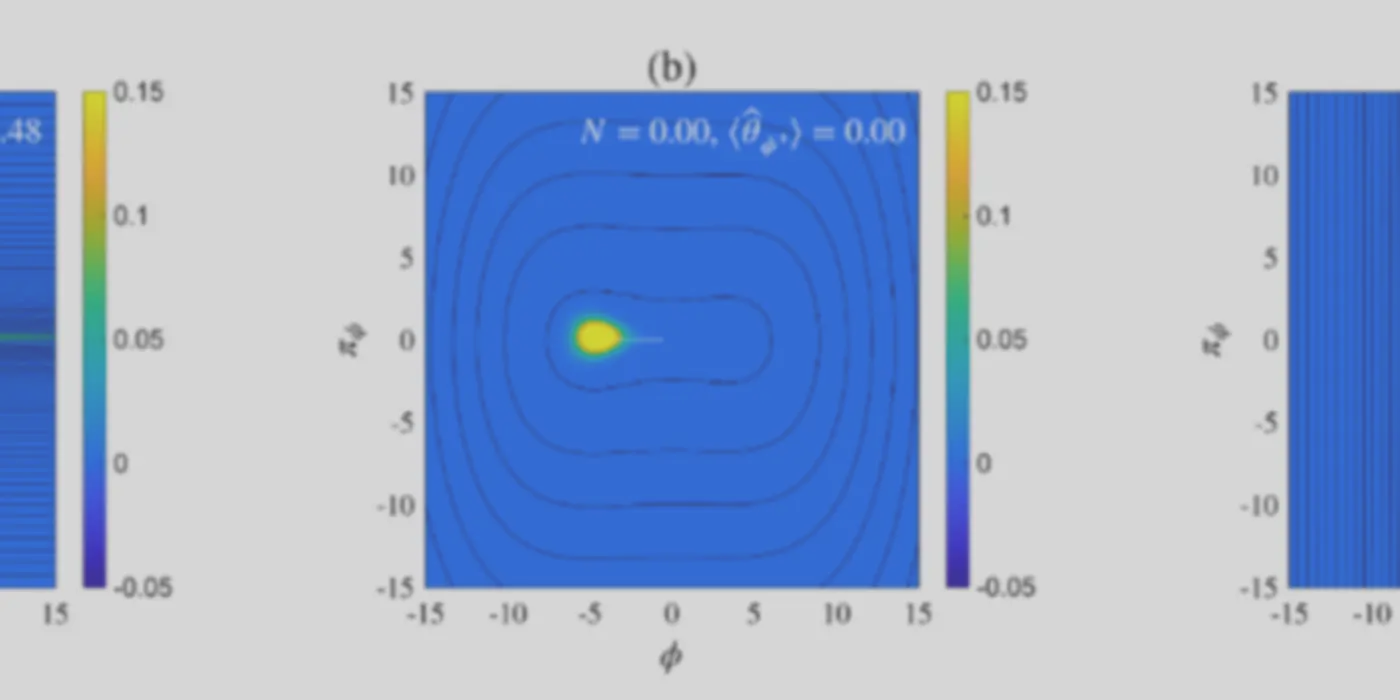
Sorry Higgs, There May Be A New Contender For Low Energy States
If we're trapped in a false vacuum, there's still hope to break free of cosmic lockdown
If we're trapped in a false vacuum, there's still hope to break free of cosmic lockdown


Tulane University anthropologist Kit Nelson is the co-director of a National Geographic-sponsored team that is in the process of unraveling a mummy bundle found in Peru's historic Huaura Valley. The mummy is believed to have been an elite member of the Chancay culture, a civilization that thrived in the central coast of Peru from about 1000 to 1400 AD. The territory of the Chancay was later home to the Incas.
Nelson's work was funded by a Faculty Enhancement Grant from Tulane University and through a grant from National Geographic's Committee for Research and Exploration, a century-old body that funds important work in the earth sciences throughout the world.

More than one million Americans currently participate in the Alcoholics Anonymous (AA) program. AA participants are stereotyped as being heavy coffee drinkers and cigarette smokers but very little research has quantified their consumption of these two products. Recent findings confirm that coffee and cigarette use among this population is greater than among the general U.S. population: most AA members drink coffee and more than half smoke.
With a grant from the World Anti-Doping Agency, University of Vermont anthropology professor Brian Gilley has spent the last year studying attitudes among under-23-year-old cyclists towards use of performance enhancing drugs.
Since the Tour de France ousted its third cyclist from the race, even after multiple doping scandals the last few years, his findings are interesting.
Using American amateur collegiate cyclists as his control, Gilley interviewed elite junior and young adult Italian, Belgian, and American riders and found a surprising mix of responses about willingness to dope. The majority, he says, believe intense pressure from team managers and sponsors forces them to cheat in order to be competitive.
There's a satellite in medium Earth orbit - one of 31 U.S. Air Force satellites - that carries some special cargo; a collection of sensors to detect and triangulate airborne or space-based nuclear explosions anywhere they may occur.
In the recent past, detection has been no problem — there haven’t been any above-ground explosions for decades - but there could be one any time and the country that did it could simply deny if its leaders didn’t believe anyone could track it.
These sensors have to be ready to detect a real explosion and also to compensate for false alarms: There are lightning bolts that occur more than once per second, energetic particles from the Van Allen radiation belt that collide with electronics on the satellite, a welter of “noise” from cell phone communications, and meteors.
Sideria Hendricks is only 10 years old, but she already has suffered two strokes.
The first occurred on Christmas Eve a few years ago. Sideria suddenly couldn't speak, and her left arm and left leg went limp. She eventually recovered, but later suffered a second minor stroke.
About 3,200 strokes occur each year in children under age 18. Although strokes are among the top ten causes of death in childhood, family members and doctors often are slow to recognize symptoms, said Dr. Jose Biller, a co-author of the American Heart Association's new guidelines for managing strokes in children.
Research shows that as more scholarly and research journals are available online, researchers are citing fewer of them - and they are primarily newer papers.
There's no question the Internet gives scientists and researchers instant access to a wealth of academic journals, a very good thing, but the impact hadn't been studied until recently. New research in Science says that scholars are actually citing fewer papers in their work, and the papers they do cite tend to be more recent publications. This trend may be limiting the creation of new ideas and theories.
James Evans is an assistant professor of sociology at the University of Chicago, who focuses on the nature of scholarly research. During a lecture on the influence of private industry money on research, a student instead asked how the growth of the Internet has shaped science. "I didn't have an immediate answer," Evans said.

Humans have long been trying to make the dream of nanoscopic robots come true. It's getting closer each time nanoscience produces components for molecular-scale machines.
One such device is a rotor; a movable component that rotates around an axis. Trying to observe such rotational motion on the molecular scale is an extremely difficult undertaking but Japanese researchers at the Universities of Osaka and Kyoto have met this challenge. As Akira Harada and his team report in the journal Angewandte Chemie, they were able to get "snapshots" of individual molecular rotors caught in motion.
As the subject of their study the researchers chose a rotaxane. This is a two-part molecular system: A rod-shaped molecule is threaded by a second, ring-shaped molecule like a cuff while a stopper at the end of the rod prevents the ring from coming off. The researchers attached one end of the rod to a glass support. To observe the rotational motions of the cuff around the sleeve, the scientists attached a fluorescing side chain to the cuff as a probe.
Researchers from China, France, Italy, and the United Kingdom, have created a model that shows exactly how, when a baby suckles at a mother's breast, it starts a chain of events that leads to a surge of the "trust" hormone oxytocin in their mother's brain.
Research at the University of Liverpool has found how Saharan dust storms help sustain life over extensive regions of the North Atlantic Ocean.
Working aboard research vessels in the Atlantic, scientists mapped the distribution of nutrients including phosphorous and nitrogen and investigated how organisms such as phytoplankton are sustained in areas with low nutrient levels.
They found that plants are able to grow in these regions because they are able to take advantage of iron minerals in Saharan dust storms. This allows them to use organic or 'recycled' material from dead or decaying plants when nutrients such as phosphorous – an essential component of DNA – in the ocean are low.
Viruses achieve their definition of success when they can thrive without killing their host. Now, biologists Pamela Bjorkman and Zhiru Yang of the California Institute of Technology have uncovered how one such virus, prevalent in humans, evolved over time to hide from the immune system.
The human immune system and the viruses hosted by our bodies are in a continual dance for survival--viruses ever seek new ways to evade detection, and our immune system devises new methods to hunt them down. Human Cytomegalovirus (HCMV), says Bjorkman, Caltech's Delbrück Professor of Biology and a Howard Hughes Medical Institute (HHMI) Investigator, "is the definition of a successful virus--it thrives but it doesn't affect the host."

A super-resolution X-ray microscope developed by a team of researchers from the Paul Scherrer Institut (PSI) and EPFL in Switzerland combines the high penetration power of x-rays with high spatial resolution, making it possible for the first time to shed light on the detailed interior composition of semiconductor devices and cellular structures.
The new instrument uses a Megapixel Pilatus detector (whose big brother will be detecting collisions from CERN's Large Hadron Collider), which has excited the synchrotron community for its ability to count millions of single x-ray photons over a large area. This key feature makes it possible to record detailed diffraction patterns while the sample is raster-scanned through the focal spot of the beam. In contrast, conventional x-ray (or electron) scanning microscopes measure only the total transmitted intensity.
"Survival of the fittest" is the catch phrase of evolution by natural selection. While natural selection favors the most fit organisms around, evolutionary biologists have long wondered whether this leads to the best possible organisms in the long run.
A team of researchers at The University of Texas at Austin, led by Drs. Matthew Cowperthwaite and Lauren Ancel Meyers, has developed a new theory, which suggests that life may not always be optimal.