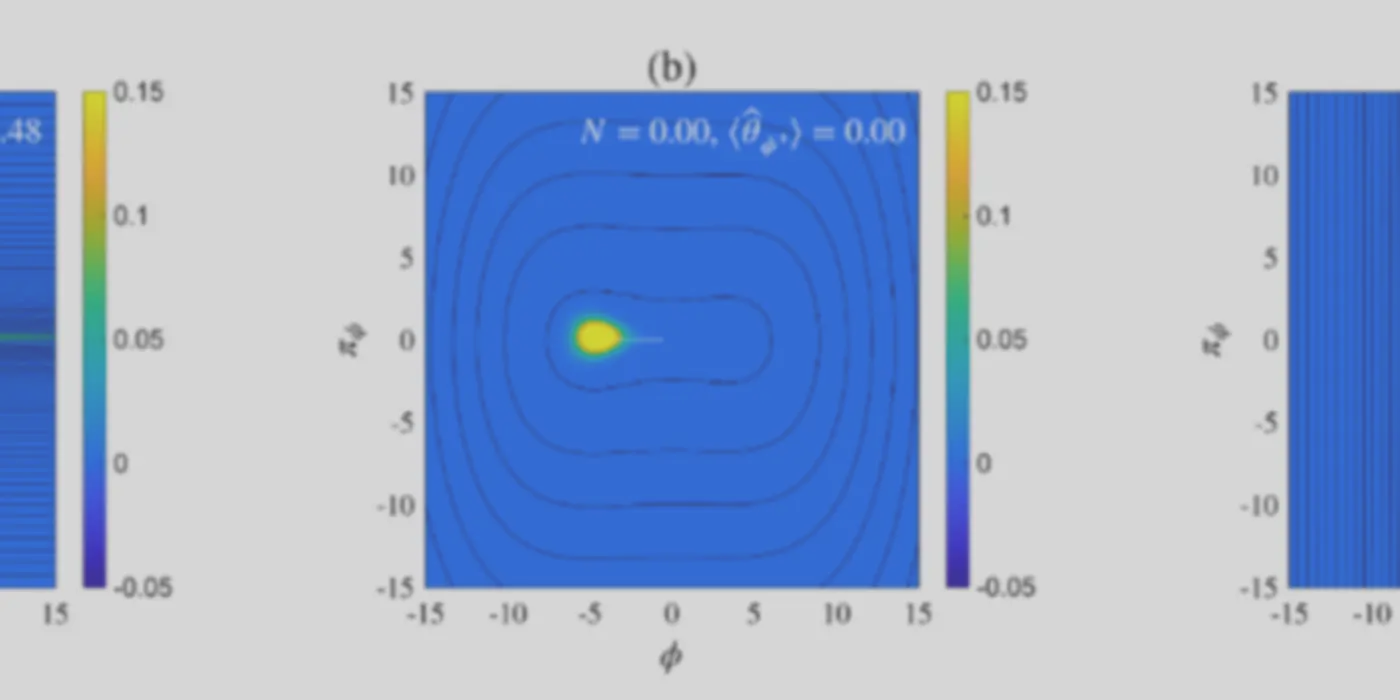
Sorry Higgs, There May Be A New Contender For Low Energy States
If we're trapped in a false vacuum, there's still hope to break free of cosmic lockdown
If we're trapped in a false vacuum, there's still hope to break free of cosmic lockdown


For the first time, a team of international researchers has found a way to view the accretion disks surrounding black holes and verify that their true electromagnetic spectra match what astronomers have long predicted they would be.
A black hole and its bright accretion disk have been thought to form a quasar, the powerful light source at the center of some distant galaxies. Using a polarizing filter, the research team, which included Robert Antonucci and Omer Blaes, professors of physics at the University of California, Santa Barbara, isolated the light emitted by the accretion disk from that produced by other matter in the vicinity of the black hole.

A recent study shows that popular fish oil supplements have an effect on the healing process of small, acute wounds in human skin. But whether that effect is detrimental, as researchers initially suspected, remains a mystery.
The omega-3 fatty acids found in fish oils are widely considered to benefit cardiovascular health and other diseases related to chronic inflammation because of their anti-inflammatory properties. But insufficient inflammation during the initial stage of wound healing may delay the advancement of later stages.
Wealthy nations willing to collectively spend about $1 billion annually could prevent the emission of roughly half a billion metric tons of carbon dioxide per year for the next 25 years, says a new study. It would take about that much money to put an end to a tenth of the tropical deforestation in the world, which would lead to lower greenhouse gas emissions, they say, and reduce global carbon emissions by between 2 and 10 percent.
The calculation is one of several estimates described by a team of scientists and economists this week in the online edition of Proceedings of the National Academy of Sciences. The calculations, based on three different forestry and land-use models, provide the best estimates so far of how much it would cost developed nations to participate in a program called "avoided deforestation" to reduce worldwide carbon emissions.
A report by scientists from The Netherlands published in The FASEB Journal identifies a compound in human saliva that greatly speeds wound healing. This research may offer hope to people suffering from chronic wounds related to diabetes and other disorders, as well as traumatic injuries and burns.
In addition, because the compounds can be mass produced, they have the potential to become as common as antibiotic creams and rubbing alcohol.
Specifically, scientists found that histatin, a small protein in saliva previously only believed to kill bacteria was responsible for the healing.
The results of a new study suggest that past climate changes and sea level fluctuations may have promoted the formation of new species in the Amazon region of South America.
The Amazon basin is home to the richest diversity of life on earth - some place had to be it - yet the reasons why are not well understood. A team of American and Brazilian researchers studied three species of leafcutter ants from Central and South America to determine how geography and climate affect the formation of new species.
Climate changes during the last ice age affected where Amazonian species, such as leafcutter ants, were able to live, restricting some to isolated "refugia" that could cause them to evolve into new species.
Mark Mulac was once an avid lover of iced tea, downing up to six glasses a day. Unfortunately, he was forced to go cold turkey. Iced tea helped to bring on an excruciating bout of kidney stones that led to surgery at Loyola University Hospital in Maywood, Ill.
Iced tea contains high concentrations of oxalate, one of the key chemicals that lead to the formation of kidney stones, a common disorder of the urinary tract that affects about 10 percent of the population in the United States.
Kidney stones are crystals that form in the kidneys or ureters, the small tubes that drain the urine from the kidney to the bladder. Men are four times more likely to develop kidney stones than women, and their risk rises dramatically once they reach their 40s.
Modern engine oil is a complex, highly engineered lubricating mixture, up to 20 percent of which may be special additives to enhance properties such as viscosity and stability and to reduce sludge formation and engine wear.
For years antiwear additives for high-performance oils have been phosphorous compounds, particularly zinc dialkyldithiophosphate (ZDDP), that work by forming a polyphosphate film on engine parts that reduces wear. Unfortunately phosphorus is a chemical poison for automobile catalytic converters, reducing their effectiveness and life span, so industry chemists have been searching for ways to replace or reduce the use of ZDDP. It’s not a simple problem because the additive has several useful functions in addition to wear resistance.

This DelFly Micro, made by Delft University of Technology, is a 'Micro Air Vehicle' (MAV), an exceptionally small remote-controlled aircraft with camera and image recognition software. The Micro, weighing just 3 grams and measuring 10 centimeters (wingtip to wingtip) has a minuscule battery weighing just 1 gram, can fly for approximately three minutes and has a maximum speed of 5 meters per second.
This kind of ultra-small, remote-controlled, camera-equipped aircraft is of great interest because they could eventually be used for observation flights in difficult-to-reach or dangerous areas.

Adding just the right dash of nanoparticles to standard mixes of lubricants and refrigerants could yield the equivalent of an energy-saving chill pill for factories, hospitals, ships, and others with large cooling systems, suggest the latest results from National Institute of Standards and Technology (NIST) research that is pursuing promising formulations.
NIST experiments with varying concentrations of nanoparticle additives indicate a major opportunity to improve the energy efficiency of large industrial, commercial, and institutional cooling systems known as chillers. These systems account for about 13 percent of the power consumed by the nation’s buildings, and about 9 percent of the overall demand for electric power, according to the Department of Energy.

A new fossil discovery, the first of its kind from the whole of the Antarctic continent, provides scientists with new evidence to support the theory that the polar region was once much warmer.
The discovery by an international team of scientists was published in Proceedings of the Royal Society B and involved researchers from the University of Leicester, North Dakota State University, the British Geological Survey, Queen Mary University of London, and Boston University.
The team made a new fossil discovery in the Dry Valleys of the East Antarctic region. The fossils (ostracods) come from an ancient lake - 14 million years old - and are exceptionally well preserved, with all of their soft anatomy in 3-dimensions.
We are continuously bombarded with messages about the dangers of too much sun and the increased risk of melanoma (the less common and deadliest form of skin cancer), but are these dangers real, or is staying out of the sun causing us more harm than good?
For sun
Sam Shuster, a consultant dermatologist at Norfolk and Norwich University Hospital, says that sun exposure is the major cause of the common forms of skin cancer, which are all virtually benign, but not the rarer, truly malignant melanoma.
Shuster says that the common skin cancers develop in pale, sun exposed skin and are less frequent in people who avoid the sun and use protection.
In any country, some place has to be the deadliest. In the United Kingdom, that place is Scotland. The key reason is drug abuse, accounts for a third of the deaths behind Scotland's higher mortality rate, according to a study published on bmj.com today.
Traditionally, higher death rates compared to England and Wales have been blamed on the higher levels of deprivation in Scotland. Yet over half the difference between Scottish and English deaths cannot be accounted for by higher levels of deprivation. This puzzling "excess" of Scottish deaths has become referred to as the "Scottish effect."
Professor Bloor and colleagues from the University of Glasgow, analysed how many of these unaccounted-for deaths were the result of drug abuse.