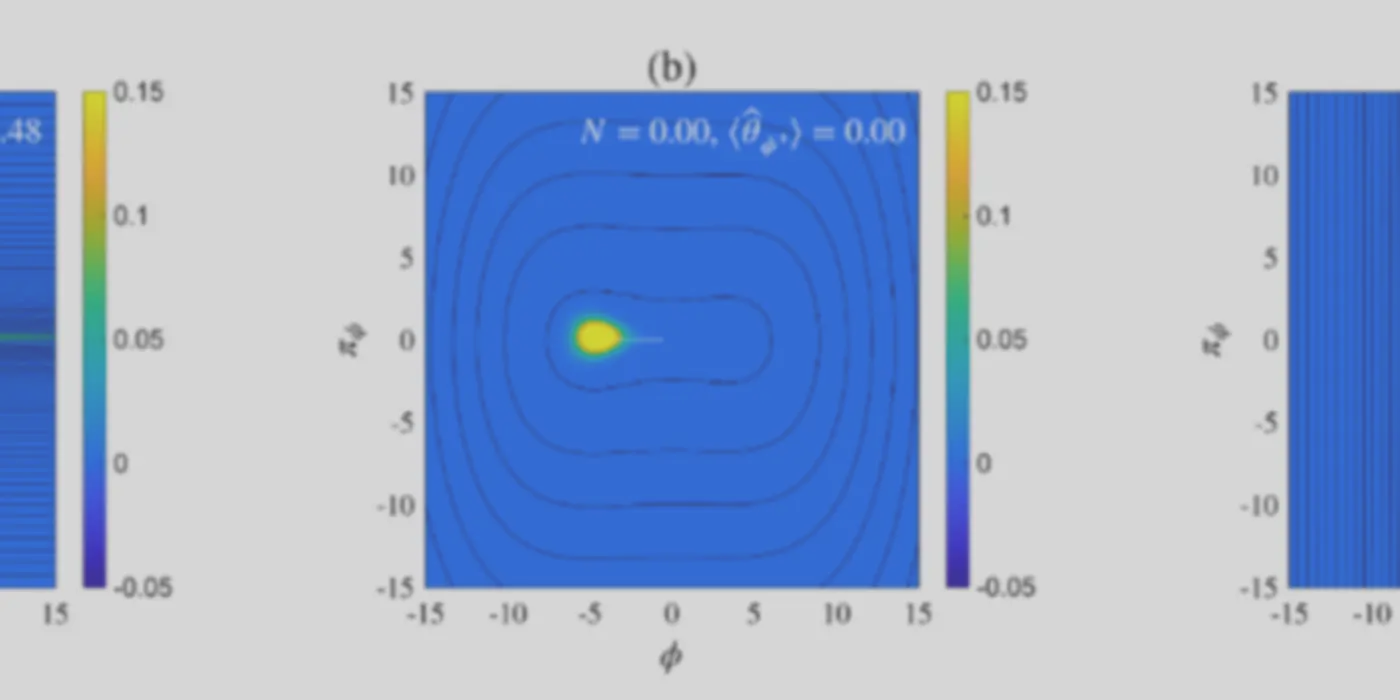
Sorry Higgs, There May Be A New Contender For Low Energy States
If we're trapped in a false vacuum, there's still hope to break free of cosmic lockdown
If we're trapped in a false vacuum, there's still hope to break free of cosmic lockdown


An aerosol mass spectrometer developed by chemists from Aerodyne Research Inc. and Boston College is giving scientists who study airborne particles the technology they need to examine the life cycles of atmospheric aerosols – such as soot – and their impact on issues ranging from climate change to public health.
BC Chemistry Professor Paul Davidovits and Aerodyne Principal Scientist Timothy B. Onasch say their novel spectrometer allows researchers to better understand what happens to these sub-microscopic particles that can absorb and scatter light and influence the lifetime of clouds.
Researchers at Wake Forest University Baptist Medical Center have disproved a long-standing clinical belief that the hepatitis C virus slows or stunts the immune system's ability to restore itself after HIV patients are treated with a combination of drugs known as the "cocktail."
Hepatitis C (HCV) infection is more serious in HIV-infected people, leading to rapid liver damage, according to the Centers for Disease Control. Intravenous drug use is a main method of contraction for both HIV and HCV and 50 to 90 percent of HIV-infected drug users are also infected with HCV.
An enormous research effort by Europe’s leading broadband players has helped accelerate dramatically the rollout of next-generation broadband services reaching speeds in the 10s of Mbit/s in many European countries. That is just the start.
The deployment of broadband services in the 10s of megabits per second (Mbit/s) is accelerating across the continent, thanks to the research efforts of Europe’s main broadband players. Even 100Mbit/s has become economically feasible and deployments have started.
Two years ago Europe’s leading telecoms, ISP companies, and its top technology vendors and research institutes finished their work on the first phase of the MUSE project. That effort led to a new set of standard specifications for broadband technology branded as the Global System for Broadband (GSB).

Officials from Florida Atlantic University (FAU) and FAU’s Center for Ocean Energy Technology (COET) in the College of Engineering and Computer Science accompanied Florida Governor Charlie Crist on a recent visit to several universities and organizations in the United Kingdom to continue discussions, exchange information and formalize agreements in areas of clean ocean energy, environmental issues and climate change.
Last year, Florida and the UK signed a partnership agreement on global climate change, physically tying one to the other by the Gulf Stream, that massive ocean current which is of critical importance to the present climate and quality of life affecting each partner.
Surcharges. those annoying fees like shipping and handling, have been around since the advent of catalogs and remain in the days of the Internet. Everyone hates them but how many of us base our purchasing decision on these bothersome fees?
Quite a lot, it seems. And not just on Ebay, where sellers make a habit of tacking on outrageous handling charges, but in all aspects of commerce. Basically, the less trustworthy the seller, the more inclined a buyer will balk at surcharges.
The new research published in The Journal of Consumer Research was conducted by Amar Cheema, Ph.D., assistant professor of marketing at Washington University in St. Louis, and he suggests that consumers pay more attention to surcharges overall than previously thought.
Somewhere, people got the idea that girls were not as good at math as boys and that was a cultural issue - discrimination on one side or favoritism on the other - and it had to be fixed, usually with legislation and money for social activists.
Is there any truth to it?
After sifting through mountains of data, including SAT results and math scores from 7 million students who were tested in accordance with the No Child Left Behind Act, a team of scientists reporting in Science says the answer is 'no.' Whether they looked at average performance, the scores of the most gifted children or students' ability to solve complex math problems, girls measured up to boys.
CD4+ T lymphocytes, or simply CD4 T cells, are the "brains" of the immune system, coordinating its activity when the body comes under attack. They are also the cells that are attacked by HIV, the devastating virus that causes AIDS and has infected roughly 40 million people worldwide. The virus slowly eats away at CD4 T cells, weakening the immune system.
But the immune systems of HIV/AIDS patients face another enemy as well — stress, which can accelerate CD4 T cell declines. Now, researchers at UCLA report that the practice of mindfulness meditation stopped the decline of CD4 T cells in HIV-positive patients suffering from stress, slowing the progression of the disease. The study was just published in the journal Brain, Behavior, and Immunity.
Using ESO's Very Large Telescope Interferometer, astronomers were able to witness for the first time the appearance of a shell of dusty gas around a star that had just erupted and follow its evolution for more than 100 days. This provided the astronomers with a new way to estimate the distance of this object and obtain invaluable information on the operating mode of stellar vampires, dense stars that suck material from a companion.
Although novae were first thought to be new stars appearing in the sky, hence their Latin name, they are now understood as signaling the brightening of a small, dense star. Novae occur in double star systems comprising a white dwarf - the end product of a solar-like star - and, generally, a low-mass normal star - a red dwarf. The two stars are so close together that the red dwarf cannot hold itself together and loses mass to its companion. Occasionally, the shell of matter that has fallen onto the ingesting star becomes unstable, leading to a thermonuclear explosion which makes the system brighter.

Themis was the blindfolded Greek goddess of order and justice. It's also a NASA-funded mission which stands for Time History of Events and Macroscale Interactions during Substorms - and, using it, UCLA space scientists and colleagues have identified the mechanism that triggers substorms in space; wreaks havoc on satellites, power grids and communications systems; and leads to the explosive release of energy that causes the spectacular brightening of the aurora borealis, also known as the northern lights.
For 30 years, there have been two competing theories to explain the onset of these substorms, which are energy releases in the Earth's magnetosphere, said Vassilis Angelopoulos, a UCLA professor of Earth and space sciences and principal investigator of THEMIS.
A new discovery contradicts the prevailing theory that aging is a buildup of tissue damage akin to rust in some metals, and implies science might eventually halt or even reverse the ravages of age.
Specific genetic instructions drive aging in worms, report researchers at the Stanford University School of Medicine.
The researchers examined the regulation of aging in C. elegans, a millimeter-long nematode worm whose simple body and small number of genes make it a useful tool for biologists. The worms age rapidly: their maximum life span is about two weeks.

By using the gravitational magnification from six massive lensing galaxy clusters, the NASA/ESA Hubble Space Telescope has provided scientists with the largest sample of very distant galaxies seen to date. Some of the newly found magnified objects are dimmer than the faintest ones seen in the legendary Hubble Ultra Deep Field, which is usually considered the deepest image of the Universe.
Over the last decade, energy drinks like such as Red Bull, Monster and Rockstar have become nearly popular on college campuses. The global market for these types of drinks currently exceeds $3 billion a year and new products are introduced annually.
Although research on the effect of energy drink consumption remains sparse, a researcher at the University at Buffalo's Research Institute on Addictions (RIA) says there are links between energy drinks and public health concerns like substance abuse and risky behaviors.
Two new research reports by RIA Research Scientist Kathleen E. Miller, Ph.D., examine the relationships between energy drink consumption and risk-taking in college students as well as "toxic jock identity" -- characterized by hyper-masculinity and risk-taking behaviors among college-age athletes.