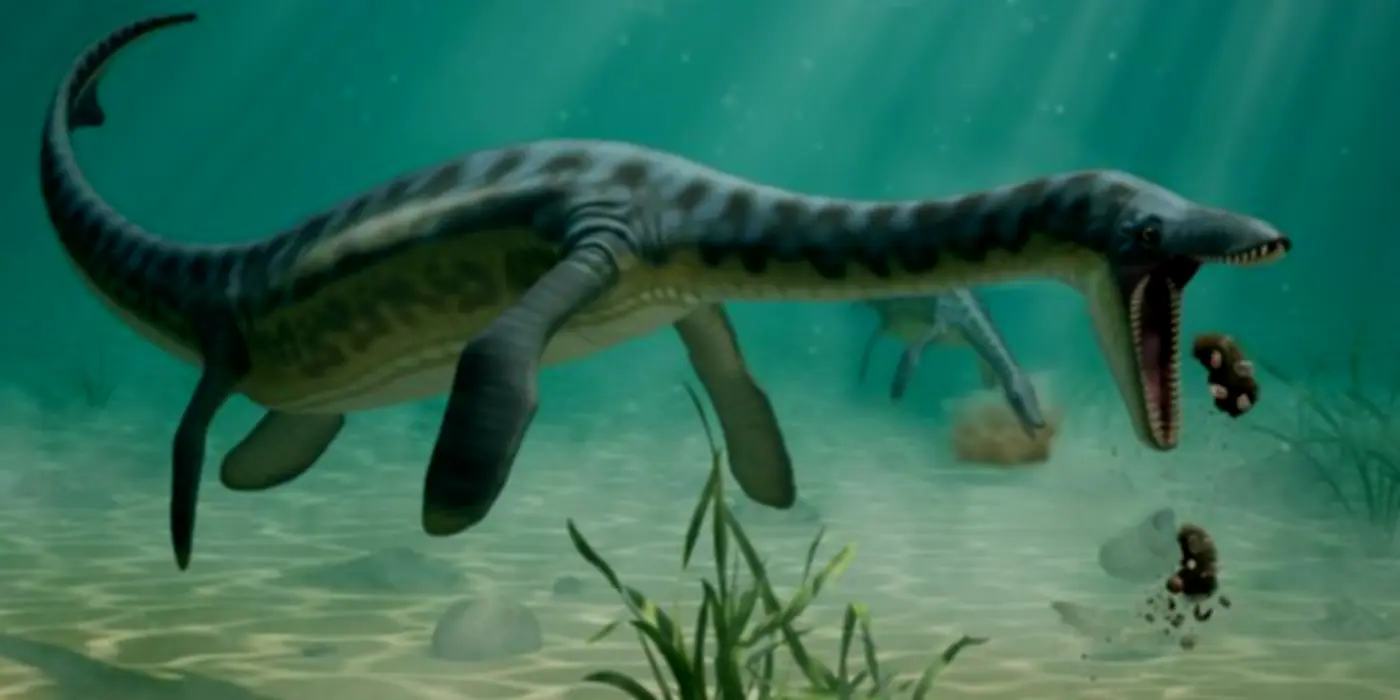
Jurassic Puke: Plesiosaurs Knew Not To Vomit Where They Eat
Jurassic monsters sometimes needed to vomit. When they did, they went to shore.
Jurassic monsters sometimes needed to vomit. When they did, they went to shore.


Scientists at UCL (University College London) have found the link between what we expect to see, and what our brain tells us we actually saw. The study, published in this week’s PLoS Journal of Computational Biology, reveals that the context surrounding what we see is all important – sometimes overriding the evidence gathered by our eyes and even causing us to imagine things which aren’t really there.
The paper reveals that a vague background context is more influential and helps us to fill in more blanks than a bright, well-defined context. This may explain why we are prone to ‘see’ imaginary shapes in the shadows when the light is poor.

People across the western hemisphere may be surprised to see a rust-colored Moon in the sky in a few days - an ominous omen to ancient people but a more predictable occurrence now. Early on 21 February (the evening of the 20 February for observers in North and South America) will be this year’s first and only total eclipse of the Moon.
Bonus: unlike the solar equivalent, the whole event is safe to watch and needs no special equipment.
In a total lunar eclipse, the Earth, Sun and Moon are almost exactly in line and the Moon is on the opposite side of the Earth from the Sun. The Moon is full, moves into the shadow of the Earth and dims dramatically but usually remains visible, lit by sunlight that passes through the Earth’s atmosphere.
The evolution of human speech was far more complex than is implied by some recent attempts to link it to a specific gene, says Robert Berwick, professor of computational linguistics at MIT.
Berwick will describe his ideas about language in a session at the annual meeting of the American Association for the Advancement of Science on Sunday, Feb. 17. The session is called “Mind of a Toolmaker,” and explores the use of evolutionary research in understanding human abilities.
“Think globally, act locally” makes for a nice bumper sticker — but is it an effective policy for coping with global climate change? Can local actions make a difference in a process principally driven by worldwide trends?
The short answer is “no,” according to the Intergovernmental Panel on Climate Change. We cannot do much locally to lessen the effects of global drivers; therefore, our local policies must focus on adaptation.
A team of scientists at JILA, a joint institute of the National Institute of Standards and Technology (NIST) and the University of Colorado (CU) at Boulder, has shown that by sampling a person’s breath with laser light they can detect molecules in the breath that may be markers for diseases like asthma or cancer. While many studies have been done to showcase the potential of optical technologies for breath analysis, the JILA approach takes an important step toward demonstrating the full power of optics for this prospective medical application.
The technique, called cavity-enhanced direct optical frequency comb spectroscopy, may one day allow doctors to screen people for certain diseases simply by sampling their breath. “This technique can give a broad picture of many different molecules in the breath all at once,” says Jun Ye, who led the research. He is a fellow of JILA, a fellow of NIST and a professor adjoint at CU-Boulder’s Department of Physics.
Large-scale digital music distribution is bringing about a profound revolution in the way we ‘consume’ music. The market is still in flux, but it is very clear that the hi-fi systems of the future will be significantly different to what we see today, say European researchers.
With the advent of compressed music files (MP3) and easily accessible internet file exchange and download services, consumers are increasingly turning to personal mini-databases of music files (iPod, MP3 players) for their musical enjoyment. The CD market has already taken a hard knock and many predict its imminent demise. The hi-fi market is also suffering with sales decreasing steadily every year.

Anyone trying to build sandcastles on the beach will need some degree of skill and imagination, but not an instruction manual. The water content is actually relatively unimportant to the mechanical properties of the sand.
This observation, which is borne out by precise measurements in the laboratory, puzzles researchers.
Even with water content of just 3%, the fluid inside represents a highly-complex structure. The mechanical stiffness of the wet sand remains practically constant with moisture ranging from less than 1% to well over 10%, although the fluid structure changes enormously internally.
While most people understand the dangers of flushing toxic chemicals into the ecosystem through municipal sewer systems, one potentially devastating threat to wild fish populations comes from an unlikely source: estrogen.
After an exhaustive seven-year research effort, Canadian biologists found that miniscule amounts of estrogen present in municipal wastewater discharges can decimate wild fish populations living downstream.
The strange world of quantum mechanics can provide a way to surpass limits in speed, efficiency and accuracy of computing, communications and measurement, according to research by MIT scientist Seth Lloyd.
Quantum mechanics is the set of physical theories that explain the behavior of matter and energy at the scale of atoms and subatomic particles. It includes a number of strange properties that differ significantly from the way things work at sizes that people can observe directly, which are governed by classical physics.
A relatively small proportion of individuals with hypertension (high blood pressure) eat diets that align with government guidelines for controlling the disease, according to a report in the February 11 issue of Archives of Internal Medicine, one of the JAMA/Archives journals. In fact, since the introduction of a diet shown to help reduce blood pressure, the dietary quality of those with hypertension has decreased.
UK space scientist Emeritus Professor Alan Wells is to speak at the American Association for the Advancement of Science (AAAS) in Boston in February on: International Cooperation in Developing Swift and its Scientific Achievements.
Professor Wells' presentation will be on Saturday 16th February at around 11.00 a.m. as part of a symposium entitled: Worldwide Hunt to Solve the Mystery of Gamma-Ray Bursts. In it, he will discuss the breadth of international collaborations, including the prominent contributions from UK scientists, in new discoveries about gamma ray bursts obtained from the Swift satellite and coordinated observations from a global network of ground based telescopes.
New technology allowing a group of vehicles to exchange data automatically with each other and with traffic control centres could pave the way for a more efficient and safer European road network.
The Com2React team says their technology could be useful to drivers, traffic police, emergency services and companies with a fleet of vehicles to manage.
The researchers developed a system to help inform drivers of poor weather or road conditions immediately ahead, allowing them to choose alternate routes, easing congestion and cutting down on accidents, says Dr Chanan Gabay, Com2React’s (C2R) project coordinator.