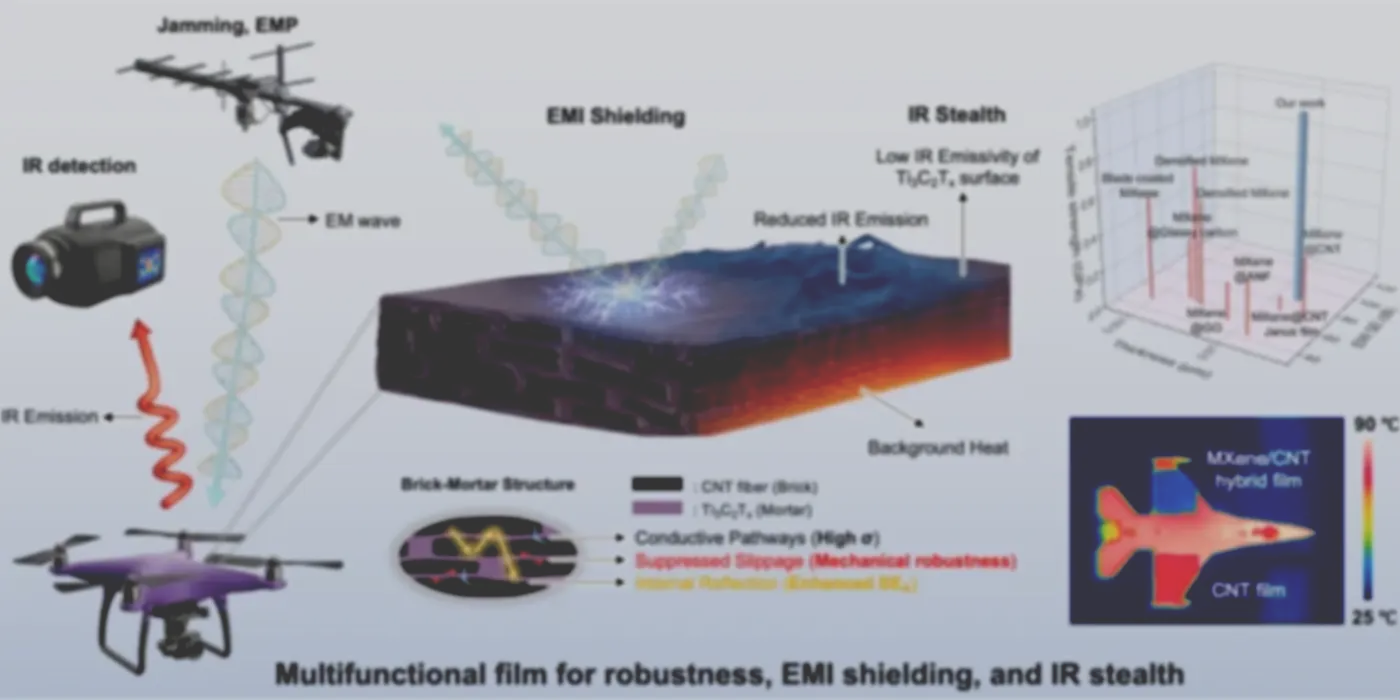
Carbon Nanotube Has EMI And Hides Heat
Researchers have developed a composite film that combines electromagnetic interference shielding, infrared stealth, and high mechanical strength using carbon nanotube fibers and MXene.
Researchers have developed a composite film that combines electromagnetic interference shielding, infrared stealth, and high mechanical strength using carbon nanotube fibers and MXene.


Recent research shows that carbon dioxide (CO2) can offer a new – and completely free – way to prevent fever-related epileptic seizures. The discovery was made by the NordForsk-financed Nordic Centre of Excellence on Water Imbalance Related Disorders (WIRED)

In the cover story of this month’s BioScience journal, leading tiger experts warn that if tigers are to survive, governments must stop all trade in tiger products from wild and captive-bred sources, as well as ramp up efforts to conserve the species and their habitats.
The paper, “The Fate of Wild Tigers,” describes the wild tiger's population decline as "catastrophic" and urges international cooperation to ensure the animal's continued existence in the wild.
Courtesy: www.tigertrust.info

Researchers of the Group of Recent Prehistory Studies (GEPRAN) of the University of Granada, from the department of Prehistory and Archaeology, have taken an important step to determine how life was in the Iberian Peninsula in the Bronze Age.
Credit: Motilla del Azuer archaeological site -- Bronze Age.
Weather models are not good at predicting rain. Particularly in hilly terrain, this can lead to great damage arising from late warnings of floods, or even none at all. From June 1 to September 1, 2007 Delft University of Technology is participating in a major international experiment in Germany’s Black Forest, to learn more about what causes rain. Aircraft and an airship are to be used alongside ground-based observatories and satellites.
TARA at its homebase in Cabauw, Holland. Credit: TU Delft
The most comprehensive study of its kind has found that violence costs the United States $70 billion annually, a figure that rivals federal education spending and the damage caused by hurricane Katrina.
Phaedra Corso, lead author of study and associate professor of health policy at the University of Georgia College of Public Health and health economist at the Centers for Disease Control and Prevention, said the study illustrates how much money can be saved by investing in programs that decrease interpersonal violence and self-inflicted violence such as suicide. For comparison, the federal Department of Education has an annual budget of $67.2 billion and hurricane Katrina caused an estimated $80 billion in damage.
It might be time to change some history books.
Prehistoric Polynesians, not European voyagers, may have brought chickens to the Americas, according to new research from The University of Auckland’s Department of Anthropology.
Fancy artwork courtesy of University of Auckland
University of Colorado researchers will scan Venus during a spacecraft flyby this week using an $8.7 million instrument they designed and built for NASA's MESSENGER Mission, launched in 2004 and speeding toward Mercury.
Built by CU-Boulder's Laboratory for Atmospheric and Space Physics, the instrument will make measurements of the thick clouds and shrouded surface of Venus during the June 5th flyby, said LASP Senior Research Associate William McClintock, a mission co-investigator who led the CU-Boulder instrument development team.
An artists rendition of NASA's MESSENGER spacecraft, which will make its first flyby of Mercury in 2008.
A team of researchers from Arizona State University, Purdue University and the Norwegian University of Life Sciences has discovered evidence that honeybees have adopted a phylogenetically old molecular cascade – TOR (target of rapamycin), linked to nutrient and energy sensing – and put it to use in caste development.
Effect of rapamycin/FK506 pharmacology on caste characters in honey bees (Vehicle = 2% ethanol in insect saline; FK+R = sequential treatment of FK506, rapamycin; R = rapamycin; W = worker as comparison).
To learn a language is to learn a set of all-purpose rules that can be used in an infinite number of ways. A new study shows that by the age of seven months, human infants are on the lookout for abstract rules – and that they know the best place to look for such abstractions is in human speech.
Carbon monoxide (CO) poisoning kills over 200 people every year in the United States. Although inexpensive CO detectors have been available since 1989, their use in hotels, motels and resorts is not widespread. In fact, while every guest room in the U.S. must contain a smoke detector, there is no federal mandate for CO detectors.
While recent advances in neurosurgery have made it possible to precisely target areas in the brain with minimum invasiveness -- using a small hole to insert a probe, needle or catheter -- there remains a disadvantage. The small size of the openings reduces or eliminates direct site visibility and requires greater dexterity, stability and precision by the surgeon.
Prof. Leo Joskowicz
A groundbreaking surgical therapy capable of stabilising and restoring vision in the vast majority of patients who currently suffer blindness through Age-Related Macular Degeneration (AMD) is to be taken to clinical trial by scientists and clinicians at the UCL Institute of Ophthalmology, Moorfields Eye Hospital and the University of Sheffield.
The therapy, using cells derived from human embryonic stem cells to replace the faulty retinal cells that cause AMD, will be developed by the London Project to Cure AMD, a collaborative project launched today bringing together some of the leading specialists in the field.