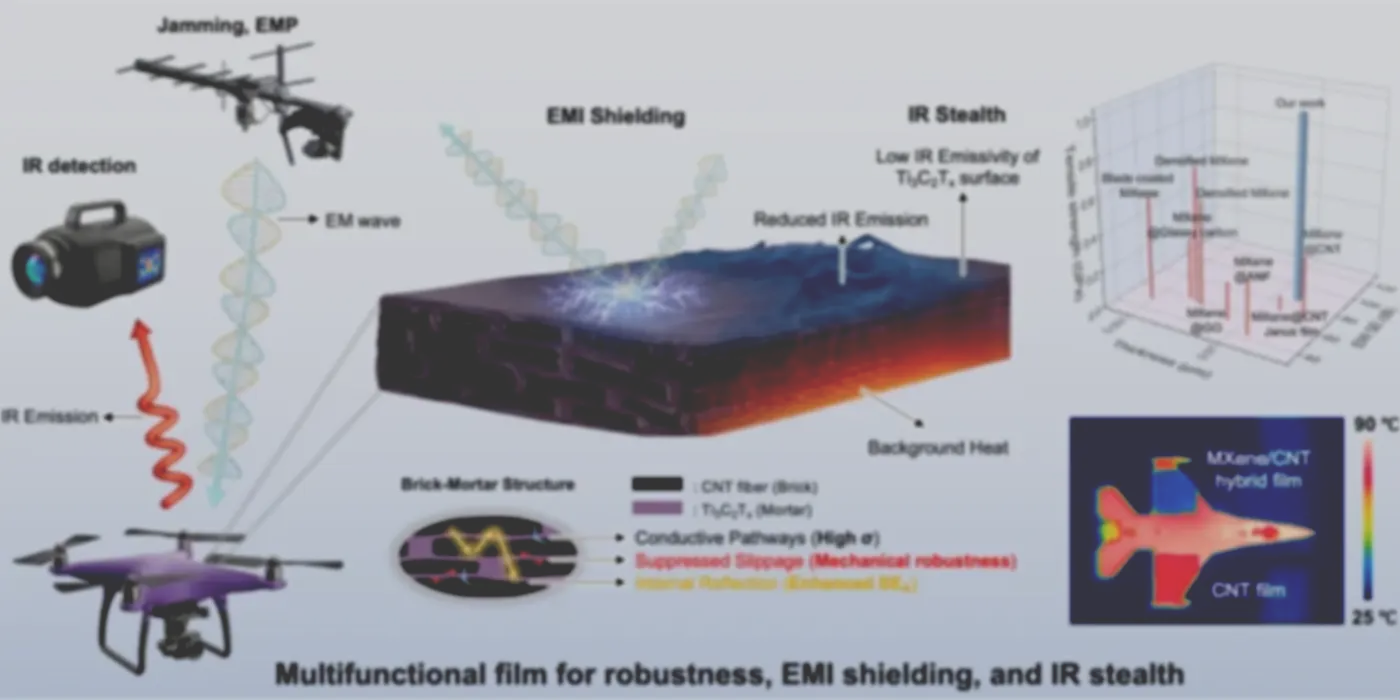
Carbon Nanotube Has EMI And Hides Heat
Researchers have developed a composite film that combines electromagnetic interference shielding, infrared stealth, and high mechanical strength using carbon nanotube fibers and MXene.
Researchers have developed a composite film that combines electromagnetic interference shielding, infrared stealth, and high mechanical strength using carbon nanotube fibers and MXene.


Indiana University neuroscientists Olaf Sporns and Christopher Honey find the 98 percent of brain activity that other researchers consider just background noise to be fascinating and important.
Brains are always active, even when people are at rest. In this "resting state," waves of neural activity ripple through the brain, creating fluctuating and ever-changing patterns. Sporns and Honey's work on modeling this brain activity sheds new light on how and when these mysterious fluctuations occur and offers insights into what the brain does while idle.
Global warming and the destruction of natural habitats will lead to significant declines and extinctions in the world’s 8,750 terrestrial bird species over the next century, according to a study conducted by biologists at the University of California, San Diego and Princeton University.
Their study, the first global assessment of how climate change and habitat destruction may interact to impact the distribution of a large group of vertebrates over the next century, appears in the June 5 issue of the journal PLoS Biology.
Researchers at the Stanford University School of Medicine have illuminated the path taken by human neural stem cells that were transplanted into the brains of rats and mice, and found that the cells successfully navigate toward areas damaged by stroke.
The research group placed miniscule particles of iron inside stem cells to act as cellular beacons detected by magnetic resonance imaging. With the ability to monitor where the human stem cells go in real time, researchers will have an easier time learning the best way of using the cells to treat human neural disorders, such as stroke, traumatic brain injury, Parkinson's disease or radiation damage.
It could be an artist’s depiction of someone’s stomach before and after a rather decadent meal. But it is a 3-D cryoelectron microscope reconstruction of the cross-section of a virus, before and after cramming itself full of its own DNA.
The Library of Congress has no shortage of reading materials with more than 134 million items in its collection. This summer, a Florida State University chemist will use his knowledge of cellulose, a key component of paper, to help the world’s largest library find ways of preserving its vast treasure trove of books, manuscripts, maps, newspapers and pamphlets, many of which are irreplaceable.
André Striegel, an assistant professor of chemistry and biochemistry at FSU, has been invited to serve as the first Preservation Research and Testing Professor in Residence at the Library of Congress’ Preservation Research & Testing Division.
Divorce puts children at higher risk of Ritalin use compared to kids whose parents stay together, says new research by a University of Alberta sociologist, who cautions that this doesn’t necessarily mean that divorce is harmful to a child. The study appears in this week’s issue of the Canadian Medical Association Journal.
A new study shows that use of antipsychotic drugs is associated with an early and sustained increase in risk of death when used to treat disruptive behavior of older adults with dementia.
The study suggests that both newer “atypical” antipsychotics and older conventional antipsychotics are associated with increased mortality. The highest risk appears to involve use of the older conventional drugs.
Ghost pains, it seems. Why do some people still feel discomfort long after their injuries have healed?
The definitive answer -- and an effective treatment -- has long eluded scientists. Traditional analgesic drugs, such as aspirin and morphine derivatives, haven’t worked very well.
A Northwestern University researcher has found a key source of chronic pain appears to be an old memory trace that essentially gets stuck in the prefrontal cortex, the site of emotion and learning. The brain seems to remember the injury as if it were fresh and can’t forget it.

University of Utah physicists developed small devices that turn heat into sound and then into electricity. The technology holds promise for changing waste heat into electricity, harnessing solar energy and cooling computers and radars.
"We are converting waste heat to electricity in an efficient, simple way by using sound," says Orest Symko, a University of Utah physics professor who leads the effort. "It is a new source of renewable energy from waste heat."
University of Utah physicist Orest Symko holds a match to a small heat engine that produces a high-pitched tone by converting heat into sound.

Southeastern Brazil, South America’s largest and most populous country, is highlighted in this 26 May 2007 Envisat image.
Brazil consists of one federal district and twenty-six states, four of which comprise the southeastern region – Rio de Janeiro, Minas Gerais, Sao Paolo (all visible) and Espirito Santo.
CLICK ABOVE FOR HIGH RES. Credits: ESA
The huge potential of agricultural soils to reduce greenhouse gases and increase production at the same time has been reinforced by new research findings at NSW Department of Primary Industries' (DPI) Wollongbar Agricultural Institute.
Trials of agrichar - a product hailed as a saviour of Australia's carbon-depleted soils and the environment - have doubled and, in one case, tripled crop growth when applied at the rate of 10 tonnes per hectare.
Albert Einstein’s theory of general relativity has fascinated physicists and generated debate about the origin of the universe and the structure of objects like black holes and complex stars called quasars. A major focus has been on confirming the existence of the gravitomagnetic field, as well as gravitational waves.
A physicist at the University of Missouri-Columbia recently argued in a paper that the interpretation of the results of Lunar Laser Ranging (LLR), which is being used to detect the gravitomagnetic field, is incorrect because LLR is not currently sensitive to gravitomagnetism and not effective in measuring it.