Carbon Nanotube Has EMI And Hides Heat
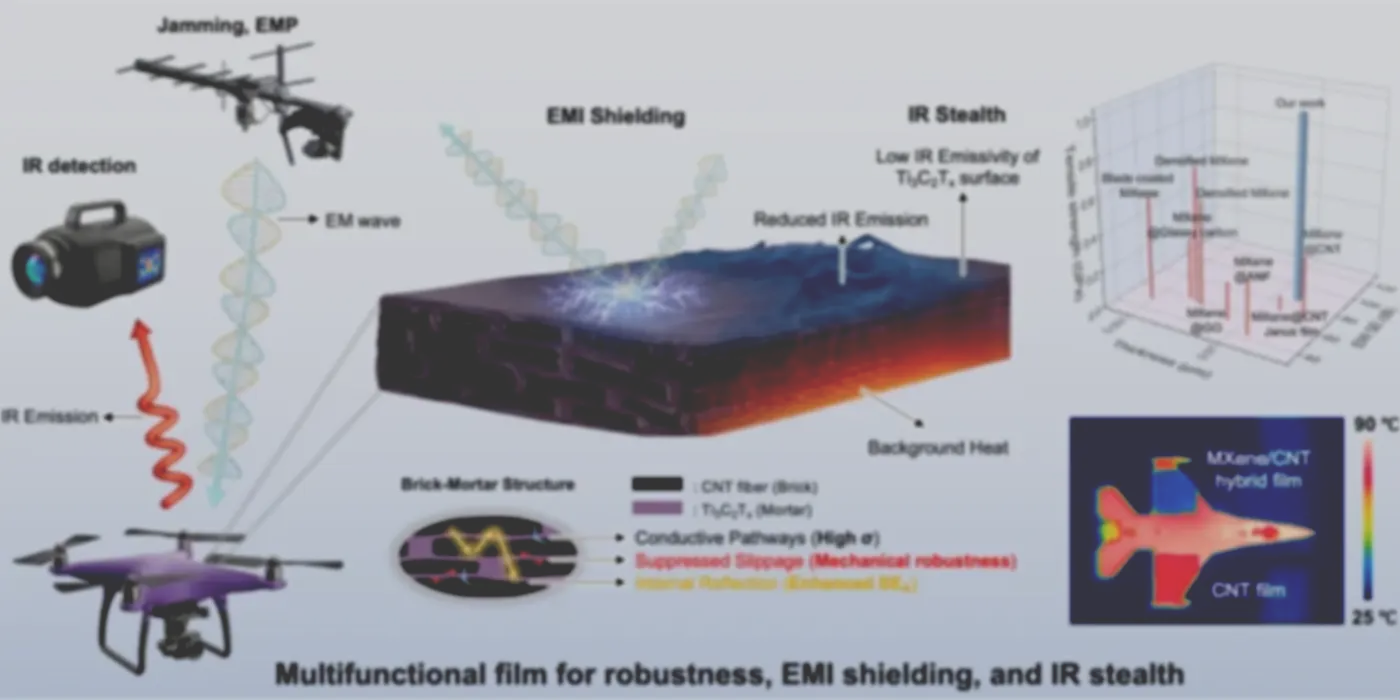
Researchers have developed a composite film that combines electromagnetic interference shielding, infrared stealth, and high mechanical strength using carbon nanotube fibers and MXene.
Researchers have developed a composite film that combines electromagnetic interference shielding, infrared stealth, and high mechanical strength using carbon nanotube fibers and MXene.


You might think it's something from the movie "Total Recall" but instead researchers are using brain "pacemakers" to regulate diseased signals in the brains of Parkinson's disease patients.
These devices are FDA-approved and in use in 30,000 patients but still not well understood.
Biomedical engineers at Duke University's Pratt School of Engineering have found that stimulation administered by rapid-fire electrical pulses deep in the brain produces what they call an "informational lesion." By relaying a repetitious and therefore meaningless message, constant pulses overwhelm the erratic bursts of brain activity characteristic of disease.
"Periodic bursts in the brains of people with tremor -- which might follow a pattern such as 'pop-pop-pop, silence, pop-pop-pop, silence' -- propa
How well do you know your child's pediatrician? Is he or she board certified in pediatrics, or has he or she ever completed specialty training in the field?
Findings from a new study from the University of Michigan C.S. Mott Children's Hospital's Child Health Evaluation and Research (CHEAR) Unit may prompt parents to find out if their child's physician really is who he claims to be – a board-certified and specialty-trained pediatrician.
The signature of climate change over the past 40 years has been identified in temperatures of the Indian Ocean near Australia.
"From ocean measurements and by analysing climate simulations we can see there are changes in features of the ocean that cannot be explained by natural variability," said CSIRO oceanographer Dr Gael Alory.

Mule deer are giving new meaning to watching out for other mothers' kids. Whitetail deer, not so much.
An intriguing study of mule deer and whitetail deer conducted by the University of Alberta in Edmonton, Canada and the University of Lethbridge, also in Canada, showed that both species responded to the recorded distress calls of fawns, similar to the responses elicited when coyotes attack fawns, with mule deer mothers responding to both whitetail and mule deer calls, even when their own fawn stood next to them.
Recent discoveries regarding the physics of ceramic superconductors may help improve scientists' understanding of resistance-free electrical power.
Tiny, isolated patches of superconductivity exist within these substances at higher temperatures than previously were known, according to a paper by Princeton scientists, who have developed new techniques to image superconducting behavior at the nanoscale.
Using a customized microscope, Princeton scientists have mapped the strength of current-carrying electron pairs as they form in a ceramic superconductor. From the top left, the images show the same 30-nanometer square region of the ceramic at successively cooler temperatures.
Children are able to solve approximate addition or subtraction problems involving large numbers even before they have been taught arithmetic, according to a study conducted at Harvard University, by researchers from the University of Nottingham and Harvard.
The study suggests that children do not need to master either the logic of place value or the addition table in order to perform approximate addition and subtraction. Children’s difficulty with learning school arithmetic may stem from the need to produce an exact number when solving problems. Elementary education in mathematics might be improved – and children’s interest in the subject enhanced – if children’s talent for approximate calculation could be built upon in the classroom, the authors suggest.
Many insects living in northern climates don't die at the first signs of cold weather. Rather, new research suggests that they use a number of specialized proteins to survive the chilly months.
These so-called "heat-shock proteins" ensure that the insects will be back to bug us come spring.
Idiopathic pulmonary fibrosis (IPF) is a chronic lung disease typically characterized by the slow but progressive onset of shortness of breath or cough. Most patients live about five years after diagnosis. According to a new study a subset of patients with a specific genetic profile has a much more rapid progression to complete pulmonary failure and death without a lung transplant.
The simple notion of copying the body’s own natural "waste disposal" chemistry to mop up potentially toxic nitrogen has saved an estimated 80 percent of patients with urea cycle disorders --- most of them children – according to a report in this week’s New England Journal of Medicine summarizing a quarter century of experience with the treatment.
In a night sky filled with hungry bats, good-tasting moths increase their chances of survival by mimicking the sounds of their bad-tasting cousins, according to a new Wake Forest University study.
The study is the first to definitively show how an animal species uses acoustic mimicry as a defensive strategy. The research was conducted by Jesse Barber, a doctoral student in biology at Wake Forest. William E. Conner, professor of biology at Wake Forest, co-authored the study.
Matthew Tyska, Ph.D., recalls being intrigued, from the first day of his postdoctoral fellowship in 1999, with a nearly 30-year-old photograph. It was an electron micrograph that showed the internal structures of an intestinal cell microvillus, a finger-like protrusion on the cell surface. Microvilli are common features on the epithelial cells that line the body’s cavities.
Evidence for an awesome upheaval in a massive galaxy cluster was discovered in an image made by NASA’s Chandra X-ray Observatory. The origin of a bright arc of ferociously hot gas extending over two million light years requires one of the most energetic events ever detected.
The cluster of galaxies is filled with tenuous gas at 170 million degree Celsius that is bound by the mass equivalent of a quadrillion, or 1,000 trillion, suns. The temperature and mass make this cluster a giant among giants.