Brain Circuit Linked To Pregnancy Food Cravings Identified
Pregnant women have experienced exotic food cravings since recorded history began. This may be why.
Pregnant women have experienced exotic food cravings since recorded history began. This may be why.


Your football coach always told you that the low man wins. Seems that ape-like ancestors may have evolved that way for the same reason.
Australopiths maintained short legs for 2 million years because a squat physique and stance helped the males fight over access to females, a University of Utah study concludes.
"The old argument was that they retained short legs to help them climb trees that still were an important part of their habitat," says David Carrier, a professor of biology. "My argument is that they retained short legs because short legs helped them fight."
This drawing of a male gorilla skeleton illustrates their very short legs.

Human embryonic stem cells (hESCs) hold great promise for benefiting degenerative diseases, and do so by invoking multiple mechanisms. Such cells can be grown in a manner compatible with clinical use (i.e., without animal feeder layers) and even without the need for immunosuppression. These were a few of a number of conclusions arrived at by an international collaboration led by Evan Y. Snyder, M.D., Ph.D., and spearheaded by a member of his lab, Jean-Pyo Lee, Ph.D., of the Burnham Institute for Medical Research ("Burnham"). The study, to be published in Nature Medicine, will be made available by advanced publication at the journal's website on March 11, 2007.
The "raging hormones" of puberty are known to produce mood swings and stress for most teenagers, making it difficult to cope with this period of life. Until now, the specific causes of pubertal anxiety have not been identified, making it harder to understand and treat adolescent angst.
In the current edition of the journal Nature Neuroscience, researchers led by Sheryl S. Smith, PhD, professor of physiology and pharmacology at SUNY Downstate Medical Center, report findings demonstrating that a hormone normally released in response to stress, THP, actually reverses its effect at puberty, when it increases anxiety.
This hormone normally acts like a tranquilizer, acting at sites in the brain that "calm" brain activity.
Each year, malaria results in more than a million deaths. Controlling this disease involves understanding its transmission, and understanding its transmission means understanding its basic reproductive number, R0. For all infectious disease, R0 describes the most important aspects of transmission as it is the expected number of hosts that can trace their infection directly back to a single host after one disease generation. For vector-borne diseases, such as malaria, R0 is given by a classic formula. In a new study published in PLoS Biology, David Smith and colleagues demonstrate that estimates of R0 range from around one to over 3,000, providing much higher estimates than previously thought, with serious implications for the control of the disease.
Understanding the origin and behavior of the magnetic fields of planets and stars is the goal of research being carried out by many teams from all over the world. The VKS1 collaboration (CEA2, CNRS3,4, Ecole normale supérieure in Lyon3, Ecole normale supérieure in Paris4) has succeeded in creating in the laboratory a magnetic field in a highly turbulent flow of liquid sodium. Although the extreme conditions specific to astrophysical and geophysical environments cannot all be reproduced in the laboratory, the magnetic field observed shows remarkable similarities with magnetic fields observed in the cosmos. The findings represent a significant advance in the understanding of the mechanisms at work in the formation of natural magnetic fields.
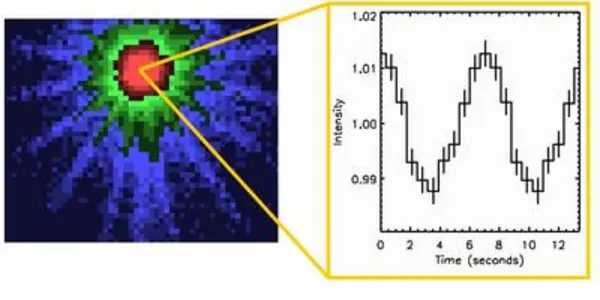
A decade-long mystery has been solved using data from ESA's X-ray observatory XMM-Newton. The brightest member of the so-called 'magnificent seven' has been found to pulsate with a period of seven seconds.
The discovery casts some doubt on the recent interpretation that this object is a highly exotic celestial object known as a quark star.
This X-ray image, obtained by the EPIC instrument on-board the ESA XMM-Newton observatory in October 2006 over a 19-hour observation session, shows the neutron star RXJ1856.
Severe climate changes during the last ice-age could have been caused by random chaotic variations on Earth and not governed by external periodic influences from the Sun. This has been shown in new calculations by a researcher at the Niels Bohr Institute, Copenhagen University.
The temperature curve through the Greenland inland ice sheet shows 26 dramatic and abrupt climate shifts during the last ice age that lasted more than 100.000 years. This curve shows the climate shifts during 40,000 years. The climate shifts appear to be periodic, but mathematical computer simulations shows that they are probably chaotic and random. Credit: Peter Ditlevsen
King Alfred burned the cakes, right? Wrong.
A project by University of Wisconsin-Madison researchers has come one step closer to making fusion energy possible.
The research team, headed by electrical and computer engineering Professor David Anderson and research assistant John Canik, recently proved that the Helically Symmetric eXperiment (HSX), an odd-looking magnetic plasma chamber called a stellarator, can overcome a major barrier in plasma research, in which stellarators lose too much energy to reach the high temperatures needed for fusion.
Helically Symmetric Experiment
The first detailed images of an elusive drug target on the outer wall of bacteria may provide scientists with enough new information to aid design of novel antibiotics. The drugs are much needed to treat deadly infections initiated by Staphylococcus aureus and other bacterial pathogens.
The research team, led by Natalie Strynadka, a Howard Hughes Medical Institute (HHMI) international research scholar at the University of British Columbia in Vancouver, Canada, published its findings in the March 9, 2007, issue of the journal Science.
The image shows a substrate based inhibitor in the GT region (blue) of the PBP2 enzyme that blocks bacterial cell wall synthesis.
High performance schools integrate the best in today's design strategies and building technologies. Even better, they make a difference in the way children learn. Research has shown that better buildings produce better student performance, reduce operating costs and increase average daily attendance. They also are more likely to maintain teacher satisfaction and retention and reduce liability exposure.
Deane Evans, FAIA, executive director of the Center for Architecture and Building Science Research at New Jersey Institute of Technology (NJIT), numbers among the nation's top boosters for high-performance schools.
Cuttlefish are well-known masters of disguise who use highly developed camouflage tactics to blend in almost instantaneously with their surroundings. These relatives of octopuses and squid are part of a class of animals called cephalopods and are found in marine habitats worldwide. Cephalopods use camouflage to change their appearance with a speed and diversity unparalleled in the animal kingdom, however there is no documentation to date that they use their diverse camouflage repertoire at night.