Brain Circuit Linked To Pregnancy Food Cravings Identified
Pregnant women have experienced exotic food cravings since recorded history began. This may be why.
Pregnant women have experienced exotic food cravings since recorded history began. This may be why.


Researchers at the Smithsonian Environmental Research Center report the results of a six-year experiment in which doubling the atmospheric greenhouse gas carbon dioxide (CO2) in a scrub oak ecosystem caused a reduction in carbon storage in the soil.
The scientists said this response suggests a limited capacity of Earth’s ecosystems to stabilize atmospheric CO2 and slow global warming. These findings add a new perspective and a measure of caution suggesting that elevated CO2, by altering microbial communities, may turn a potential carbon sink into a carbon source.
Previous studies have shown that plants will respond to higher CO2 by increasing growth and taking up much of the excess carbon.
New research suggests that a child's race may be a factor in determining his/her susceptibility to tobacco toxins associated with environmental tobacco smoke (ETS). The study, published in the March issue of CHEST, the peer-reviewed journal of the American College of Chest Physicians (ACCP), reveals that African American children with asthma, who are exposed to ETS, have significantly higher toxin levels when compared to their Caucasian counterparts.
"African American children suffer from higher rates of tobacco-related disorders, such as asthma, sudden-infant death syndrome, and low birth weight, and we need to know why," said lead author Stephen Wilson MD, University of Cincinnati.
Sexual victimization can mean several things -- verbal coercion to have sex with an intimate partner, rape by a stranger, a woman fondled in a bar or forced intercourse when a woman is too intoxicated to consent or object.
Researchers at the University at Buffalo's Research Institute on Addictions report that 18 percent of young women recruited into a study experienced sexual victimization in a two-year period. Victimization was defined as unwanted sexual contact, verbally coerced sex, rape or attempted rape. Among this group, the majority (approximately 66 percent) stated that their victimization was perpetrated by an intimate partner.

Two Iowa State University botanists and their colleague at the University of North Carolina have discovered a new species of North American bamboo in the hills of Appalachia. It is the third known native species of the hardy grass. The other two were discovered more than 200 years ago.
Lynn Clark, Iowa State professor of ecology, evolution and organismal biology, and Ph.D. student Jimmy Triplett study bamboo diversity and evolution. They first heard about "hill cane" from Alan Weakley, a botanist at the University of North Carolina. Although the plant was known to the people in the area, its distinctiveness was not recognized.
Fig. 2. Arundinaria appalachiana. A.
Imagine having a discussion with Isaac Newton or Albert Einstein on the nature of the universe, where their 3-D, life-sized representations looked you in the eye, examined your body language, considered voice nuances and phraseology of your questions, then answered you in a way that is so real you would swear the images were alive.
This was an opening scene from an episode of the TV show "Star Trek" almost a decade and a half ago. A new research project between the University of Illinois at Chicago and the University of Central Florida in Orlando may soon make such imaginary conversations a reality.
Technology from computer games, animation and artificial intelligence provide the elements to make this happen.
Work completed by a visiting research professor at Rowan University, physics professors and a student from the institution shows that light is made of particles and waves, a finding that refutes a common belief held for about 80 years.
Shahriar S. Afshar, the visiting professor who is currently at Boston's Institute for Radiation-Induced Mass Studies (IRIMS), led a team, including Rowan physics professors Drs.
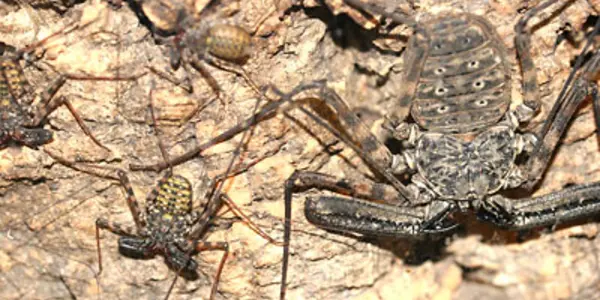
Whip spiders, considered by many to be creepy-crawly, are giving new meaning to the term touchy-feely.
In two species of whip spiders, or amblypygids, mothers caress their young with long feelers, siblings stick together until they reach sexual maturity, and all mix in social groups. This is surprising behavior for these arachnids long-thought to be purely aggressive and anti-social, according to a Cornell researcher.
A mother amblypygid with several of her 7-month-old offspring. Their whips are touching one another.
Plants can do it: they simply grab carbon dioxide out of the air and covert it into biomass. In this process, known as photosynthesis, the plants use light as their energy source. Chemists would also like to be able to use CO2 as a carbon source for their synthetic reactions, but it doesn’t work just like that. A team headed by Markus Antonietti at the Max Planck Institute for Colloids and Interfaces has now taken an important step toward this goal. As described in the journal Angewandte Chemie, they have successfully activated CO 2 for use in a chemical reaction by using a special new type of metal-free catalyst: graphitic carbon nitride.
Employers would be better at keeping workers if they focused on why their employees want to stay rather than what kinds of things make them quit, according to researchers from the University of Washington and Truman State University.
Until recently, most research focused on why people leave jobs rather than why they choose to stay. In a review of the past 15 years of research on employee job satisfaction and voluntary turnover, the researchers examined not only why people quit but what makes workers stay in their current positions.
They found that the decision to quit one's job doesn't necessarily come from job dissatisfaction. Employees may have a plan to leave should something happen in their lives, such as a spouse getting a job in another town.
Probiotic supplements have been used around the world for at least half a century, but almost half (49 percent) of Americans indicate that they have never heard of them, according to a recent survey conducted by Harris Interactive® for Florastor®, the world’s top-selling probiotic, now being launched widely in the United States.
Derived from a Greek term meaning, "for life," probiotics are defined by the World Health Organization (WHO) as "live micro-organisms, which, when administered in proper amounts, confer a health benefit on the host."
Florastor, which utilizes a beneficial, clinically-studied form of a freeze-dried yeast called Saccharomyces boulardii (S.
By mapping the interlocking structures of small molecules and mutated protein "receptors" in non-small cell lung cancer (NSCLC) cells, scientists at Dana-Farber Cancer Institute and their colleagues have energized efforts to design molecules that mesh with these receptors, potentially interfering with cancer cell growth and survival.
In a study published in the March issue of Cancer Cell, researchers led by Michael Eck, MD, PhD, of Dana-Farber used X-ray crystallography to determine the structure of two mutated forms of the epidermal growth factor receptor (EGFR) in lung cancer cells. EGFR, a protein known as a tyrosine kinase, plays a key role in relaying growth signals within cells.
It's a modern medicinal miracle. Health food advocates haven't been this excited since Psyllium took the nation by storm. Cocoa is for real and it apparently does everything.
A short while ago, it was said to make us smarter. and before then it could improve blood flow and maybe deter cancer.