Acts of piracy at sea are on the rise. Piracy - boarding a ship to commit theft or another crime - totaled 2,463 actual or attempted incidents between 2000 and 2006, according to a new RAND report, but they claim nearly half of all piracy attacks are not reported, usually due to fears about subsequent investigation costs and increases of insurance premiums.
Reported incidents worldwide increased 68 percent from 2000 to 2006, compared to the previous six year period, according to the study, though there was only a modest spike in terrorist attacks and plots at sea, including the 2004 bombing of the Philippine ship SuperFerry 14 that killed 116 people.
They're probably not colluding with one another, or terrorists, despite what some organizations claim. They're still pirates and pirates care about money while the goal of terrorism is religious or political. Although both events are increasing, piracy is growing much faster and remains far more common than seaborne terrorism, according to the report.
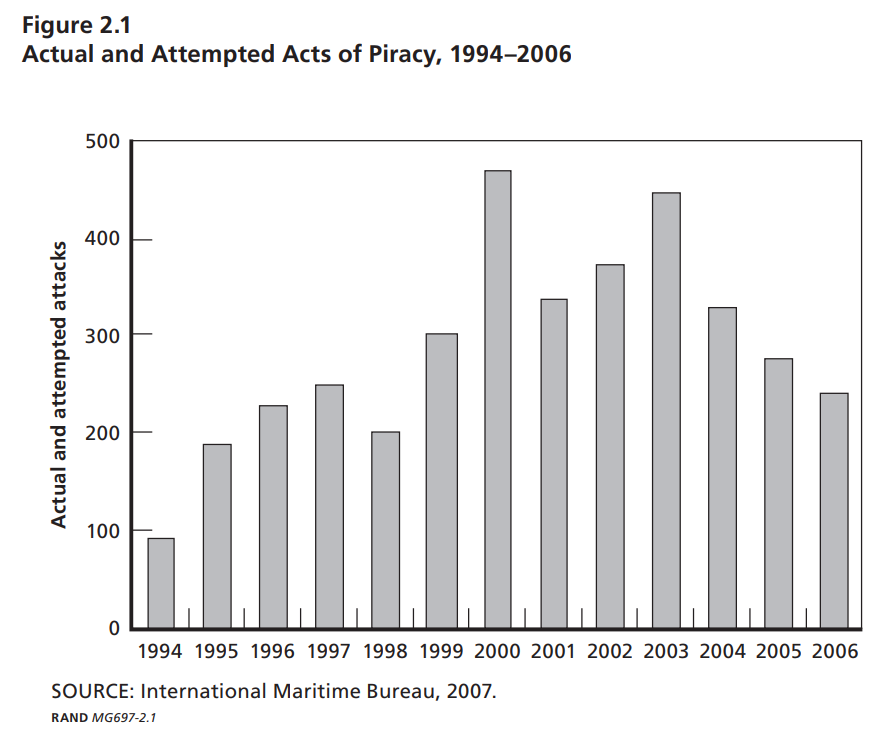
Peter Chalk, author of the study, said the study's findings suggest U.S. policymakers focus too much on responding to worse-case terrorist scenarios rather than crafting policies to combat lower consequence (but more probable) attacks that could strike cruise ships or passenger ferries. Just as seriously, the U.S. government has paid comparatively little attention to combating piracy, despite its proven cost in terms of human lives, political stability and economic disruption.
"The maritime environment will likely remain a favorable theater for armed violence, crime and terrorism given its expanse, lack of regulation and general importance as a critical conduit for international trade," said Chalk. "While there is no quick fix for eliminating all of this, we can rationally manage the threats within acceptable boundaries."
Piracy remains greatest in Southeast Asia, especially around the Indonesian archipelago. That region accounted for nearly a quarter of all piracy incidents recorded during 2006. Other high-risk areas include the waters off Bangladesh, Somalia, the Gulf of Aden/Red Sea, Nigeria, Tanzania and Peru, which collectively accounted for the bulk of remaining incidents that year.
Chalk said that a number of factors have contributed to the recent growth of piracy, including: lax port security and ineffective coastal surveillance; massive growth in commercial maritime traffic; heavy use of narrow and congested chokepoints, such as the Strait of Malacca; and competing resource requirements stemming from heightened national and international pressure to enact expensive, land-based homeland security systems following the Sept. 11 terrorist attacks.
Maritime terrorism -- attacks against vessels, sea platforms, ports or other coastal facilities -- has also experienced a modest increase, particularly over the past six years when several attacks and plots have been attributed to al-Qaeda and affiliated jihadist networks. These incidents have raised concerns in the West, especially in the United States, that terrorists are now actively seeking to extend their operational reach beyond land-based attacks, Chalk said.
The study concludes that there are at least four policy-level contributions that U.S. policymakers can make to help better safeguard the world's oceans:
- Expand the post-9/11 maritime security regime.
- Conduct regular, focused threat assessments.
- Redefine the mandates of multilateral security arrangements to make sure they provide for a greater role in countering maritime threats.
- Encourage the maritime industry to make greater use communication and defensive technologies, while accepting more transparency in its corporate structures.