More on Radiacode 110
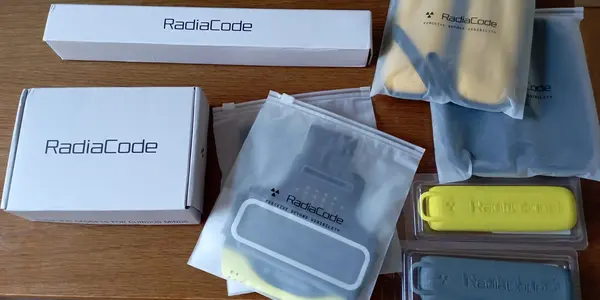
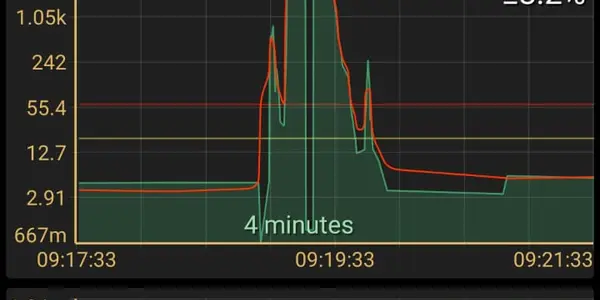
This is the second post reporting a few tests of the Radiacode 110 spectrometer, an extra-cool pocket dosimeter/radiation counter/spectrograph sold by RadiaCode.
This is the second post reporting a few tests of the Radiacode 110 spectrometer, an extra-cool pocket dosimeter/radiation counter/spectrograph sold by RadiaCode.

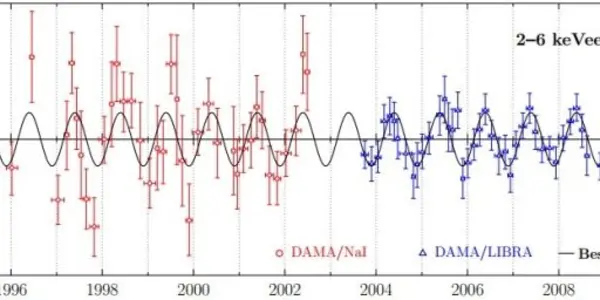
What is dark matter (DM)? This is one of the most pressing questions in fundamental science nowadays. We have observed that only one fifth of the matter that exists in the Universe clusters into stars and emits light - the rest appears to only interact gravitationally, producing phenomena we can study through the dynamics of galaxy rotation or by observing the deflection of light passing through it.
Nima Arkani-Hamed needs no introduction - he's a superstar theoretical physicist, and whenever he speaks, his colleagues listen - so much so that his seminars regularly overrun twice past their scheduled duration, without anybody blinking. And today it's your lucky day (and mine), as you get to listen to a clear thinker explaining what really is the status of research in fundamental physics, and why it is actually extremely exciting, much to the discomfort of those who would prefer that public money were spent to reduce taxes (if you don't get the pun, please leave).

Today's news is that five months after Alessandro Strumia's controversial talk at a conference on "Theory and Gender", CERN decided to terminate the Italian theorist's status of "guest professor", effectively cutting its ties with him. The decision certainly affects the ability of Strumia to further his research in particle phenomenology, which centered on models of physics beyond the Standard Model, and is rather unprecedented.
As the regulars here already know, I am an employee of the INFN. This is the "Istituto Nazionale di Fisica Nucleare", which translates as "National institute for nuclear physics", a slight misnomer of historical origin, as the institute today actually centers its activities on SUB-nuclear physics - i.e. study of elementary particles (but nuclei are still one of the targets!).
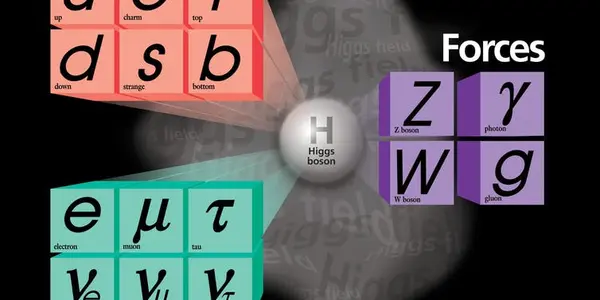
The ATLAS and CMS collaborations released yesterday a joint document where they discuss the combination of their measurements of the rate of production of single top quarks in proton-proton collisions delivered by the LHC collider. The exercise is not an idle one, as the physics behind the production processes is interesting, and its study as well as the precise comparison of experimental results and theory predictions improves our ability to predict other reactions, wherein we might find deviations from the currently accepted theory, the Standard Model.
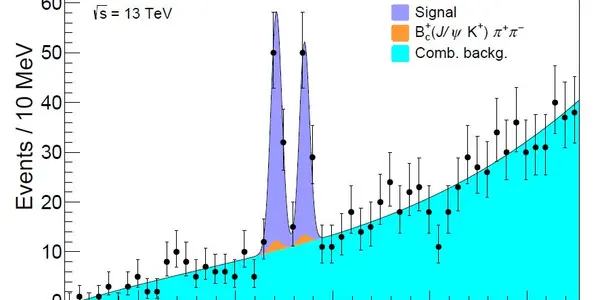
I am very happy to report today that the CMS experiment just confirmed to be an excellent spectrometer - as good as they get, I would say - by discovering two new excited B hadrons. The field of heavy meson spectroscopy proves once again to be rich with new gems ready to be unearthed, as we collect more data and dig deeper. For such discoveries to be made, collecting as many proton-proton collisions as possible is in fact the decisive factor, along with following up good ideas and preserving our will to not leave any stone unturned.
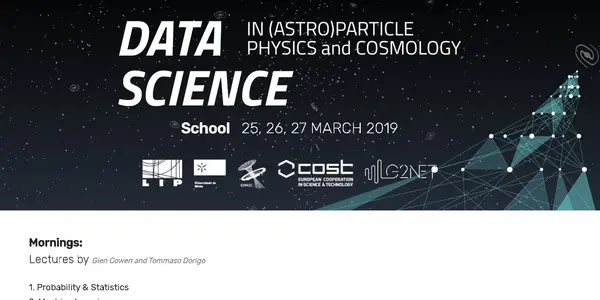
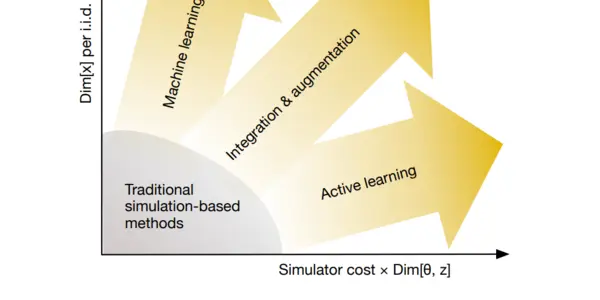
On March 25 to 27 will be held the school titled "Data Science in (astro)particle physics and cosmology", in Braga (Portugal). The lecturers are prof. Glen Cowan (RHUL), who will cover Statistics, and myself, who will cover topics in Machine Learning. I thought I would mention this here, as for me it is a novelty - in the past years I have often given lectures in advanced statistics topics at various Ph.D. schools around the world, but I never focused explicitly and solely on ML.
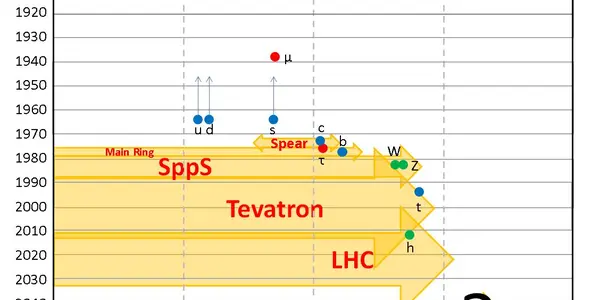
In the previous post I discussed, among other things, a purely empirical observation on the mass spectrum of elementary particles, which I summarized in a graph where on the vertical scale I put the year of discovery, and where I only cared to plot particles with a mass above a keV - in fact, we know that neutrinos have non-zero masses, but we have not measured them and they are of the order of an eV or below. Okay, for simplicity I will re-publish the graph below.
I have long been of the opinion that writing about science for the public requires the writer to simplify things down to a level which is sometimes dangerously close to mislead the uninformed readers. I think is a small price to pay if you want to keep open the channel of communication with the general public, but it is indeed a narrow path the one you sometimes find yourself walking on, and fallacy is always a possible outcome.
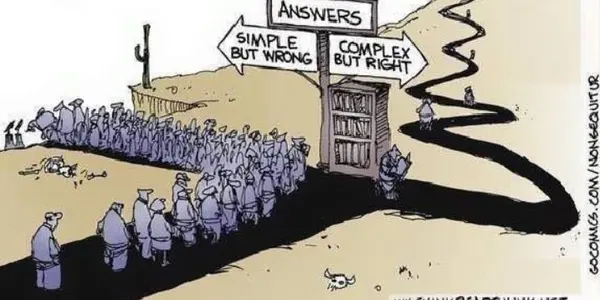
As the well-informed readers will realize, I am hat-tipping Hank Campbell and the catchy title of his best-selling book "Science Left Behind" with the title of this post, for lack of more imagination. What I want to discuss is, however, something only partly in line with the interesting topics of Hank's book. It is something that I see happening around these days, and which I ache for: the dumbing down of our decision making in science.
Given the use that people do of Google searches nowadays, and the rather special nature of my usual readership, I feel I may need to first of all apologize for the deceiving title of this post to the 80 to 90% of the visitors, who came to this page by searching for ways to become a member of a selection committee of miss Universe. Sorry, you had it wrong - we are going to discuss parametric models here, not top models. But if you are happy to hear about the issues of fitting data with different functional forms, you are welcome to read on.
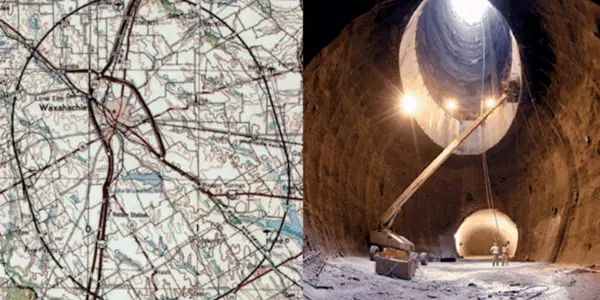
[Update: I found the time to add a few links to the post below, which I had previously omitted for lack of time (hey I'm on vacation!), and I also updated it to add some commentary of Sabine Hossenfelder's latest post on "the end of particle physics".]In this age of short-term reward strategies (in politics, in society, and in individual behaviour) planning huge endeavours 20 years ahead is harder than it used to be. In the late eighties, when the Large Hadron Collider (LHC) was conceived and argued to be doable by a few visionaries, it immediately looked like a great idea to all.