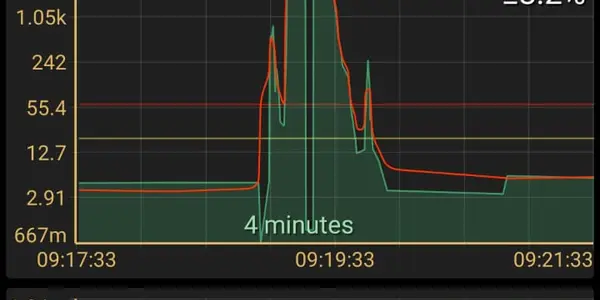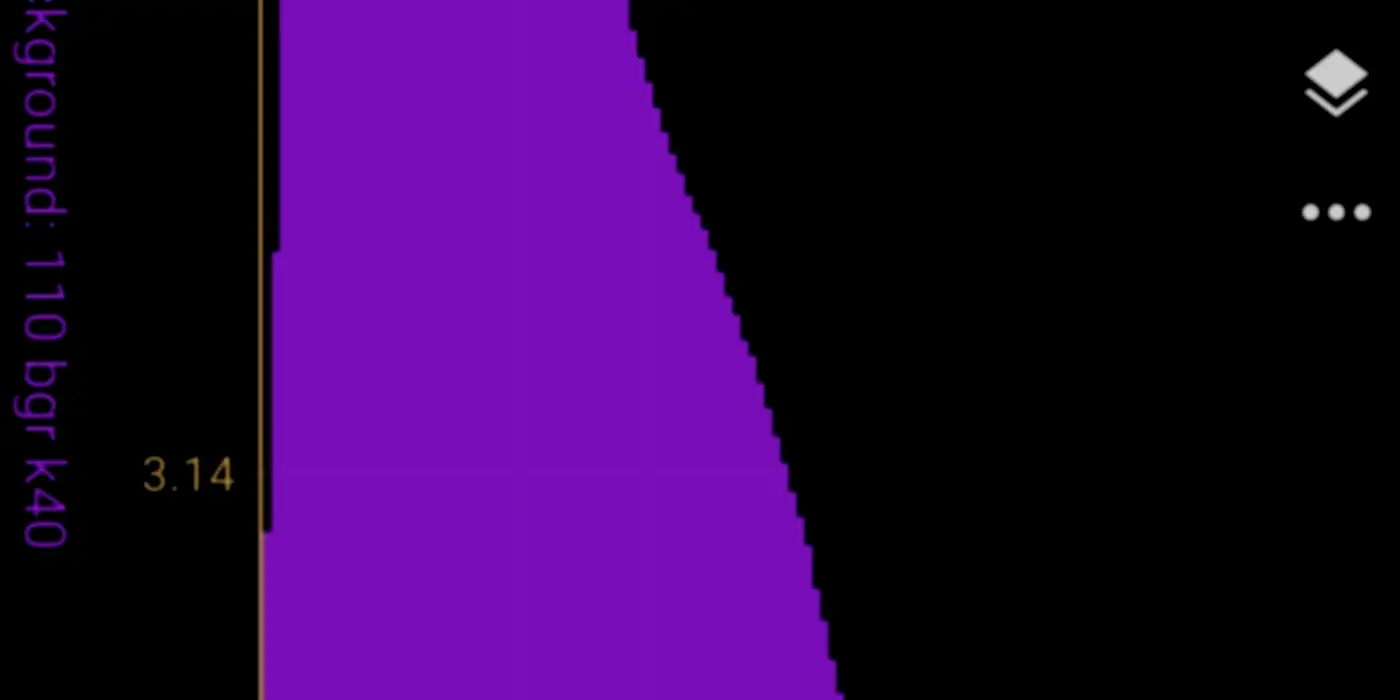
More on Radiacode 110
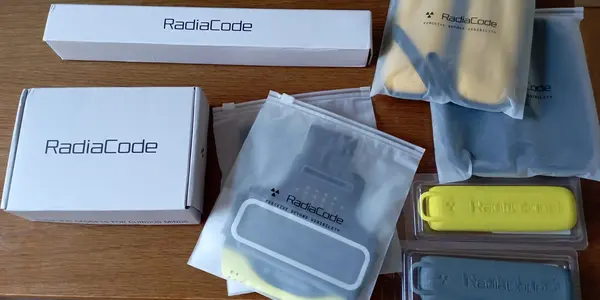
This is the second post reporting a few tests of the Radiacode 110 spectrometer, an extra-cool pocket dosimeter/radiation counter/spectrograph sold by RadiaCode.
This is the second post reporting a few tests of the Radiacode 110 spectrometer, an extra-cool pocket dosimeter/radiation counter/spectrograph sold by RadiaCode.

So you're planning ahead for your next trip to a remote location, and you try to make sense of those TripAdvisor listings. Great tool - there's a bunch of there around, but let's focus on that one here. It allows you to type in your preferences, location, restrictions, and it dumps a list of facilities together with easy access to the reviews of previous customers. How could we possibly live without it, twenty years ago?Now, the point of this article is to make sure you can USE the data you are able to get on the web. I use to say "there's not such a thing as too much information", but then I shoud qualify that statement: it all depends on whether you have a brain and a will to put it to work.
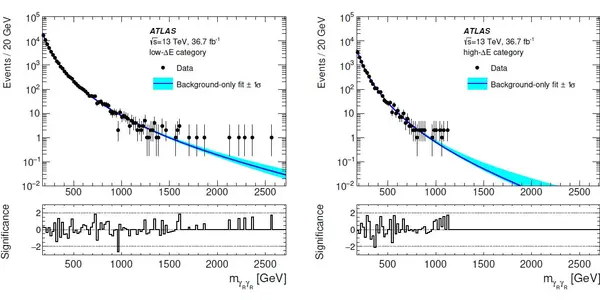
What is a photon jet? Despite their exotic name, photon jets are a well studied thing nowadays. The original studies were performed by experimentalists who aimed to test quantum chromodynamics: they used to spend their time discriminating prompt photon production in hadron collisions from backgrounds. I remember a lot of such studies were performed in the 80ies and 90ies by my CDF colleagues, especially within the "QCD working group".The importance of the detection of single, isolated photons of high energy has risen enormously since then, given their role in the discovery of the Higgs boson. Photon jets are in fact the background to beat down if you want a neat peak of H --> γγ decays to pop out of a mass histogram constructed from events featuring two photon candidates.
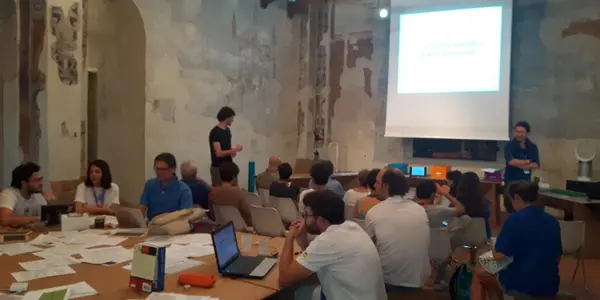
Since yesterday, and for almost a week, the literature festival in Mantova hosts "ScienceGround", a quite innovative initiative at the boundary between a science fair, a workshop, a library, and a place to hang around together and exchange ideas and information. The location is the beautiful hall of the church of Santa Maria della Vittoria, where a modular and dynamically configurable space has been set up.
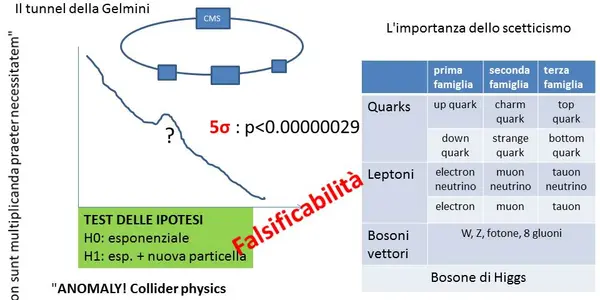
On September 4 to 8 the city of Mantova, in northern Italy, will be brimming with writers and readers. The event is called "Festivaletteratura" and brings together authors and consumers of books of all kinds, in a week-long kermesse with interviews, debates, public lectures, and the like.
Version 2 of a thick textbook on particle and astroparticle physics is out, and you should have a look at it (well, at least if you're seriously interested in the topic!). The book, titled "Introduction to Particle and Astroparticle Physics" (not a very imaginative title, admittedly, but at least a faithful one) has a more descriptive subtitle: "Multimessenger Astronomy and its Particle Physics Foundations". It is authored by Alessandro de Angelis and Mario Pimenta, two acknowledged experts of the field.

Do you know the works of Tim Blais, the guy behind "A Capella Science"? I sincerely hope you do, but otherwise this post is for you. Tim has a youtube page where he publishes his amazing works.
Tim sings modified lyrics of famous songs, and mixes them with multiple tracks of his own voice imitating each of the instruments of the underlying orchestra, or other choral voices. Until here you could well say there's nothing new under the Sun, except that Tim has been capable, through amazing mixing and editing skills as well as awesome vocal gift, of producing quite entertaining videos. But there is more.
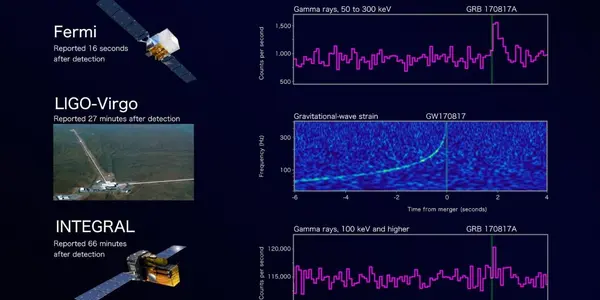
I am very happy to host here today an article by my INFN colleague Alessandro de Angelis, a well-known and authoritative italian astrophysicist. Alessandro has recently published a beautiful new book on this subject, which I invite you to have a look at (see link at the bottom of the article) - T.Dorigo .
What is chance? Or better, does the word "chance" really have an absolute meaning? I believe this is not an idle question. We tend to use that word to describe phenomena which we cannot trace back to an explanatory cause by a cause-effect relation. But words are important: labeling an event as due to chance has a direct impact on our perception of reality, as the statement that something "happened by chance" constitutes a final verdict, which labels the event as something not liable to be scrutinized in more depth.
There is very little I love more than the world wide web. No, seriously, I mean it.
Internet has changed my life more than any other "thing" around, and it has provided me with an enormous wealth - information, knowledge, simplification of otherwise difficult tasks, ease of access to data, solution to problems, connection with people all over the world, possibility to broadcast and publish. And entertainment, online gaming, music, videos, free porn, free movies, paid movies. I could go on, of course.

[Eleni Petrakou, Ph.D., is a physicist and an independent researcher, besides being a longtime follower of this blog. She now has a newsletter of her own; it is high S/N stuff - check it out here. After a past collaboration with the CMS experiment, she has recently become intrigued with the dynamics of the Sun, and she developed a model to try and predict the solar cycle, a 11-year variation of the activity of sunspots and solar flares whose origin is still debated. I asked her to describe the matter for this blog, and the text below is the result - TD]
DESCRIBING THE SOLAR CYCLE
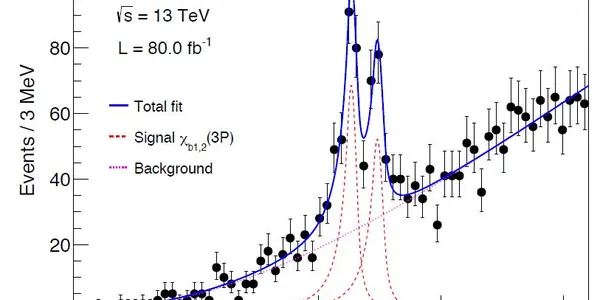
What is spectroscopy ? (A) the observation of ghosts by infrared visors or other optical devices(B) the study of excited states of matter through observation of energy emissionsIf you answered (A), you are probably using a lousy internet search engine; and btw, you are rather dumb. Ghosts do not exist. Otherwise you are welcome to read on. We are, in fact, about to discuss a cutting-edge spectroscopy measurement, performed by the CMS experiment using lots of proton-proton collisions by the CERN Large Hadron Collider (LHC).
Happy Birthday Higgs boson! The discovery of the last fundamental particle of the Standard Model was announced exactly 6 years ago at CERN (well, plus one day, since I decided to postpone to July 5 the publication of this post...).In the Standard Model, the theory of fundamental interactions among elementary particles which enshrines our current understanding of the subnuclear world, particles that constitute matter are fermionic: they have a haif-integer value of a quantity we call spin; and particles that mediate interactions between those fermions, keeping them together and governing their behaviour, are bosonic: they have an integer value of spin.