More on Radiacode 110
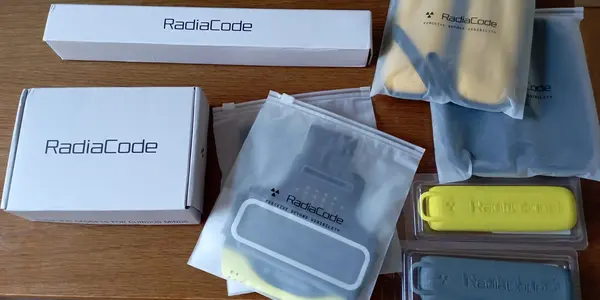
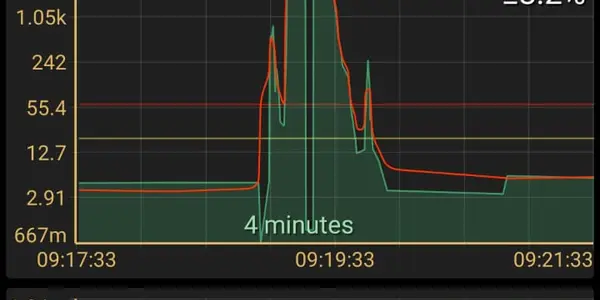
This is the second post reporting a few tests of the Radiacode 110 spectrometer, an extra-cool pocket dosimeter/radiation counter/spectrograph sold by RadiaCode.
This is the second post reporting a few tests of the Radiacode 110 spectrometer, an extra-cool pocket dosimeter/radiation counter/spectrograph sold by RadiaCode.

Some shameless self-promotion is in order today, as my review titled "Hadron Collider Searches for Diboson Resonances", meant for publication on the prestigious journal "Progress in Particle and Nuclear Physics", has been made available on the Cornell Arxiv.My review covers quite extensively the topic, as it is not constrained in length as other reviews usually are. At 76 pages, and with 500 references, it aims to be the main reference on this type of physics for the next five years or so - at least, this is the stipulation with PPNP. Whether I managed to make it such, it is something to be judged by others.The plan of the work is as follows:
The field of particle physics is populated with believers and skeptics. The believers will try to convince you that new physics is about to be discovered, or that is anyway at close reach. The skeptics will on the other hand look at the mass of confirmations of the current theory -the Standard Model- and claim that any speculation about the existence of discoverable new phenomena has no basis.
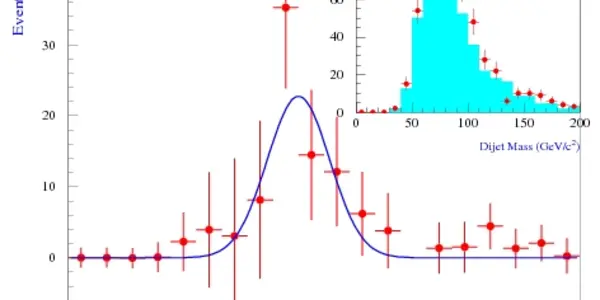
A search just posted on the Cornell arXiv by the ATLAS Collaboration caught my eye today, as it involves a signature which I have been interested on for quite a while. This is the final state of proton-proton collisions that includes an energetic photon and a recoiling dijet system, when the dijet system may be the result of the decay of a W or Z boson - or of a heavier partner of the Z, called Z'. The setting
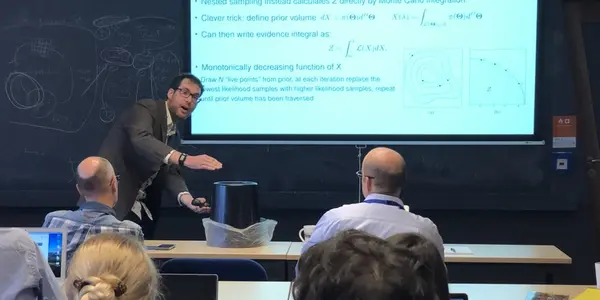
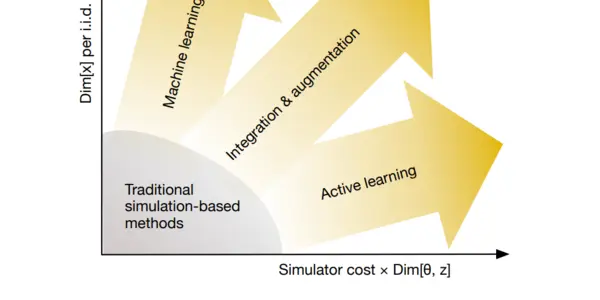
I am currently spending the week in Leiden (Netherlands), attending to a very interesting workshop that brought together computer scientists, astronomers, astrophysicists, and particle physicists to discuss how to apply the most cutting-edge tools in machine learning to improve our chances of discovering dark matter, the unknown non-luminous substance that vastly overweights luminous matter in the Universe.

Peer review is the backbone of high quality scientific publications. Although the idea that only articles that are approved by a set of anonymous nitpickers can ever see the light of publication on "serious" journals is old and perfectible, there is currently no valid alternative to identify verified, rigorous scientific work, and to filter out unsubstantiated claims, and methodologically unsound results - the scientific analogue of "fake news".
The title of this post is the password code required to connect to my wireless network at home. The service, provided by the Italian internet provider Fastweb, has been discontinued as I moved to Padova from Venice, so you can't really do much with the code itself. On the other hand, it should give you hints on a couple of things.
I was born and have lived in Venice for over 51 years now (omitting to mention some 2 years of interruption when I worked for Harvard University, 18 years ago), but this has come to an end on December 31st, when I concluded a rather complex move to Padova, 35 kilometers west. Venice is a wonderful city and quite a special place, if you ask me. A city with a millenary history, crammed with magnificent palaces and churches. A place where one could write a book about every stone. Walking through the maze of narrow streets or making one's way through a tight network of canals is an unforgettable experience, but living there for decades is something else - it makes you a part of it. I feel I own the place, in some way. So why did I leave it?
Scared by the void of Christmas vacations? Unable to put just a few more feet between your mouth and the candy tray? Suffocating in the trivialities of the chit-chat with relatives? I have a solution for you. How about trying to solve a few simple high-energy physics quizzes? I offer three questions below, and you are welcome to think any or all of them over today and tomorrow. In two days I will give my answer, explain the underlying physics a bit, and comment your own answers, if you have been capable of typing them despite your skyrocketing glycemic index.
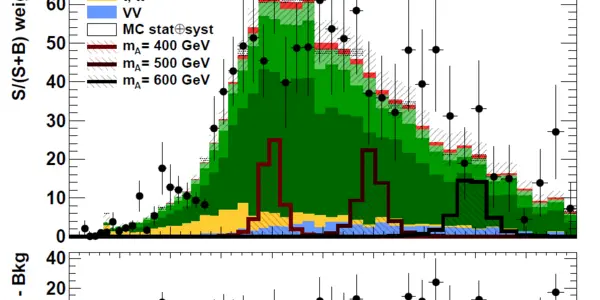
In the previous post I discussed the generalities of "diboson production" at the LHC. Dibosons are pairs of elementary bosons - the photon (carrier of electromagnetic interactions), the W and Z bosons (carriers of the weak interaction, respectively charged and neutral), the gluon (carrier of the strong interaction, and coming in 8 undistinguishable varieties), and the Higgs particle.
After one quite frantic November, I emerged victorious two weeks ago from the delivery of a 78-pages, 49-thousand-word review titled "Hadron Collider Searches for Diboson Resonances". The article, which will be published in the prestigious "Progress in Particle and Nuclear Physics", an Elsevier journal with an impact factor above 11 (compare with Physics Letters B, IF=4.8, or Physical Review Letters, IF=8.5, to see why it's relevant), is currently in peer review, but that does not mean that I cannot make a short summary of its contents here.
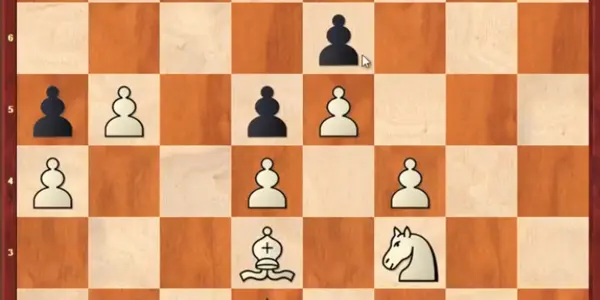
Peter Heine Nielsen, a Danish chess Grandmaster, summarized it quite well. "I always wondered, if some superior alien race came to Earth, how they would play chess. Now I know". The architecture that beat humans at the notoriously CPU-impervious game Go, AlphaGo by Google Deep Mind, was converted to allow the machine to tackle other "closed-rules" games. Successively, the program was given the rules of chess, and a huge battery of Google's GPUs to train itself on the game. Within four hours, the alien emerged. And it is indeed a new class of player.
It was nice to find John Duffield's review of my book "Anomaly! Collider Physics and the Quest for New Phenomena at Fermilab" in the Amazon site today.