More on Radiacode 110
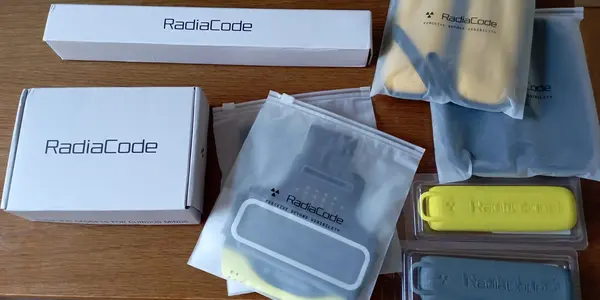
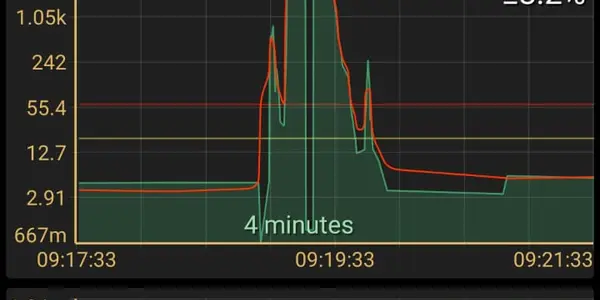
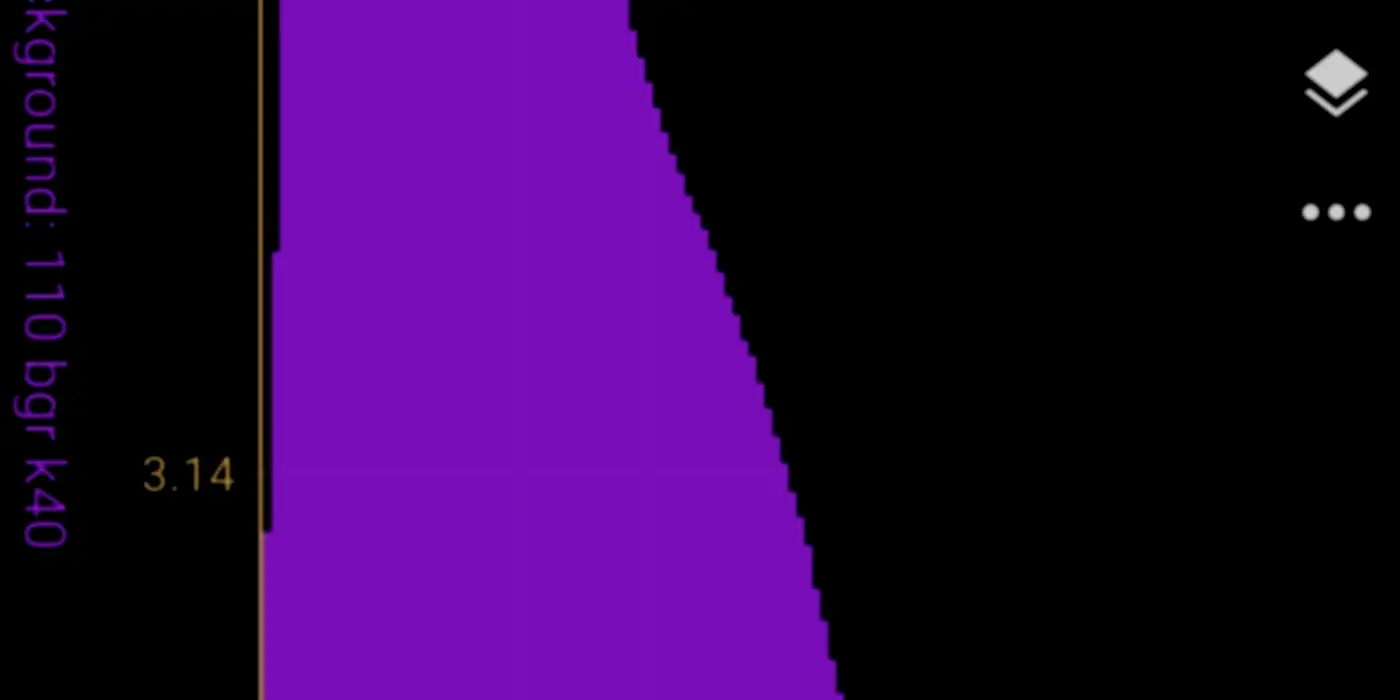
This is the second post reporting a few tests of the Radiacode 110 spectrometer, an extra-cool pocket dosimeter/radiation counter/spectrograph sold by RadiaCode.
This is the second post reporting a few tests of the Radiacode 110 spectrometer, an extra-cool pocket dosimeter/radiation counter/spectrograph sold by RadiaCode.


Another chapter in the saga of the search for the elusive, but dominant, decay mode of the Higgs boson has been reported by the CMS collaboration last month. This is one of those specific sub-fields of research where a hard competition arises on the answer to a relatively minor scientific question. That the Higgs boson couples to b-quarks is indirectly already well demonstrated by a number of other measurements - its coupling to (third generation) quarks being demonstrated by its production rate, for example. Yet, being the first ones to "observe" the H->bb decay is a coveted goal.

Back from vacations, I think I need to report a few random things before I get back into physics blogging. So I'll peruse the science20 article category aptly called "Random Thoughts" for this one occasion.My summer vacations took place just after a week spent in Ecuador, where I gave 6 hours of lectures on LHC physics and statistics for data analysis to astrophysics PhD students. I did report about that and an eventful hike in the last post. Unfortunately, the first week of my alleged rest was mostly spent fixing a few documents that the European Commission expected to receive by August 31st. As a coordinator of a training network, I have indeed certain obligations that I cannot escape.

If I am alive, I probably owe it to my current very good physical shape.That does not mean I narrowly escaped a certain death; rather, it means that if I had been slower there are good chances I would have got hit by lightning, under arduous conditions, at 4300 meters of altitude.
This is the fifth and final part of Chapter 3 of the book "Anomaly! Collider Physics and the Quest for New Phenomena at Fermilab". (the beginning of the chapter was omitted since it described a different story). The chapter recounts the pioneering measurement of the Z mass by the CDF detector, and the competition with SLAC during the summer of 1989. The title of the post is the same as the one of chapter 3, and it refers to the way some SLAC physicists called their Fermilab colleagues, whose hadron collider was to their eyes obviously inferior to the electron-positron linear collider.
This is the fourth part of Chapter 3 of the book "Anomaly! Collider Physics and the Quest for New Phenomena at Fermilab". The chapter recounts the pioneering measurement of the Z mass by the CDF detector, and the competition with SLAC during the summer of 1989. The title of the post is the same as the one of chapter 3, and it refers to the way some SLAC physicists called their Fermilab colleagues, whose hadron collider was to their eyes obviously inferior to the electron-positron linear collider.
This is the third part of Chapter 3 of the book "Anomaly! Collider Physics and the Quest for New Phenomena at Fermilab". The chapter recounts the pioneering measurement of the Z mass by the CDF detector, and the competition with SLAC during the summer of 1989. The title of the post is the same as the one of chapter 3, and it refers to the way some SLAC physicists called their Fermilab colleagues, whose hadron collider was to their eyes obviously inferior to the electron-positron linear collider.
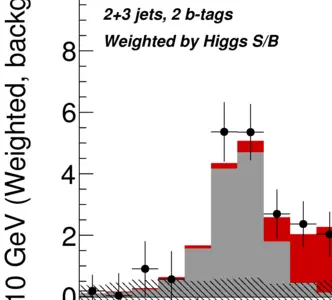
I have recently been reproached, by colleagues who are members of the competing ATLAS experiment, of misusing the word "see" in this blog, in the context of searches for physics signals. That was because I reported that CMS recently produced a very nice result where we measure the rate of H->bb decays in events where the Higgs boson recoils against a energetic jet; that signal is not statistically significant, so they could argue that CMS did not "see" anything, as I wrote in the blog title.
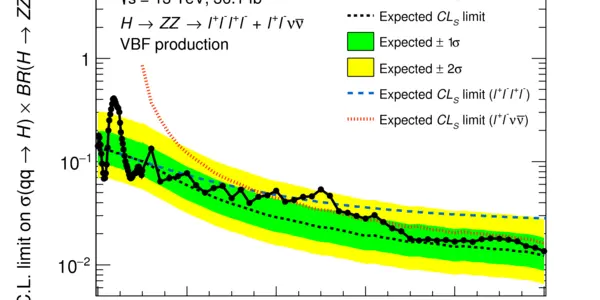
A new analysis by the ATLAS collaboration, based of the data collected in 13 TeV proton-proton collisions delivered by the LHC in 2016, finds an excess of X-->4 lepton events at a mass of 240 GeV, with a local significance of 3.6 standard deviations. The search, which targeted objects of similar phenomenology to the 125 GeV Higgs boson discovered in 2012, is published in ATLAS CONF-2017-058. Besides the 240 GeV excess, another one at 700 GeV is found, with the same statistical significance.
This is the second part of a section taken from Chapter 3 of the book "Anomaly! Collider Physics and the Quest for New Phenomena at Fermilab". The chapter recounts the pioneering measurement of the Z mass by the CDF detector, and the competition with SLAC during the summer of 1989. The title of the post is the same as the one of chapter 3, and it refers to the way some SLAC physicists called their Fermilab colleagues, whose hadron collider was to their eyes obviously inferior to the electron-positron linear collider.
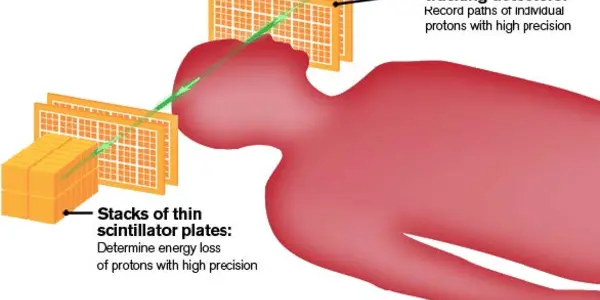
Last week-end Padova researchers tested the first calorimeter and tracker prototypes of the iMPACT project at the APSS/TIFPA Proton Therapy Facility in Trento (Italy).iMPACT (innovative Medical Proton Achromatic Calorimeter and Tracker) is a project led by Piero Giubilato, who won an ERC consolidator grant from the European Union. The project aims to develop a high resolution and high rate (>100 kHz/cm2) proton Computed Tomography (pCT) scanner. The scanner will combine a highly-segmented range calorimeter made of PVT scintillators, for energy measurements, and a silicon pixel tracker, for trajectory reconstructions.
The clip below, together with the following few which will be published every few days in the coming weeks, is extracted from the third chapter of my book "Anomaly! Collider Physics and the Quest for New Phenomena at Fermilab". It recounts the pioneering measurement of the Z mass by the CDF detector, and the competition with SLAC during the summer of 1989.
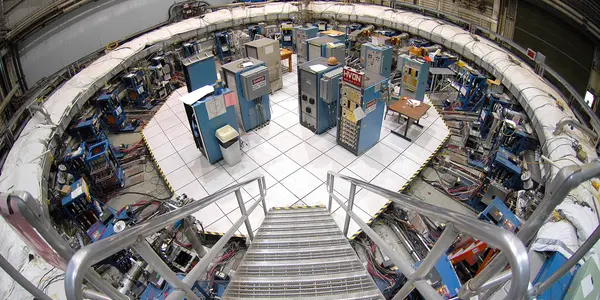
Do you remember the infamous "g-2" measurement ? The anomalous magnetic moment of the muon has been for over a decade in the agenda of HEP physicists, both as a puzzle and as a hope for good things to come. Ever since the Brookhaven laboratories estimated the quantity at a value over 3 standard deviations away from the equally precise theoretical predictions, the topic (could the discrepancy be due to new physics??) has been commonplace in dinner table conversations among HEP physicists.