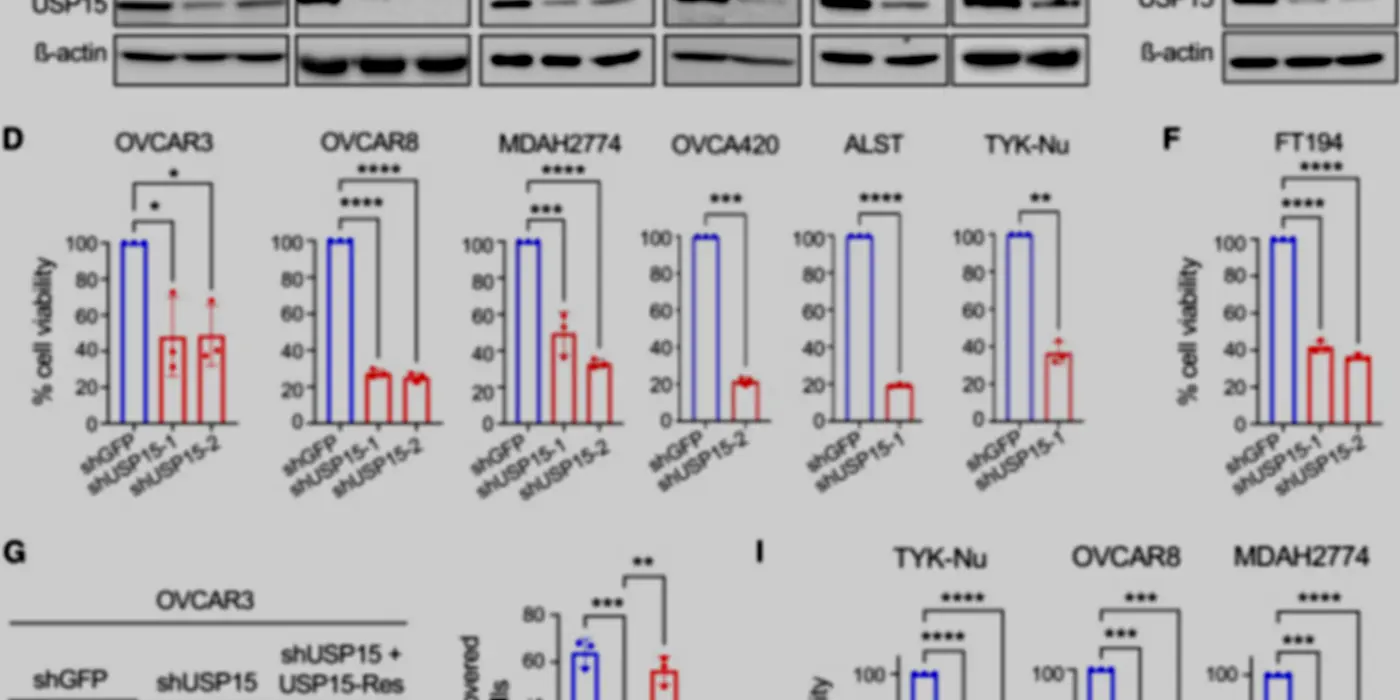
Enzyme USP15 Limits Ovarian Cancer Cells And Boosts Chemotherapy
Ovarian cancer is devastating, five-year survival rate under 30%, when detected after it has spread. New basic research may improve that.
Ovarian cancer is devastating, five-year survival rate under 30%, when detected after it has spread. New basic research may improve that.


In a just-published series of studies involving hundreds of volunteers, University of Georgia and Duke University psychologists say that watching or even thinking about someone with good self-control makes others more likely exert self-control. The research found that the opposite holds, too; people with bad self-control influence others negatively. The effect is so powerful, in fact, that seeing the name of someone with good or bad self-control flashing on a screen for just 10 milliseconds changed the behavior of volunteers.
Researchers at Duke University Medical Center have identified neurons in the songbird brain that convey the auditory feedback needed to learn a song. Their research, published in Neuron, lays the foundation for improving human speech, for example, in people whose auditory nerves are damaged and who must learn to speak without the benefit of hearing their own voices. "This work is the first study to identify an auditory feedback pathway in the brain that is harnessed for learned vocal control," said Richard Mooney, Ph.D., Duke professor of neurobiology and senior author of the study. The researchers also devised an elegant way to carefully alter the activity of these neurons to prove that they interact with the motor networks that control singing.
An excess of a particular serotonin receptor in the center of the brain may explain why antidepressants fail to relieve depression symptoms for 50 percent of patients, indicates a new study published in Neuron.The authors say the study is the first to find a causal link between receptor number and antidepressant treatment and may lead to more personalized treatment for depression, including treatments for patients who do not respond to antidepressants and ways to identify these patients before they undergo costly, and ultimately, futile therapies.
The disastrous magnitude 7.0 earthquake that triggered destruction and mounting death tolls in Haiti this week occurred in a highly complex tangle of tectonic faults near the intersection of the Caribbean and North American crustal plates, according to a geologist at the Woods Hole Oceanographic Institution (WHOI).Jian Lin, a WHOI senior scientist in geology and geophysics, said that there were three factors that made the quake particularly devastating: First, it was centered just 10 miles southwest of the capital city, Port au Prince; second, the quake was shallow—only about 10-15 kilometers below the land's surface; third, and more importantly, many homes and buildings in the economically poor country were not built to withstand such a force and collapsed or crumbled.
While people typically blame incompetency when airport security screeners fail to keep dangerous weapons off airplanes or when doctors miss developing cancer tumors, the real culprit may be evolution, according to researchers at Harvard Medical School. Their new study published in Current Biology suggests that people simply haven't evolved superior skills for finding things that are rare. "We know that if you don't find it often, you often don't find it," said Jeremy Wolfe of Harvard Medical School. "Rare stuff gets missed." That means that if you look for 20 guns in a stack of 40 bags, you'll find more of them than if you look for the same 20 guns in a stack of 2,000 bags.
An expert panel of library scientists, publishers, and university academics said today that the results of scientific research funded by the federal government should be made freely available to the public "as soon as possible after those results have been published in a peer-reviewed journal." The Scholarly Publishing Roundtable was convened last summer by the U.S. House Committee on Science and Technology, in collaboration with the White House Office of Science and Technology Policy (OSTP). Policymakers asked the group to examine the current state of scholarly publishing and seek consensus recommendations for expanding public access to scholarly journal articles.
Loss of smell function may predict the onset of Alzheimer's disease, according to a new study published in the January 13 issue of the Journal of Neuroscience. The research links a loss of smell function in Alzheimer's disease (AD) model animals with amyloid ß (protein) accumulation in the brain, a distinguishing hallmark of Alzheimer's disease.
While much concern has been generated by the obesity epidemic in the United States in recent years, with about one-third of adults obese in 2007-2008, new data suggest that the rate of increase for obesity may be slowing, say the authors of a study appearing in the January 20 issue of JAMA. "Data from 1988-1994 showed that the prevalence of obesity in adults had increased by approximately 8 percentage points in the United States since 1976-1980, after being relatively stable over the period 1960-1980. Analyses of data from 1999-2000 showed further increases in obesity for both men and women and in all age groups," the authors write.
If left unaddressed, the U.S. government's growing debt will inevitably limit America's future wealth and risk a disruptive fiscal crisis, claims a new report from the National Research Council and the National Academy of Public Administration. The report lays out several tax and spending options that would stabilize the national debt within a decade as well as a set of simple tests to determine whether any proposed federal budget would lead to long-term fiscal stability.
The rate of smoking among nursing students is twice that of the general population, indicates a survey of over 800 new nursing students published in the Journal of Advanced Nursing. Busy bodies in the health community argue the results indicate that smoking cessation programs should be incorporated into nursing studies. They say that smoking among healthcare professionals undermines the credibility of anti-smoking campaigns aimed at the general public.
The Tibetan Plateau—thought to be the primary source of heat that drives the South Asian monsoon—may have far less of an effect than moist, warm air insulated over continental India by the Himalayas and other surrounding mountains, say Harvard climate scientists writing this week in Nature. The team says that understanding the monsoon's proper origin, especially in the context of global climate change, is crucial for the future sustainability of the region. The findings also have broad implications for how the Asian climate may have responded to mountain uplift in the past, and for how it might respond to surface changes in the coming decades, the researchers say.
Conservation efforts aimed at protecting Gorillas And Elephants in African parks and reserves are well intentioned but are often based on incorrect assumptions about the local culture, say Purdue University anthropologists. In a new Conservation Biology paper, the team says that understanding local human communities is key to protecting the wildlife they live alongside.