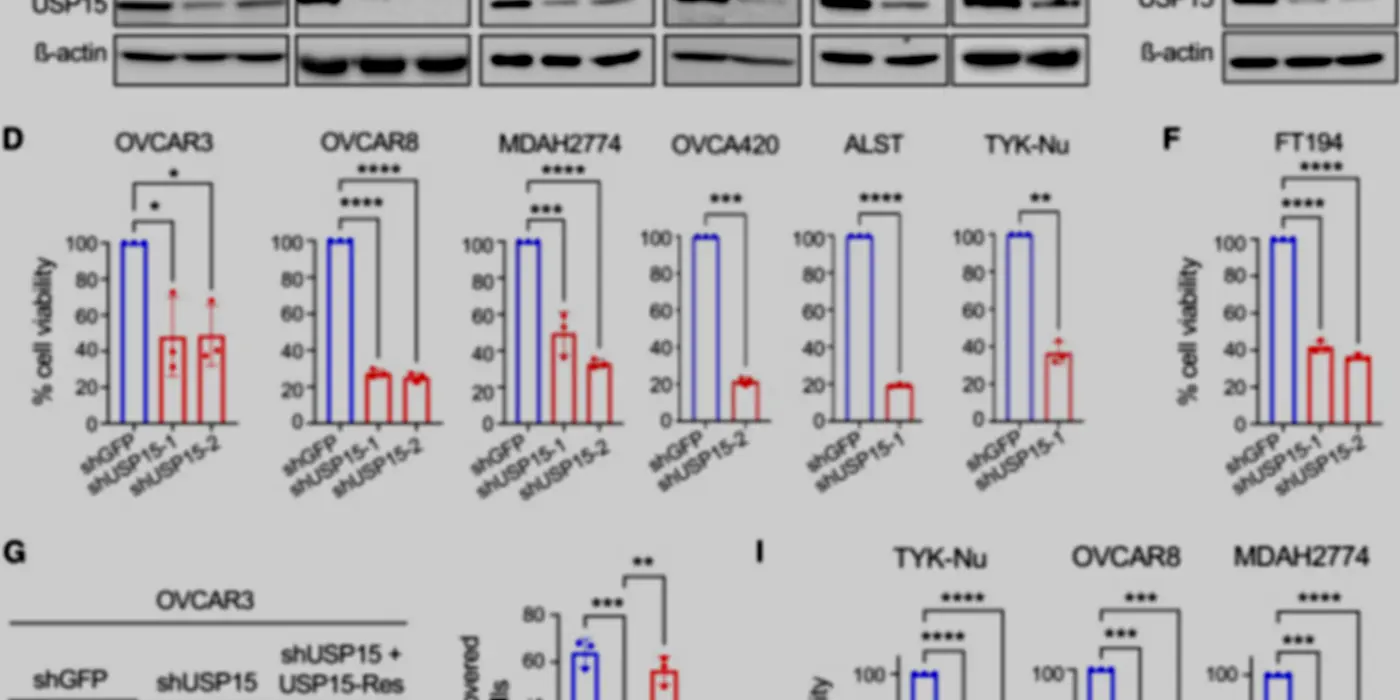
Enzyme USP15 Limits Ovarian Cancer Cells And Boosts Chemotherapy
Ovarian cancer is devastating, five-year survival rate under 30%, when detected after it has spread. New basic research may improve that.
Ovarian cancer is devastating, five-year survival rate under 30%, when detected after it has spread. New basic research may improve that.


Researchers have demonstrated for the first time that calcium channels
on the tongue are the targets of compounds that can enhance taste. In addition to molecules that directly trigger specific taste buds (salty, sweet etc.), there are other substances which have no flavor of their own but can enhance the flavors they are paired with (known as kokumi taste in Japanese cuisine). The results appear in the January 8 issue of the Journal of Biological Chemistry. Exploiting this enhancement could have practical uses in food modulation; for example, creating healthy foods that contain minimal sugar or salt but still elicit strong taste. At the moment, though, the mode of action for these substances is poorly understood.
Adolescents with earlier bedtimes are significantly less likely to suffer from depression and suicidal thoughts, suggesting that earlier bedtimes could have a protective effect by increasing the likelihood of getting enough sleep, reports a new study in the journal Sleep.The results show that adolescents with parental set bedtimes of midnight or later were 24 percent more likely to suffer from depression (odds ratio = 1.24) and 20 percent more likely to have suicidal ideation (OR=1.20) than adolescents with parental set bedtimes of 10 p.m. or earlier. This association was appreciably attenuated by self-reported sleep duration and the perception of getting enough sleep.
A team of radiologists publishing in Autism Research says that children with autism spectrum disorders (ASDs) process sound and language a fraction of a second slower than children without ASDs, and measuring magnetic signals that mark this delay may become a standardized way to diagnose autism.The researchers used magnetoencephalography (MEG), which detects magnetic fields in the brain, similar to the way electroencephalography (EEG) detects electrical fields. Using a helmet that surrounds the child’s head, the team presents a series of recorded beeps, vowels and sentences. As the child’s brain responds to each sound, noninvasive detectors in the MEG machine analyze the brain’s changing magnetic fields.

Archaeologists from the Department of Biblical Studies at the University of Haifa say they've deciphered the earliest known Hebrew writing in existence, an inscription dating from the 10th century BCE (the period of King David's reign). The discovery is significant because it means the Bible may be several centuries older than current estimates suggest, researchers say. "It indicates that the Kingdom of Israel already existed in the 10th century BCE and that at least some of the biblical texts were written hundreds of years before the dates presented in currentresearch," says Prof. Gershon Galil of the University of Haifa who deciphered the inscription.
Writing in the January 8 issue of Science, a group of environmental scientists is calling on the U.S. Environmental Protection Agency and the U.S Army Corps of Engineers to stay all new mountaintop mining permits. They argue that peer-reviewed research unequivocally documents irreversible environmental impacts from this form of mining, which also exposes local residents to a higher risk of serious health problems.
Contrary to the conclusions of dozens of other studies, a new paper appearing in Global Change Biology argues that as the climate warms and growing seasons lengthen, subalpine forests are likely to soak up less carbon dioxide. The authors, scientists at the University of Colorado, say that more of the greenhouse gas will be left to concentrate in the atmosphere as a result. The researchers found that while smaller spring snowpack tended to advance the onset of spring and extend the growing season, it also reduced the amount of water available to forests later in the summer and fall. The water-stressed trees were then less effective in converting CO2 into biomass. Summer rains were unable to make up the difference.
When people think of the Cold War they tend to dwell on all the negatives that came with it: totalitarian governments, proxy wars, a nuclear arms race, and so on. But looking back on the period, the authors of a new paper in the journal Biological Conservation say there was an odd ecological benefit that resulted from the interruption of trade that occurred between Eastern and Western Europe during the Cold war--fewer invasive species. "Global trade is a real concern for invasive species, and the lessons we can learn from the Cold War offer a warning flag to developing countries that are now expanding in an international economy," said co-author Susan M. Shirley.
While fossils may provide some tantalizing clues about human history, they also lack vital information needed to understand the past, such as which pieces of human DNA have been favored by evolution because they confer beneficial traits. Those genetic signs can only be revealed through studies of modern humans and other related species, and in a new Science Express paper, researchers describe a method for pinpointing these preferred regions within the human genome.
Researchers from the University of Bristol have analyzed the teeth of a 30,000-year-old child originally found in the Abrigo do Lagar Velho, Portugal in 1998. Classified as a modern human with Neanderthal ancestry, the child raises controversial questions about how extensively Neanderthals and modern human groups of African descent interbred when they came into contact in Europe
Blanket subsidies for hybrid electric vehicles won't get drivers out of their old gas guzzlers and into the new energy efficient cars, according to a new study in Energy Policy. When it comes to pumping up the appeal of plug-in hybrid electric vehicles (PHEVs), researchers say some regions are more ripe for the cars than others, and some consumers' buttons need more pushing than others.The study found that giving consumers who live and drive in regions where the social benefits of electric–boosted cars are strongest, and recognizing the circumstances of consumers – such as their income, life stage and family size – gives PHEVs a better shot at both sales and environmental and energy security effectiveness.
If your friends and family give you trouble for spending too much time on your cell phone, scientists at the University of South Florida may have discovered the ultimate excuse for your constant yakking. In a surprising study published today in the Journal of Alzheimer's Disease, researchers reported the first evidence that long-term exposure to electromagnetic waves associated with cell phone use may actually protect against, and even reverse, Alzheimer's disease. The study also challenges claims that EMF exposure causes brain cancer
Researchers at the American Museum of Natural History and the University of Cambridge have developed models they say explain how earth survived its birth. Presenting their findings at the 2010 meeting of the American Astronomical Society in Washington, D.C., the team suggests that variations in temperature can lead to regions of outward and inward migration that safely trap planets on orbits. When the protoplanetary disk begins to dissipate, planets are left behind, safe from impact with their parent star.