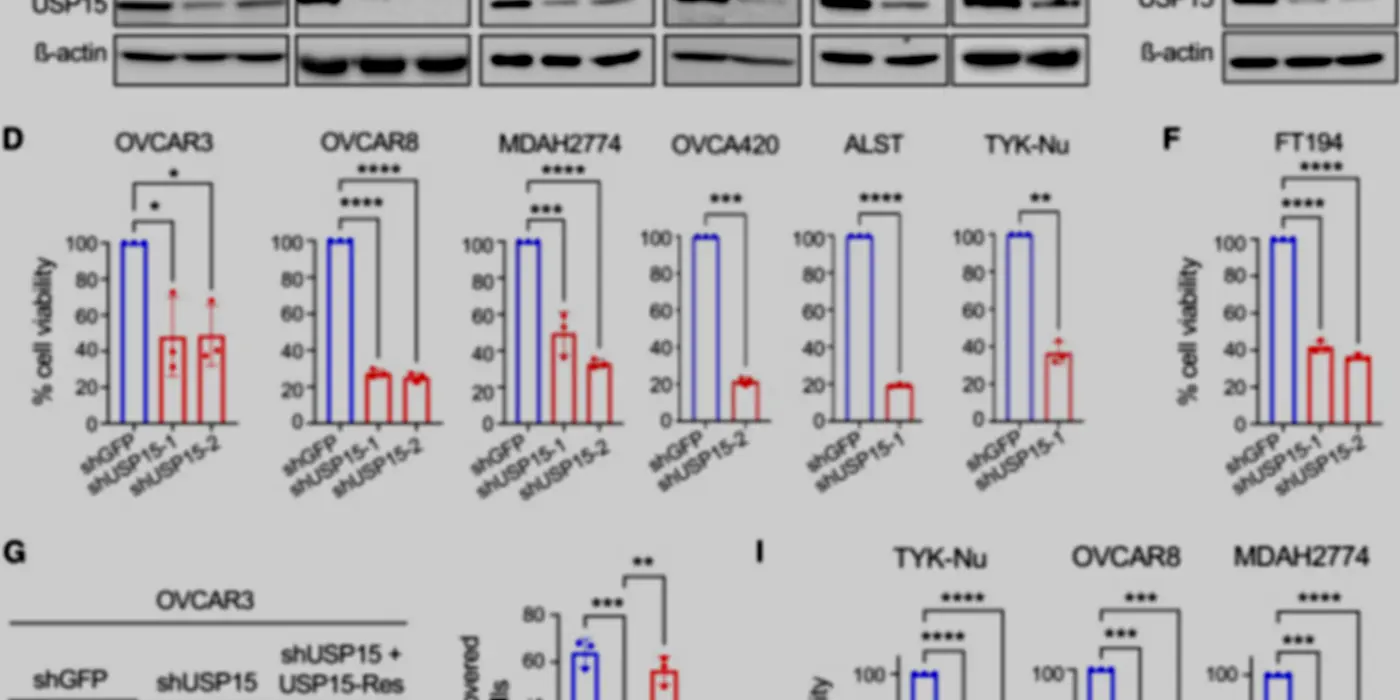
Enzyme USP15 Limits Ovarian Cancer Cells And Boosts Chemotherapy
Ovarian cancer is devastating, five-year survival rate under 30%, when detected after it has spread. New basic research may improve that.
Ovarian cancer is devastating, five-year survival rate under 30%, when detected after it has spread. New basic research may improve that.


Consumers who choose what they eat based on nutrition labels may think they're making healthy choices, but new research published in the Journal of the American Dietetic Association indicates that those familiar labels may be greatly underestimating the number of calories in restaurant and packaged food. Measured energy values of 29 quick-serve and sit-down restaurant foods averaged 18% more calories than the stated values. Likewise, measured energy values of 10 frozen meals purchased from supermarkets averaged 8% more calories than stated on the label.
Patients with chronic hepatitis C virus (HCV) who consume more than 308 mg of caffeine daily have milder liver fibrosis, according to a study featured in the January 2010 issue of Hepatology. The daily amount of caffeine intake found to be beneficial was equivalent to 2.25 cups of regular coffee, and other sources of caffeine beyond coffee did not have the same therapeutic effect.

Using NASA's Hubble Space Telescope, astronomers have broken the distance limit for galaxies by uncovering a primordial population of never-before-seen ultra-blue galaxies. At 13 billion years old, they formed approximately 600 to 800 million years after the Big Bang. Researchers say these newly found objects are crucial to understanding the evolutionary link between the birth of the first stars, the formation of the first galaxies, and the sequence of evolutionary events that resulted in the assembly of our Milky Way and the other "mature" elliptical and majestic spiral galaxies in today's universe.
Despite the stereotype that girls aren't very good with numbers, it appears that they're just as proficient as boys when it comes to mathematics, and girls from countries where gender equity is acceptable are more likely to perform better on mathematics assessment tests. The findings are detailed in the latest issue of Psychological Bulletin. "Stereotypes about female inferiority in mathematics are a distinct contrast to the actual scientific data," said Nicole Else-Quest, PhD, a psychology professor at Villanova University, and lead author of the meta-analysis. "These results show that girls will perform at the same level as the boys when they are given the right educational tools and have visible female role models excelling in mathematics."
According to a new study published in this month's Genomics journal, so called 'junk' DNA may help doctors diagnose breast and bowel cancer. Researchers from the University of Nottingham discovered that a group of genetic rogue elements--called chimeric transcripts--produced by 'junk' DNA sequences are more common in breast cancer cells. Five were only present in
breast cancer cells while two were found in both normal and breast
cancer cells.These chimeric transcripts are produced by DNA sequences called LINE-1 (L1). Despite being labelled as 'junk DNA' it is clear that some of these sequences have important roles in the genome, such as influencing when genes are switched on.
While communicating with out hands is often considered strange (or even rude) today, gesturing may actually improve our communication abilities, according to research conducted by an international team of scientists and published in a recent issue of Psychological Science. The authors say the finding has important social implications for "everyday communicative situations," like political speeches and classroom lectures.
Researchers from the Mayo Clinic and the University of Iowa say that the key to bringing obesity under control is to make our muscle a little less efficient and they may have found a way to do it. In a new study in the January issue of Cell Metabolism, the team discusses the possibility that treatments designed to disrupt so-called sarcolemmal ATP-sensitive K+ (KATP) channels specifically in muscles might allow us to control our weight by increasing the number of calories our muscles will burn with regular activity or exercise.
Using insect cells, scientists in Vienna have developed an alternative method for producing the H1N1 vaccine. The researchers say the discovery, detailed in the Biotechnology Journal, will aid the fight against influenza pandemics by speeding up production and making it easier to meet the demand for vaccines. "Recent outbreaks of influenza highlight the importance of a rapid and sufficient vaccine supply for pandemic and inter pandemic strains," said co-author Florian Krammer from the University of Natural Resources and Applied Life Science in Vienna. "However, classical manufacturing methods for vaccines fail to satisfy this demand."
By studying unknown high-energy sources detected by NASA's Fermi Gamma-ray Space Telescope, radio astronomers have uncovered 17 millisecond pulsars in our galaxy. The discovery was made in less than three months, and such a jump in the pace of locating these hard-to-find objects holds the promise of using them as a kind of "galactic GPS" to detect gravitational waves passing near Earth.
In their quest to find solar systems analogous to ours own, astronomers have determined how common our solar system is--not very. In a study presented today at the American Astronomical Society Meeting in Washington, DC, Ohio State researchers explained that approximately 10 percent of stars in the universe host systems of planets like our own, with several gas giant planets in the outer part of the solar system."Now we know our place in the universe," said Ohio State University astronomer Scott Gaudi. "Solar systems like our own are not rare, but we're not in the majority, either."
Writing in the American Journal of Physical Anthropology, a team of researchers says that testing hair from Asian monkeys living close to people may provide early warnings of toxic threats to humans and wildlife.In parts of South and Southeast Asia, macaques and people are synanthropic, which means they share the same ecological niche. They drink from identical water sources, breathe the same air, share food sources, and play on the same ground."Macaques are similar to humans anatomically, physiologically and behaviorally," said the senior author on the study, Dr. Lisa Jones-Engel, a senior research scientist at the National Primate Research Center at the University of Washington in Seattle.
Children whose parents refuse to vaccinate them are nine times more likely to get chickenpox compared to fully immunized children, according to a new study led by a vaccine research team at Kaiser Permanente Colorado's Institute for Health Research. The study was published today in the January issue of the journal Archives of Pediatrics&Adolescent Medicine.To assess the risk of varicella vaccine refusal, researchers reviewed the electronic health records of 86,993 children between the ages of 12 months and 8 years who were members of Kaiser Permanente Colorado between 1998 and 2008. First, investigators confirmed which childrenhad varicella infections. Next, they verified whether parents had refused some or all varicella vaccines for their children.