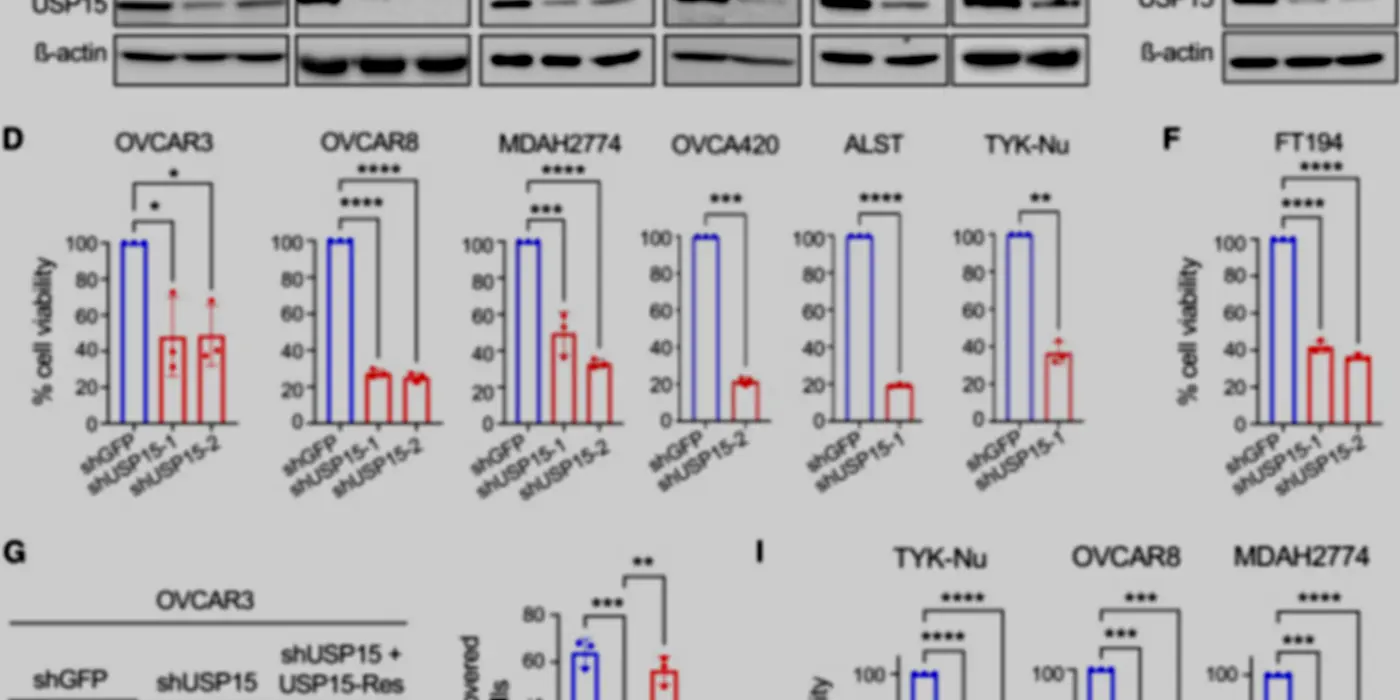
Enzyme USP15 Limits Ovarian Cancer Cells And Boosts Chemotherapy
Ovarian cancer is devastating, five-year survival rate under 30%, when detected after it has spread. New basic research may improve that.
Ovarian cancer is devastating, five-year survival rate under 30%, when detected after it has spread. New basic research may improve that.


Universities, with a young constituency and an employee base of academics interested in new discoveries and ways of communication, should have embraced social media early - but they have not and if they don't embrace new techniques in pedagogy they risk becoming seen as anachronisms in today’s hyper-connected world where information is available freely, says a University of Illinois expert who studies the knowledge economy’s effect on higher education.
Earthstock, Stony Brook University’s 8th annual week long awareness-raising celebration of Earth Day, kicks off at 10 am on Friday, April 17 with a full day of entertainment, food, refreshments, environmentally-oriented activities and visual displays situated all around the Academic Mall.
It is a fact of science that people who consume fewer calories than they burn will lose weight. It is 100 percent effective. But it is equally well-known that some people cannot do that and neuroscience has yet to find a reasonable explanation for it.For those who truly cannot lose weight by a disciplined approach to diet and exercise, surgery is a last resort but Nick Nicholson, M.D., weight loss surgeon on the medical staff at Baylor Regional Medical Center at Plano, says outside the usual benefits, surgery can actually improve other health conditions. Here are 5 other improvements weight loss surgery can bring:
If words were people, then "eloquent," "love" and "symphony" would get dates most Friday nights but "vomit," "moist" and "puke" would stay home alone, wondering what went wrong. How are words pretty or ugly? That's the question Robert E. Wolverton Sr., a Mississippi State University classics professor, recently asked in a survey of some 75 students in his classes. The poll is part of the foreign language faculty member's "semi-frequent" examination of how students at the land-grant university view widely used terms. Of the 148 different "beautiful" words submitted by students this year are several listed multiple times: eloquent (six), love (four) and symphony (four). Beautiful, lavender and tranquility each received three mentions.

A magnitude 8.0. earthquake destroyed 90 percent of the city of Pisco, Peru on August 16, 2007. The event killed 595 people, while another 318 were missing. Tsunami waves were observed locally, off the shore of Chile, and as far away as New Zealand. In a study published in the Geophysical Journal International, scientists from the University of Miami's Rosenstiel School of Marine and Atmospheric Science, in collaboration with scientists from the University of Oxford (U.K.) have analyzed data on this earthquake and its impact on regional topography. Using InSAR-based geodetic data and teleseismic data, the scientists were able to use satellite images to identify details of this major plate boundary event.
The skills learned while raising a family are readily transferable into the knowledge work environment, according to a study published in the International Journal of Knowledge and Learning.Researchers in Spain suggest that breaching the boundary between parenting skills and conventional work skills represents not only an untapped human resource but could improve work-life balance for working parents.

A protein that the heart produces during its early development reactivates the embryonic coronary developmental program and initiates migration of heart cells and blood vessel growth after a heart attack, researchers at UT Southwestern Medical Center have found.The molecule, Thymosin beta-4 (TB4), is expressed by embryos during the heart's development and encourages migration of heart cells. The new findings in mice suggest that introducing TB4 systemically after a heart attack encourages new growth and repair of heart cells. The research findings indicate that the molecule affects developmental gene expression as early as 24 hours after systemic injection. The study will appear in an upcoming issue of the Journal of Molecular and Cellular Cardiology.

A research team say they have found a sample of massive galaxies with properties that suggest that they may have formed relatively recently, which runs counter to the widely-held belief that massive, luminous galaxies (like our own Milky Way) began their formation and evolution shortly after the Big Bang, some 13 billion years ago. Further research into the nature of these objects could open new windows into the study of the origin and early evolution of galaxies.
New research from Vanderbilt University has found students benefit more from being taught the concepts behind math problems rather than the exact procedures to solve the problems. The findings offer teachers new insights on how best to shape math instruction to have the greatest impact on student learning.The research by Bethany Rittle-Johnson, assistant professor of psychology and human development at Vanderbilt University's Peabody College and Percival Mathews, a Peabody doctoral candidate, is in press at the Journal of Experimental Child Psychology.
Researchers have reported that they have been able to determine the molecular structure of a plant photolyase protein that is surprisingly similar to two cryptochrome proteins that control the "master clock" in humans and other mammals. They have also been able to test how structural changes affect the function of these proteins.

The central African belt is a fascinating look back in time for humanity because the largest group of hunter–gatherers of Africa, the Pygmies, still inhabit the region and they coexist with neighboring farmers. All African Pygmies, inhabiting a large territory extending west-to-east along Central Africa, descend from a unique population who lived around 20,000 years ago, according to an international study led by researchers at the Institut Pasteur in Paris. The research concludes that the ancestors of present-day African Pygmies and neighboring farmers separated ~60,000 years ago.
A natural, biological pacemaker; that's what a heart is, right? Sure, but our hearts can wear out and while artificial heart pacemakers have saved and extended the lives of thousands of people, but they have their shortcomings – such as a fixed pulse rate and a limited life.Could a permanent replacement biological solution be in our future? Richard Robinson and colleagues at New York's Columbia and Stony Brook Universities certainly think so, and their work published in the latest issue of The Journal of Physiology outlines how we can bring it a step closer to reality.