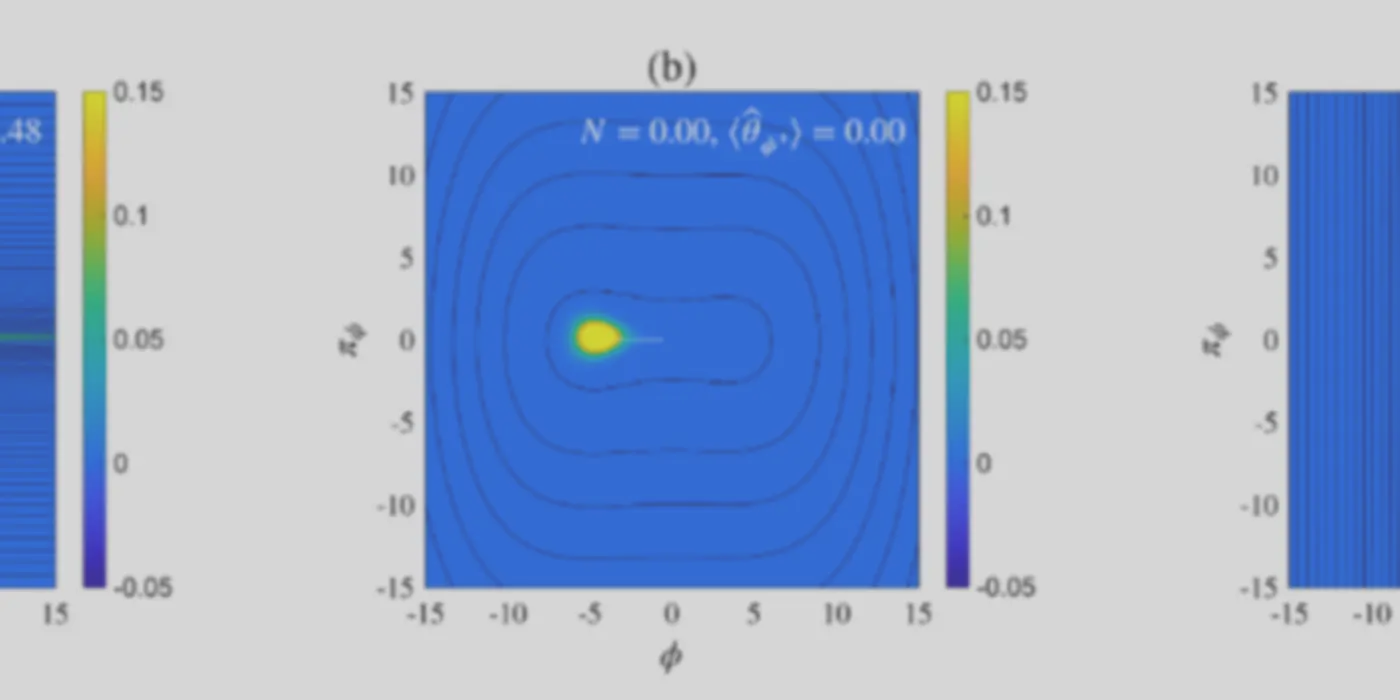
Sorry Higgs, There May Be A New Contender For Low Energy States
If we're trapped in a false vacuum, there's still hope to break free of cosmic lockdown
If we're trapped in a false vacuum, there's still hope to break free of cosmic lockdown


When it comes to embryo formation in the lowly fruit fly, a little molecular messiness actually leads to enhanced developmental precision, according to a study in the Oct. 14 Developmental Cell from Cincinnati Children's Hospital Medical Center.
While the fundamentals of this tiny bug's reproductive biology may seem insignificant, one day they could matter quite a bit to humans. That's because the study provides new information about how cells choose their own fates, especially in maintaining the size relationship and proportionality of body parts during embryonic development, said Jun Ma, Ph.D., a researcher in the divisions of Biomedical Informatics and Developmental Biology at Cincinnati Children's and the study's corresponding author.
By mopping up excess neurotrophic factor from neuronal synapses, astrocytes may finely tune synaptic transmission to affect processes such as learning and memory, say Bergami et al.
The major cellular events of learning and memory are long-term potentiation (LTP) and long-term depression (LTD), both of which affect neurons' ability to communicate with one another. Neurons that have undergone LTP display a stronger electrical response to the same level of a stimulus, whereas neurons that have gone through LTD display a weaker response. These changes are thought to result from modifications of the neuronal synapses, such as alterations in the density of postsynaptic receptors, or downstream signaling events.
The transportation of antibodies from a mother to her newborn child is vital for the development of that child's nascent immune system.
Those antibodies, donated by transfer across the placenta before birth or via breast milk after birth, help shape a baby's response to foreign pathogens and may influence the later occurrence of autoimmune diseases.
Images from biologists at the California Institute of Technology (Caltech) have revealed for the first time the complicated process by which these antibodies are shuttled from mother's milk, through her baby's gut, and into the bloodstream, and offer new insight into the mammalian immune system.
Chicken soup isn't just good for the common cold and, apparently, our souls, that popular home remedy so ubiquitous it is sometimes known as "Grandma's Penicillin" may also have a new role alongside medication and other medical measures in fighting high blood pressure, scientists in Japan are reporting. Their research is in the Journal of Agricultural and Food Chemistry.
Ai Saiga and colleagues cite previous studies indicating that chicken breast contains collagen proteins with effects similar to ACE inhibitors, mainstay medications for treating high blood pressure. But chicken breast contains such small amounts of the proteins that it could not be used to develop food and medical products for high blood pressure. Chicken legs and feet, often discarded as waste products in the U.S. but key soup ingredients elsewhere, appear to be a better source.
Heavy industry takes a lot of blame for greenhouse gas emissions but at least one segment may be able to do something to give a little back. Steelworks around the world emitting large quantities of carbon dioxide but scientists report that a byproduct of steel production could be used to absorb that greenhouse gas and help control global warming. The study is in Industrial & Engineering Chemistry Research.
Professor Mourad Kharoune and colleagues point out that production of one ton of steel releases up to one ton of CO2. With global steel production standing at 1.34 billion tons in 2007, that adds up to a substantial contribution of carbon dioxide.
Kharoune suggests a new method to sequester, or capture, carbon dioxide so that it does not contribute to global warming – using steel slags, which are complex mixtures of compounds produced during the separation of the molten steel from impurities.
Scientists have found a new possible explanation for why people who eat more fruit and vegetables may gain protection against the spread of cancers; a fragment released from pectin, found in all fruits and vegetables, that binds to and may inhibit galectin 3 (Gal3), a protein that plays a role in all stages of cancer progression.
Population studies such as EPIC, the European Prospective Investigation of Cancer, identified a strong link between eating lots of fibre and a lower risk of cancers of the gastrointestinal tract. But exactly how fibre exerts a protective effect is unknown.
Pectin is better known for its jam-setting qualities and as being a component of dietary fibre. The present study supports a more exciting and subtle role.
Scientists have discovered that a bone infection is caused by a newly described species of bacteria that is related to the tuberculosis pathogen. The discovery may help improve the diagnosis and treatment of similar infections, according to an article published in the International Journal of Systematic and Evolutionary Microbiology.
Some rare genetic diseases can make patients susceptible to infections with Mycobacterium species, the bacteria that amongst other diseases, cause tuberculosis and leprosy. These patients often suffer from recurring mycobacterial infections throughout their whole lives. Because of this, researchers are trying to identify unusual species that cause disease in order to improve treatment strategies.
Scientists at Bonn and Düsseldorf Universities investigated over 500,000 positions in the human genome and found a gene variant which occurs clearly more frequently in bald men than in control persons. This means they have found a new hair loss gene, according to their study in Nature Genetics.
In 2005, these scientists had already characterized the first hair-loss gene inherited through the maternal line, which explained why hair-loss in men often reflects that of their maternal grandfathers. This newly discovered gene, on the other hand, may now account for the similarity in cranial hair growth between father and son.
Would you ever have thought there could be anyone considered an expert on the political impact of late-night comedy shows on candidates? Us either, but that's the claim.
American University says Lauren Feldman is that expert and in her real job she is an assistant professor at American University’s School of Communication. Feldman did an analysis of the 2004 election and the results say Tina Fey’s humorous impersonations of vice presidential candidate Sarah Palin on Saturday Night Live (SNL) could be doing real damage to the McCain campaign in the 2008 election. Even if they aren't, it's a good rumor to start.

To get from one cell to a complex organism, cells have to divide, travel around the body and arrange intricate shapes and specialized tissues. The best way to understand these dynamic processes is to look at what happens in the first few hours of life in every part of an embryo. While this is possible with invertebrates with a few hundred cells, like worms, it was previously impossible to achieve for vertebrates.
“Imagine following all inhabitants of a town over the course of one day using a telescope in space. This comes close to tracking the 10 thousands of cells that make up a vertebrate embryo – only that the cells move in three dimensions,” says Philipp Keller. Together with Annette Schmidt he carried out the research in the labs of Jochen Wittbrodt and Ernst Stelzer at the European Molecular Biology Laboratory (EMBL).

Unmanned helicopters could soon be a key part of emergency relief operations, as well as bringing a new dimension to filmmaking, thanks to innovative work done by European researchers.
When natural disasters happen one of the first casualties is often the communications network. As a result, rapid response crews can be working virtually blind, cut off from each other and the victims they are trying to help. Where there are transport arteries, such as roads, rivers and railways, they are also very often damaged or disrupted, which makes getting medical and relief supplies to survivors extremely difficult.
When such disasters happen in remote areas with little in the way of communications or transport infrastructure to start with, the problem is exacerbated. A solution for both the communications and delivery of supplies problems is now being researched in an EU-funded project, called AWARE, which comprises academic and commercial partners from five European countries.
Humans have a built-in weapon against HIV, but until recently no one knew how to unlock its potential. A study published in Nature reveals the atomic structure of this weapon, an enzyme known as APOBEC-3G, and suggests new directions for drug development.
APOBEC-3G is present in every human cell. It is capable of stopping HIV at the first step of replication, when the retrovirus transcribes its RNA into viral DNA.
The study's authors, led by Xiaojiang Chen of the University of Southern California, were able to show the atomic structure of the active portion of APOBEC-3G.