Brain Circuit Linked To Pregnancy Food Cravings Identified
Pregnant women have experienced exotic food cravings since recorded history began. This may be why.
Pregnant women have experienced exotic food cravings since recorded history began. This may be why.


Carnegie Mellon University's Philip LeDuc predicts the use of artificially created cells could be a potential new therapeutic approach for treating diseases in an ever-changing world. LeDuc, an assistant professor of mechanical and biomedical engineering, penned an article for the January edition of Nature Nanotechnology Journal about the efficacy of using man-made cells to treat diseases without injecting drugs.
This idea was developed by a team of researchers from disciplines including biology, chemistry and engineering during an exciting conference organized by the National Academies and the Keck Foundation for developing new disease-fighting approaches for the future.

Researchers at the National Institute of Standards and Technology (NIST) have developed a sensitive new method for rapidly assessing the quality of carbon nanotubes. Initial feasibility tests show that the method not only is faster than the standard analytic technique but also effectively screens much smaller samples for purity and consistency and better detects sample variability.
A new NIST method for rapidly assessing the quality of carbon nanotubes was evaluated in part by comparing the results to electron micrographs, which revealed uneven composition such as large bundles of nanotubes and impurities such as metallic particles. (Color added.) (Credit: NIST)

The climate system, and in particular sea level, may be responding more quickly to rising carbon emissions than climate scientists have estimated with climate models.
An international team of climate scientists has cautioned against suggestions that the Intergovernmental Panel on Climate Change (IPCC) has previously overestimated the rate of climate change.
The team, from six institutions around the world, reviewed actual observations of carbon dioxide, temperature and sea level from 1990 to 2006 and compared them with projected changes for the same period.
CSIRO Marine and Atmospheric Research and Antarctic Climate and Ecosystems CRC scientist, Dr. John Church.

For Duke University theoretical chemist David Beratan, the results of his 15 years of studying how electrons make their way through some important protein molecules can be summed up with an analogy: how do big city dwellers get from here to there?
It's often swiftest to take the subway, Beratan notes, but riders may sometimes elect to alter their route by exiting the train for a short cab ride or a walk down the street. And they also may have to work around a route that is temporarily out of service.
David Beratan poses with subway route map. (Photo Credit: Megan Morr)
MORGANTOWN, W.Va., Feb. 5 (UPI) -- U.S. scientists are using a computer program to develop an objective method of determining when a boxing match should be stopped.
The researchers at West Virginia University say a computerized approach to counting punches at ringside identifies certain characteristics related to deaths in the ring.
"This approach could provide sufficient data to stop matches that might result in fatalities," said Drs. Vincent Miele and Julian Bailes of West Virginia University School of Medicine.
Miele and Bailes performed a computer-assisted video analysis to compare three groups of professional boxing matches.
Expectant parent' desire to see images of their unborn children has given rise to commercial companies offering keepsake ultrasound scans without medical supervision, often referred to as "boutique ultrasonography."
In a special report in this week's British Medical Journal, journalist Geoff Watts considers whether this non-medical use of the technique can be justified.
Improvements in ultrasound technology have transformed antenatal scans from two dimensional black and white images to 3D, 4D and even moving pictures of the unborn child.
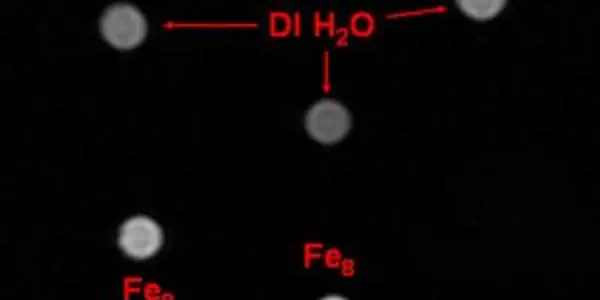
Nanoscale magnets in the form of iron-containing molecules might be used to improve the contrast between healthy and diseased tissue in magnetic resonance imaging (MRI)--as long as the concentration of nanomagnets is carefully managed--according to a new report* by researchers at the National Institute of Standards and Technology (NIST) and collaborators. Molecular nanomagnets are a new class of MRI contrast agents that may offer significant advantages, such as versatility in design, over the compounds used today.
NIST studies show that molecular nanomagnets create concentration-dependent contrast in magnetic resonance imaging (MRI).

The time is ripe for scientific organizations to adopt codes of ethics, according to a scientist and bioethicist from Wake Forest University School of Medicine in the current issue of Science and Engineering Ethics.
"Medical practice and human subject research is influenced by the Hippocratic tradition," said Nancy L. Jones, Ph.D., "but no similar code of ethics has been formalized for the life and biomedical sciences.

Carbon dioxide, a greenhouse gas that has become a bane of modern society, may have saved Earth from freezing over early in the planet's history, according to the first detailed laboratory analysis of the world's oldest sedimentary rocks.
Scientists have theorized for years that high concentrations of greenhouse gases could have helped Earth avoid global freezing in its youth by allowing the atmosphere to retain more heat than it lost.
A novel experiment conducted by Carnegie Mellon University Professor George Loewenstein and colleagues may explain why people try a drug, such as heroin, for the first time despite ample evidence that it is addictive. The results of the study, which are being published in the Journal of Health Economics, reveal that even longtime addicts underestimate the influence that drug cravings have over their behavior.
Almost all drugs produce a craving in their users. Loewenstein and his colleagues hypothesized that people experiment with drugs that they know are addictive in part because they can't appreciate the intensity of drug cravings, and thus underestimate the likelihood that they will become addicted.
A novel experiment conducted by Carnegie Mellon University Professor George Loewenstein and colleagues may explain why people try a drug, such as heroin, for the first time despite ample evidence that it is addictive. The results of the study, which are being published in the Journal of Health Economics, reveal that even longtime addicts underestimate the influence that drug cravings have over their behavior.
Almost all drugs produce a craving in their users. Loewenstein and his colleagues hypothesized that people experiment with drugs that they know are addictive in part because they can't appreciate the intensity of drug cravings, and thus underestimate the likelihood that they will become addicted.

Peering backward in time to an instant after the big bang, physicists at the University of Wisconsin-Madison have devised an approach that may help unlock the hidden shapes of alternate dimensions of the universe.
A new study demonstrates that the shapes of extra dimensions can be "seen" by deciphering their influence on cosmic energy released by the violent birth of the universe 13 billion years ago. The method, published today (Feb.