You Feel Colder As You Age: The Science Reason Why
Older people report feeling colder, enough that it is clearly happening, but why has been a mystery. Until now.
Older people report feeling colder, enough that it is clearly happening, but why has been a mystery. Until now.

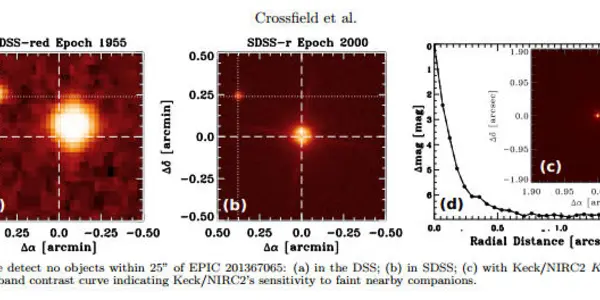
NASA's Kepler Space Telescope has been hobbled by the loss of critical guidance systems but can still find good stuff - most recently a star with three planets only slightly larger than Earth, one in the "Goldilocks" zone, a region where surface temperatures could be moderate enough for liquid water and therefore perhaps life as we know it, to exist.EPIC 201367065, is a cool red M-dwarf star about half the size and mass of our own sun. It is 150 light years, making it among the top 10 nearest stars known to have transiting planets. The star's proximity means it's bright enough for astronomers to study the planets' atmospheres to determine whether they are like Earth's atmosphere and possibly conducive to life.

The Beagle-2 Mars lander,hitched a ride on ESA’s Mars Express mission in 2003 and was released from the mothership on December 19th with a planned landing 6 days later. Then it was lost. Mars Express and NASA’s Mars Odyssey found nothing. But now the high-resolution camera on NASA’s Mars Reconnaissance Orbiter has found it on the surface. The good news is engineers now know that at least the entry, descent and landing sequence worked and it did indeed successfully 'land' on Mars on Christmas Day 2003. Beagle-2 was less than 2 meters across when fully deployed so catching sight of it was right at the limit of the resolution of cameras in orbit around Mars.

Using simulation, such as wearing a blindfold while performing everyday tasks, has negative effects on people's perceptions of the visually impaired, according to a recent paper.
In one part of the study, after simulating blindness by having their eyes covered, participants believed people who are blind are less capable of work and independent living than did participants who simulated other impairments like amputation, or had no impairment.
There is a gender gap in some fields of academia. Some are skewed heavily toward women and some are skewed heavily toward men, though some have too little variation to be meaningful.But why are there any gaps at all? Various explanations have been offered, from the bizarre - sexism among the liberals who dominate academia - to the more bizarre - the belief among those same academic leaders that women are less analytical than men. The most popular explanation is that women are the only gender that can give birth and after that they work less hours and that penalizes them in faculty and tenure hiring. Family-friendly policy is the only area of academia where people wish it was more like the corporate world.
Last week's terrorist attacks in Paris were religiously-based and they have brought to the fore an issue that France, and most of Europe, had chosen to ignore: determining how prevalent religious fundamentalism is.A new paper says that creating Muslim zones where outsiders were not allowed is not the problem, nor is Muslim hostility toward 'out groups', like non-Muslims, and the attacks on the Charlie Hebdo office by the terrorists was not even attacking people who made fun of religion, or even western religion, it was instead an attack on the religious values of peace-loving Muslims, according to sociologist Ruud Koopmans, director of the WZB Berlín Social Science Centre in Germany, writing in the Journal of Ethnic and Migration Studies.

Most people know that our biological functions use a circadian system comprised of a central clock located deep within the center of our brains and multiple clocks located in different parts of the body. When people fly to the other part of the world or work a night shift, those different biological clocks have not adjusted and so we get things like 'jet lag'. A small study may open new therapeutic avenues for improving the synchronization of the body's different biological clocks.
A new white paper finds little to no evidence for the effectiveness of opioid drugs in the treatment of long-term chronic pain, despite the explosive recent growth in the use of such drugs. The paper, which constitutes the final report of a seven-member panel convened by the
National Institutes of Health
last September, finds that many of the studies used to justify the prescription of these drugs were either poorly conducted or of an insufficient duration. That makes prolific use of these drugs surprising, says Dr. David Steffens, chair of the psychiatry department at the University of Connecticut and one of the authors of the study. When it comes to long-term pain, he says, "there's no research-based evidence that these medicines are helpful."
A new paper says that human civilization has crossed four of nine so-called planetary boundaries as the result of human activity that put humanity in a "safe operating space." The four that are already beyond that point-of-no-return are climate change, the loss of biosphere integrity, land-system change, and altered biogeochemical cycles like phosphorus and nitrogen runoff. That makes us 44 percent of the way on the path to doom.It should be a wake-up call to policymakers that "we're running up to and beyond the biophysical boundaries that enable human civilization as we know it to exist," says co-author Steve Carpenter, director of the University of Wisconsin-Madison Center for Limnology.
Brownbanded bamboo sharks take the term "resourceful" to a whole new level. Biologists have found that a shark egg case dropped by an adult bamboo shark showed signs of healthy development. What surprised them was that the aquarium's female Chiloscyllium punctatum adults had spent nearly four years--45 months--in complete isolation from males.
Everyone who has lived in snow knows it is not as white as it looks - it's rarely white at all. Mixed in with the reflective flakes are tiny, dark particles of pollution. University of Washington scientists recently published the first large-scale survey of impurities in North American snow to see whether they might absorb enough sunlight to speed melt rates and influence climate.
The results, published in the Journal of Geophysical Research, show that North American snow away from cities is similar to Arctic snow in many places, with more pollution in the U.S. Great Plains. They also show that agricultural practices, not just smokestacks and tailpipes, may have a big impact on snow purity.
A team of researchers has demonstrated the therapeutic potential of triheptanoin in ten patients with Huntington's disease. Derivatives of this triglyceride, with its unique composition, might be able to slow the progression of the disease by improving the energy metabolism of the brain. This research is published in the journal Neurology.
Huntington's disease is a genetic disease that affects approximately 5,000 people in France, with another 10,000 individuals at risk of developing it. Mutation of the gene encoding the huntingtin protein results in a progressive degeneration of the neurons, especially in regions of the brain involved in the control of movement, thereby causing serious neurological, motor, cognitive and psychiatric problems.
A new paper believes that planets outside our solar system - exoplanets - may be a lot more agreeable to life than assumed. The astrophysicists suggest that exoplanets are more likely to have liquid water and be more habitable than we thought.Scientists have thought that exoplanets behave in a manner contrary to that of Earth - that is they always show their same side to their star. If so, exoplanets would rotate in sync with their star so that there is always one hemisphere facing it while the other hemisphere is in perpetual cold darkness.The new study suggests, however, that as exoplanets rotate around their stars, they spin at such a speed as to exhibit a day-night cycle similar to Earth.