Vampire Squid And The Evolution Of Cephalopod Sex
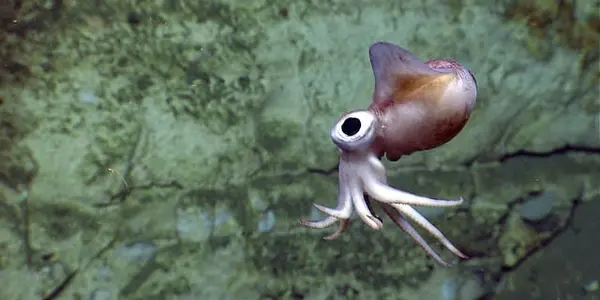
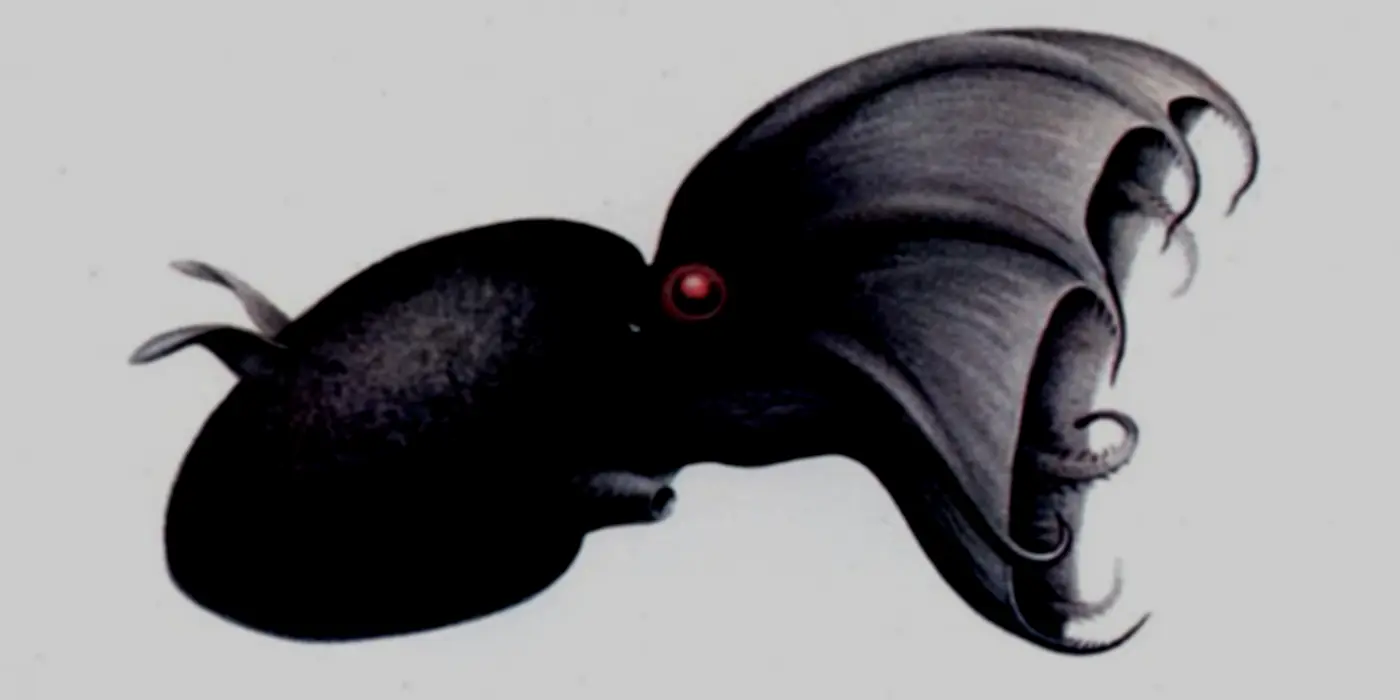
Everyone loves vampire squid, right? Their monstrous name belies their gentle nature as graceful underwater flyers who eat poop.
Everyone loves vampire squid, right? Their monstrous name belies their gentle nature as graceful underwater flyers who eat poop.

It's hard to make a good cartoon cephalopod, I guess. Yesterday I was disappointed about the Squidbillies. Tomorrow I may despair of Spongebob's pal Squidward. Today, I sigh over Nemo's little octopus friend Pearl.I was profoundly impressed with the combination of scientific accuracy and aesthetic appeal achieved by the writer and animators of Finding Nemo. I mean, that song Mr. Ray sings about naming the zones of the ocean? Total brilliance!
One of my favorite zoologist habits is to gesture on one's own body when describing an animal's anatomy. The weirder the animal, the funnier the implicit analogy."These worms have a ventral nerve cord," I explain, drawing a line from my collarbone to my navel. "This mollusc has gills on its dorsal surface," reaching over one shoulder to pat my back.Easy to do in front of a class, harder on the printed page. There we rely on diagrams to indicate dorsal (top), ventral (bottom), anterior (front), and posterior (back). For example, here's a squid:
This post is not even remotely about a cephalopod, but because I mentioned polyps yesterday I feel justified in discussing a cnidarian. Besides, these headlines really got me steamed, and what better place to vent than a blog?Enormous Jellyfish Sink Japanese Fishing Boat (Fox News)Japanese fishing trawler sunk by giant jellyfish (Telegraph)
After yesterday's cliffhanger, I suppose I should explain what it means for a squid to fly. Can they control their aerial trajectory? Can they gain altitude, once airborne, which is the definition of "true" flight?
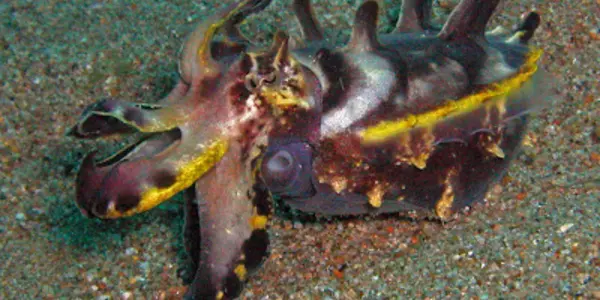
Speaking of cephalopods which have surprised by not being too heavy to fly after all, I was reminded of one little cuttlefish who is actually too heavy to swim: Metasepia pfefferi, or Pfeffer's Flamboyant Cuttlefish. With the scientist's charming penchant for repurposing ordinary adjectives, biologists describe the body of this little fellow as "robust," which means that it is chubby in all dimensions. It may sound insulting to keep calling it heavy and chubby, but actually these features make for a very cool trick.The Flamboyant doesn't swim and hover midwater like other cuttlefish. Instead, it crawls on the seafloor like an octopus.
The guys over at Deep-Sea News have organized an "Ocean Bloggers Challenge" to fund ocean-related education for classrooms in need. It's through a really nifty website called Donors Choose, which lets you see exactly where your money is going. The projects they've chosen for the challenge include sending students on an overnight sea voyage and setting up a classroom saltwater aquarium, among others.

Now that we're all convinced the Humboldt squid isn't going to eat you, let's turn the question around: can you eat the Humboldt squid?First, from the public health angle: Does it have mercury, everyone wants to know about any seafood, quickly followed by, I don't want nasty parasites.
I was going to write about this article in the Kitsap Sun, which highlighted my advisor's recent research trip off the WA coast. I thought that was pretty cool, but the article had a few science points confused, so I was going to clarify them. But then I got to the end of the article and was blown away by the most egregious mistake yet:Eggs have never been seen by researchers, but females probably hide their eggs in rocks, as other squid do.
I'm starting to suspect that my study organism, Dosidicus gigas, is a bit of a diva.It seems like every other day there's a news story on Humboldt squid, jumbo squid, or (my favorite!) giant squid. (D. gigas is still not a giant squid.) I haven't been covering all of these articles here because, well . . . I didn't want to be a diva by association.But this article is the most thorough I've seen yet, including all the interviews and topics that have been covered piecemeal in earlier articles, so it seemed like a good time to jump in and clarify a few items.
Did you know that Isabella Rossellini writes, co-directs, and stars in a show about reproductive behavior and conservation? The show is called Green Porno. Yes, really!It has just come to my attention that Season Three includes a squid episode! It's pretty awesome and only a few minutes long, so you should definitely go the website and check it out.If Isabella Rossellini were a squid, she claims:"Everyone would want to eat me." So true! Any marine predator (and even some terrestrial and avian predators) that can fit a squid in their mouth will happily devour these swimming protein bars.
I love it! As soon as I start whining about how humans are always exploiting resources without checking first for sustainability, along comes a story to prove me wrong. The Giant Pacific Octopus or GPO, who lives throughout the Pacific Northwest (if terrestrial terms) or Northeast (in oceanic terms), has never been the target of a federally managed commercial fishery. But occasionally people murmur about it, and some clever folks have decided that we'd better know a bit more about octopus biology before such a fishery (octopussery?) comes on the scene.
Proving myself wrong in record time (see comments on my first post, where I claimed I wouldn't be discussing squid recipes), today's squid is served with chiles, lime, and herbs.Why?The coincidence was just too good to pass up. Another commenter suggested that squid popularity these days isn't just a flash in the pan--and then a recipe blog in the Village Voice by that very name posts a squid dish!