You Feel Colder As You Age: The Science Reason Why
Older people report feeling colder, enough that it is clearly happening, but why has been a mystery. Until now.
Older people report feeling colder, enough that it is clearly happening, but why has been a mystery. Until now.


UCLA scientists have designed and mass-produced billions of fluorescent microscale particles in the shapes of all 26 letters of the alphabet in an “alphabet soup” displaying “exquisite fidelity of the shapes.”
The letters are made of solid polymeric materials dispersed in a liquid solution. The research will be published March 29 in the Journal of Physical Chemistry C, where it will be illustrated on the cover. The scientists anticipate that their “LithoParticles” will have significant technological and scientific uses.
“We can even choose the font style; if we wanted Times New Roman, we could produce that,” said study co-author Thomas G.

After years of results that repeatedly dogged him, University of Oregon geologist Douglas R. Toomey decided to follow the trail of data surfacing from the Pacific Ocean. In doing so, he and his collaborators may have altered long-held assumptions involving plate tectonics on the ocean floor.
Reporting in the March 22 issue of Nature, Toomey and co-authors from four other institutions propose that, one, the flow in the Earth's mantle is rotated beneath the East Pacific Rise, causing the plate boundary to change orientation with time. Secondly, they argue that deep-sea hydrothermal vents frequently form above volcanoes where upwelling of the mantle and spreading of the plates are aligned.

The inventors of self-healing plastic have come up with another invention: a new way of doing chemistry.
Researchers at the University of Illinois at Urbana-Champaign have found a novel way to manipulate matter and drive chemical reactions along a desired direction. The new technique utilizes mechanical force to alter the course of chemical reactions and yield products not obtainable through conventional conditions.
An overlay of images at successive stages of force-induced chemical change. The blue image is the start of the reaction. The yellow image represents the end of the reaction. Graphic by Ashley Levato

Research funded by Metallica?
Gifted students who feel the pressure of their ability could be using Heavy Metal music to get rid of negative emotions.
This is the conclusion of Stuart Cadwallader and Professor Jim Campbell of The National Academy for Gifted and Talented Youth at the University of Warwick. They will discuss their findings at the British Psychological Society’s Annual Conference at the University of York on Wednesday 21 March 2007.
Current methods used to sniff out dangerous airborne pathogens may wrongly suggest that there is no threat to health when, in reality, there may be.
But researchers have found a better method for collecting and analyzing these germs that could give a more accurate assessment of their actual threat. For example, the findings may make it easier to detect airborne pathogens in low concentrations.
Scientists from NOAA’s Earth System Research Laboratory (ESRL) announced today a new tool to monitor changes in atmospheric carbon dioxide and other greenhouse gases by region and source. The tool, called CarbonTracker, will enable its users to evaluate the effectiveness of their efforts to reduce or store carbon emissions.
The online data framework distinguishes between changes in the natural carbon cycle and those occurring in human-produced fossil fuel emissions. It also provides verification for scientists using computer models to project future climate change. Potential users include corporations, cities, states and nations assessing their efforts to reduce or store fossil fuel emissions around the world.
Engineers at Purdue University have designed and tested a "structural health monitoring" system to detect flaws that could hinder the performance of new types of military missiles made of composite materials instead of metal.
Missiles are sometimes damaged when struck by rocks and debris kicked up by helicopter rotors or when mishandled during shipping or maintenance.
Unlike missiles made of metallic alloys, which often show external signs of damage such as cracks or dents, damage in the new "filament wound" composite materials may not reveal telltale signs, said Douglas Adams, an associate professor of mechanical engineering.
Douglas Adams, an associate professor of
Women who undergo breast enlargement often see a sizable boost in self-esteem and positive feelings about their sexuality, a University of Florida nurse researcher reports.
Although plastic surgery should not be seen as a panacea for feelings of low self-worth or sexual attractiveness, it is important for health-care practitioners to understand the psychological benefits of these procedures, says Cynthia Figueroa-Haas, a clinical assistant professor at UF’s College of Nursing who conducted the study. The findings — which revealed that for many women, going bigger is better — appear in the current issue of Plastic Surgical Nursing.
In today’s online edition of Genome Research, a husband-and-wife research team from Thomas Jefferson University report the discovery of a gene that, when mutated, may suppress colorectal cancer. To conduct the study, the researchers used a strain of mice that develop polyps, or small growths of tissue, in the digestive tract—the harbingers of cancer. When these mice possessed one copy of the mutated gene, the incidence of small intestinal and colon polyps were reduced by about 90%.
“This gene may give us a novel target to aid in the diagnosis, prevention, and/or treatment of cancer,” says Dr. Arthur Buchberg, one of the co-senior authors on the report.
Generating electricity from renewable sources will soon become as easy as putting a brush and a tube in a tub of wastewater.
A carbon fiber, bottle-brush anode developed by Penn State researchers will provide more than enough surface for bacteria to colonize, for the first time making it possible to use microbial fuel cells for large scale electricity production. In addition, a membrane-tube air cathode, adapted from existing wastewater treatment equipment, will complete the circuit.
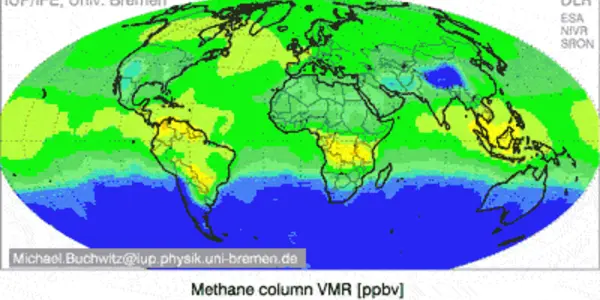
Based on three years of observations from the SCIAMACHY instrument aboard ESA's Envisat, scientists have produced the first movies showing the global distribution of the most important greenhouse gases – carbon dioxide and methane – that contribute to global warming.
The importance of cutting emissions from these 'anthropogenic', or manmade, gases has been highlighted recently with European Union leaders endorsing binding targets to cut greenhouse gases by at least 20 percent from 1990 levels by 2020. Further illustrating the urgency to combat global warming, Britain became the first country last week to propose legislation for cutting the gases.
Using lasers and tuning forks, researchers at Pacific Northwest National Laboratory have developed a chemical weapon agent sensing technique that promises to meet or exceed current and emerging defense and homeland security chemical detection requirements. The technique, called Quartz Laser Photo-Acoustic Sensing, or "QPAS," is now ready for prototyping and field testing.
PNNL, a Department of Energy national laboratory, has demonstrated QPAS's ability to detect gaseous nerve agent surrogates. In one test, researchers used diisopropyl methyl phosphonate (DIMP), which is a chemical compound that's similar to sarin. QPAS detected DIMP at the sub-part-per-billion level in less than one minute.