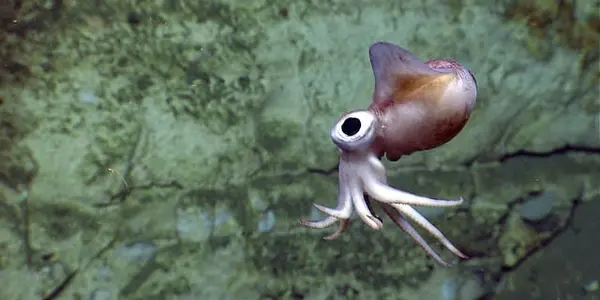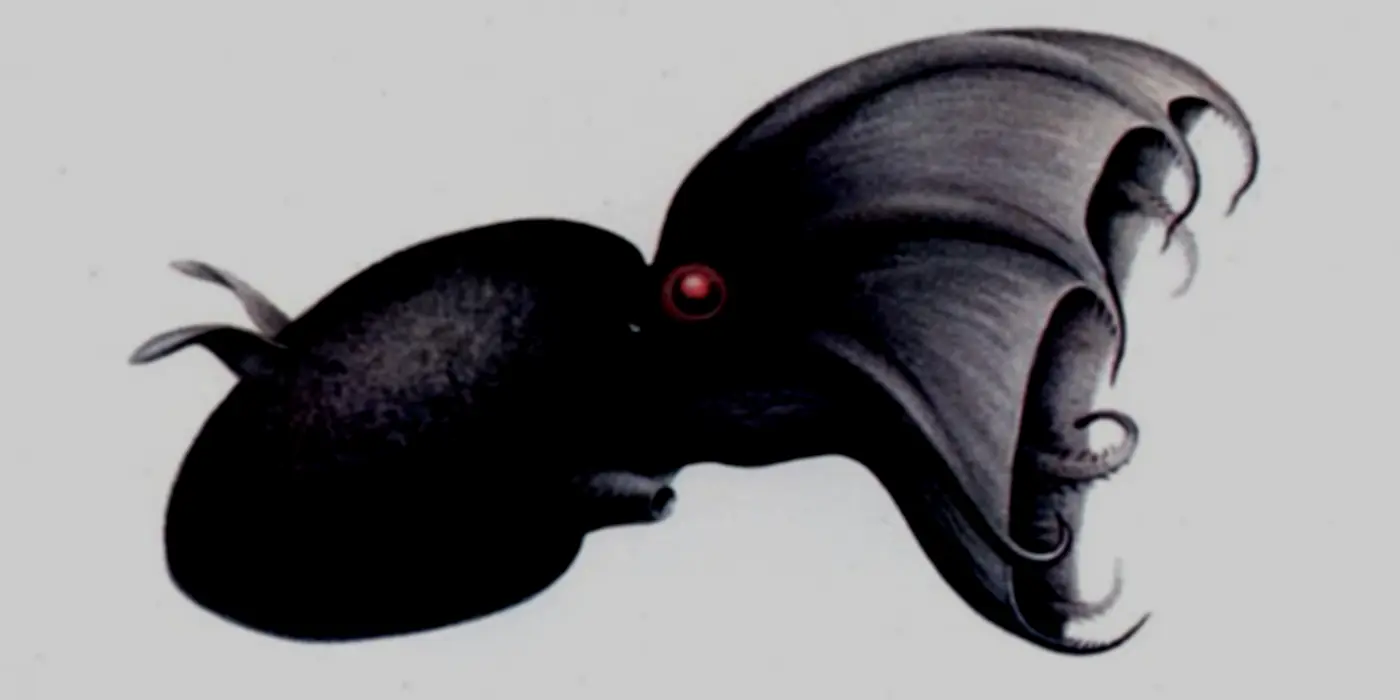
Vampire Squid And The Evolution Of Cephalopod Sex
Everyone loves vampire squid, right? Their monstrous name belies their gentle nature as graceful underwater flyers who eat poop.
Everyone loves vampire squid, right? Their monstrous name belies their gentle nature as graceful underwater flyers who eat poop.
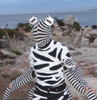

Dear squid blog, I am sorry that so many other projects have been keeping me from you lately! My love for squid remains undimmed. Just to prove it, I will share with the world a helpful chart that I drew several years ago and recently unearthed.The Humboldt squid (Dosidicus gigas) and the purpleback flying squid (Sthenoteuthis oualaniensis) can look very similar. If you're fishing in a location where only one of them lives (like Indonesia for Sthenoteuthis or California for Dosidicus), no problem. But in certain areas of the Pacific Ocean--oh look I have a map--their ranges overlap, so there is confusion. Panic. Mayhem. Which squid is it?

Usually "No Change in X" doesn't make a very splashy headline, but when the lack of change occurs over 160,000,000 years and X is squid ink, people get excited.And with good cause. This is the first time that ink from a fossil cephalopod has been analyzed chemically, and it turned out to be indistinguishable from modern cephalopod ink. One hundred and sixty million years. No change.

My very first mentor in cephalopod research was Eric Hochberg at the Santa Barbara Museum of Natural History. I think I was seventeen when he welcomed me into the museum's secret catacombs (at least, that's how I thought of them) of preserved specimens. Awe washed over me as I stared at shelves upon shelves of jarred octopuses.Eric introduced me to the California pygmy octopus, Octopus micropyrsus, which would proceed to fascinate me for the rest of my undergraduate career. I saw more of them in jars than I ever did alive, though I kept doggedly digging through kelp holdfasts trying to find them. Reclusive little beasts.

I may have mentioned before that squid fishermen of the Falkland Islands go after two very different species: Illex argentinus, the shortfin squid, an open-ocean animal that migrates between Falkland and Argentinian waters, and Loligo gahi, the Patagonian squid, which is present in both Falkland and Argentinian waters but doesn't move much between the two.

It's called Knowledge and it's a short story by John Frizell in Nature. Did you know that Nature publishes short stories, one at the back of every issue? They do!No human could have grasped the squid's name. Human eyes could not distinguish the differences in shades of colour or register the intervals at which they changed to define the unique pattern that was his name. The squid was concentrating hard because he was holding two conversations at once, one deliberately misleading, the other closer to the truth, as he glided through the deep ocean, his mantle pulsing gently, powering him with puffs of water.
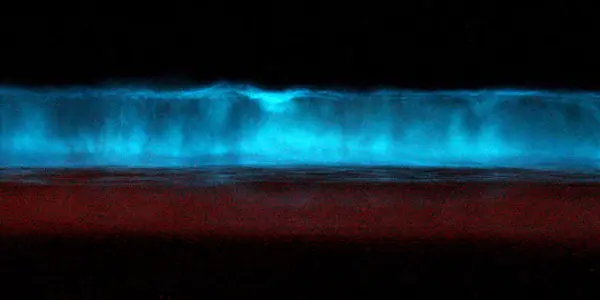
The world's biggest squids (accurately named "giant" and "colossal") have the world's biggest eyes, which may seem like a no-brainer until you consider that they are by no means the world's biggest animals. And yet, their eyes are more than twice the size of a blue whale's. Why?A group of Swedish, American, and Israeli scientists (gotta love that multicultural research!) suggests that big squid need big eyes to see their big predators--sperm whales. Specifically, big eyes are great for spotting the luminous clouds kicked up by sperm whales as they jostle the bioluminescent plankton of the deep.
Thanks to my awesome brother, I have now acquired and read the full text of the paper I blogged about yesterday: "Purification and in vitro antioxidative effects of giant squid muscle peptides on free radical-mediated oxidative systems."I was promptly horrified by the authors' two-sentence background about the animals whose skin they were studying:

UPDATE: I've learned more about how antioxidants work since writing this post.Maybe this is a sign that I've become cynical, but when I first read that peptides found in squid skin can slow aging, lower blood pressure, activate neurons, and reduce memory loss, I was like pshaw, right!

Is the Age of Exploration long dead? At The Last Word on Nothing, Richard Panek made the point that there's no longer anywhere on Earth people haven't been. Even the South Pole, which many would consider the most remote spot on the planet, is a regular tourist destination.Ah! But what about the deep sea? Humans obviously haven't seen every inch of it--not even close. And the deepest spot in the ocean, the Challenger Deep, is much harder to visit than the South Pole. In fact, only one manned expedition has ever touched bottom, making it more like the moon than the pole.

If you want to know basic things about animals, like who eats whom, you might guess that your days would consist of watching real-life nature documentaries. You might expect to go out into the savannah or into the depths of the sea to observe predators hunting and devouring their prey.Actually, it takes a lot of sitting still and watching to see even a single predation event. It turns out you can get a lot more data a lot more quickly by looking at predator vomit and feces. Oh, the glamour of science!When it comes to squid, the remmants they leave in their predators' guts or scat are usually beaks. These hard, chitinous structures last a lot longer than the muscle that makes up the rest of the squid.

Back in August, an iPhone game called simply "Squids" charmed me with its adorable, somewhat-anatomically-plausible rendition of my favorite animal. Luckily for my productivity, however, I don't have an iPhone--I have a Nexus One.
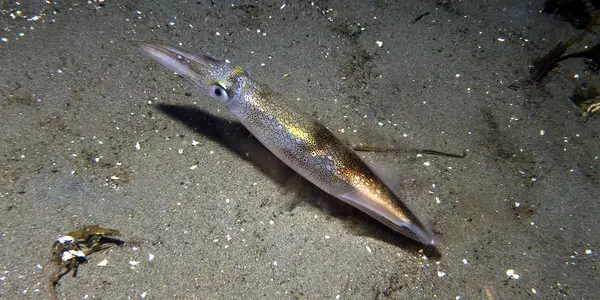
To no one's surprise, environmentalists and industry lobbyists are butting heads in a major legal wrangle over California's "wetfish"--sardines, anchovies, mackerel, and market squid. As you may recall, the pretty little market squid is the state's single biggest fishery:Opalescent inshore squid by Joshua Sera