You Feel Colder As You Age: The Science Reason Why
Older people report feeling colder, enough that it is clearly happening, but why has been a mystery. Until now.
Older people report feeling colder, enough that it is clearly happening, but why has been a mystery. Until now.

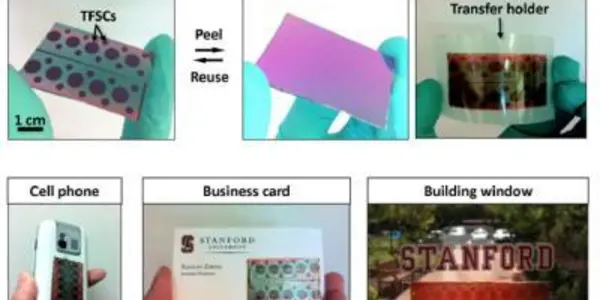
Solar panels are easily susceptible to mechanical problems. Storms, leaves, you name it - but some of that is because they are rigid. That rigidity also limits their applications.
New flexible, decal-like solar panels that can be peeled off like band-aids and stuck to virtually any surface, from papers to window panes, could make solar power a lot more deployable. The world's first peel-and-stick thin-film solar cells have been created by researchers at Stanford University and unlike standard thin-film solar cells, their peel-and-stick version does not require any direct fabrication on the final carrier substrate.

When is diversity a bad thing? When it comes to environmental action, according to a new paper from the University of East Anglia (UEA).
Scandinavian countries, low in ethnic and religious diversity, take more collective action than more diverse nations, like the UK, China and the United States. But the UEA paper frames diversity using the more negative term 'fragmentation'.
Americans may love separation of church and state and the mix of multiple religions in the USA but Dr. Elissaios Papyrakis, a senior lecturer in UEA's School of International Development and a senior researcher at Vrije Universiteit
in Holland, found that religious diversity has an even greater detrimental impact on environmental performance than ethnic diversity.
Human hands and their remarkable dexterity have given us everything from the guitar of Segovia to the art of the Dutch masters but, says David Carrier from the University of Utah, they evolved to be what they are for a more practical reason. As a weapon.
Carrier and colleague Michael Morgan publish their hypothesis that human hands evolved their square palms and long thumb to stabilise the fist and produce a compact club for use in combat in The Journal of Experimental Biology.
Scientists have found that therizinosaurs defied the sterotype of sensory abilities of plant-eating animals. Their exceptional sensory abilities - smell, hearing and balance - were well developed and might have affected or benefited from an enlarged forebrain, something typically associated with predators.
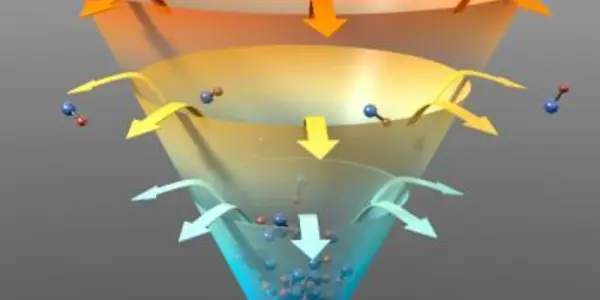
Evaporative cooling has been used to cool atoms to extraordinarily low temperatures. The process was used in 1995 to create a new state of matter, the Bose-Einstein condensate (BEC) of rubidium atoms (see Nobel laureate Carl Wieman and his Science 2.0 articles here), which was so revolutionary and unnatural that BEC atoms travel at a rate of only three feet per hour. Now in its 50th year, Joint Institute for Laboratory Astrophysics (JILA) physicists have met a goal once bordering on the impossible - they have chilled a gas of molecules to very low temperatures by adapting the familiar process by which a hot cup of coffee cools
Our eyes are the window to the world, but making sense of the thousands of images that flood us each day is squarely in the purview of the brain - and now researchers say they have created the first interactive map of how the brain organizes these groupings.
The result, achieved through computational models of brain imaging data collected while the subjects watched hours of movie clips, is what researchers call "a continuous semantic space."
Some relationships between categories make sense (humans and animals share the same "semantic neighborhood", for example) while others such hallways and buckets are less obvious. But the researchers found that different people share a similar semantic layout.
It's too late to treat Lou Gehrig, but he would probably still be batting .300 and playing every day for the New York Yankees if he had not been struck down by the disease that now bears his name.
Researchers who are not in the US, or who are Red Sox fans, prefer the more scientific amyotrophic lateral sclerosis (ALS) term for Lou Gehrig's Disease and results from eleven independent ALS studies provide some hope for the afflicted community – because they reveal that the disease may be treatable by targeting new mechanisms revealed in neural stem cell-based studies.
There's no way to legislate evil out of existence and mentally ill homicidal people are sometimes going to commit gruesome crimes. It has no cultural boundaries. The same day a mentally ill American attacked children in Connecticut a man in China did the same thing. While some are busy politicizing the issue to advance their agendas, society needs to take a renewed look at warning signs.

Globular clusters are spherical collections of stars bound to each other by their mutual gravity. They are old, relics of the early years of the Universe, with ages of typically 12-13 billion years, and we know of roughly 150 globular clusters in the Milky Way.
Yet, like many humans, these clusters are still young at heart. Some are aging faster than others and that discovery has led to a way to measure the rate of aging.
Star clusters form in a short period of time, meaning that all the stars within them tend to have roughly the same age. Because bright, high-mass stars burn up their fuel quite quickly, and globular clusters are very old, there should only be low-mass stars still shining within them.
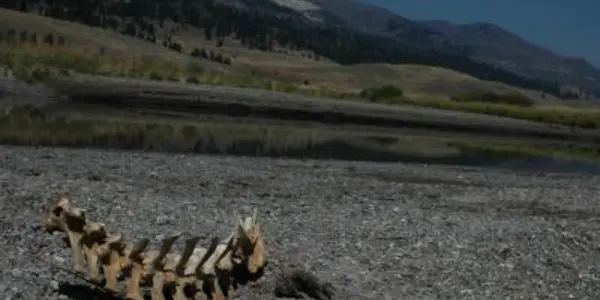
Josh Miller likes to call himself a conservation paleobiologist, which makes sense when he explains how he uses bones as up-to-last-season information on contemporary animal populations.
Bones, he says, provide baseline ecological data on animals complementary to aerial counts, adding a historical component to live observation. In his November cover article for the Ecological Society of America's journal Ecology, he assesses elk habitat use in Yellowstone National Park by their bones and antlers, testing his method against several decades of the Park Service's meticulous observations.

Tau Ceti, one of the closest stars most like our Sun, may have five planets.
Tau Ceti is just 11.9 light years away and visible to our eyes in the evening sky. It is the closest single star with the same spectral classification as our Sun. Its five planets are estimated to have masses between two and six times the mass of the Earthm making it the lowest-mass planetary system yet detected. One of the planets lies in the habitable zone of the star and has a mass around five times that of Earth, making it the smallest planet found to be orbiting in the habitable zone of a Sun-like star.

The goal of science is to explain the world according to natural laws - and then sometimes to break those rules.
And there is no greater rule than that people age and die.
But we mitigate and prevent life-threatening diseases and we have increased life spans in a quest to find a metaphorical "Fountain of Youth."
Ponce de León thought it might literally be a spring, but biologists are searching a little deeper. But they may still find it in St. Augustine some day - in the structure and function of cells within the palm.