You Feel Colder As You Age: The Science Reason Why
Older people report feeling colder, enough that it is clearly happening, but why has been a mystery. Until now.
Older people report feeling colder, enough that it is clearly happening, but why has been a mystery. Until now.


A project has identified the mechanism responsible for generating our fingers and toes, and revealed the importance of gene regulation in the transition of fins to limbs during evolution.
Their conclusion involves a theoretical model for pattern formation known as the Turing mechanism. In 1952, mathematician Alan Turing proposed equations for pattern formation, which describe how two uniformly-distributed substances, an activator and a repressor, trigger the formation of complex shapes and structures from initially-equivalent cells.
A recent Finnish analysis determined that approximately ten percent of 6-8 year olds have sleep-disordered breathing, increased among children with enlarged tonsils, crossbite and convex facial profile. Unlike in adults, excess body fat is not associated with sleep-disordered breathing in this age group. The study was part of the Physical Activity and Nutrition in Children (PANIC) Study led by the Institute of Biomedicine at the University of Eastern Finland.

A new hypothetical material offers the tantalizing possibility of a signal path smaller than the nanowires for advanced electronics.
Yes, theoretical materials. It must be the weekend.
Rice University theoretical physicist Boris Yakobson and postdoctoral fellow Xiaolong Zou were investigating the atomic-scale properties of two-dimensional materials - we all have those laying around the house to build Christmas gifts - when they concluded that a particular formation, a grain boundary in metal disulfides, will create a metallic, and therefore conducting, path only a fraction of a nanometer wide.
That's basically the width of a chain of atoms.
Globally, people are living longer and lifespans have increased dramatically in the past 40 years, but the increased life expectancy is not benefiting everyone. Adult males from low- and middle-income countries are most notably falling behind.
The average lifespan is longer than in 1970, and those extra years of life are being achieved at lower cost, but the costs for an extra year of life among adult males in lower-income countries are rising while the costs for an extra year of life among children worldwide and for adults in high-income countries continues to drop.

A new survey by the University of Iowa says casino growth in the state has not influenced gambling by residents. It instead suggests that fewer Iowans gambled overall and also that fewer people have become addicted to gambling despite a recent spurt in gaming facilities.
This is good news for those of you worried about having a crack house in your neighborhood or prostitutes on street corners. They will also apparently not lead to more drug use or prostitution.
Casino gambling was introduced in Iowa in 1991 and the state currently has 21 casinos in Iowa, three licensed by the state and the others owned and operated by Native American tribes.
The survey was conducted between 2006 and 2008 during a family study of problem gambling. The
University of Iowa
A new paper says that altered gut microbiota in humans is associated with symptomatic atherosclerosis and stroke.
The human body contains ten times more bacterial cells than human cells, most of which are found in the gut. These bacteria contain an enormous number of genes in addition to our host genome, and are collectively known as the gut metagenome. How does the metagenome affect health? It's unclear, other than that probiotic foods are a $30 billion placebo. But specifics are currently being addressed by researchers in metagenomic research.
In America, human women wake up every day and decide whether they want to have sex or not. They know somewhere a man is willing to make that happen.
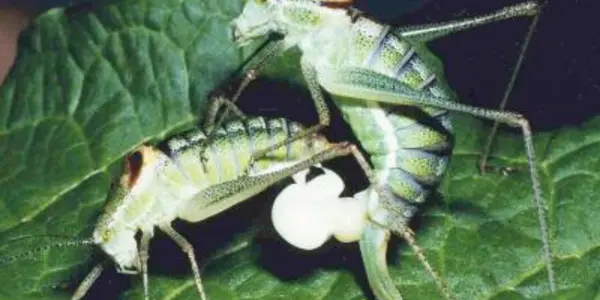
In bushcrickets, the male is in charge.
When bushcrickets mate, the male attaches a spermatophore to the female's abdomen. Alongside the sperm themselves, the spermatophore contains a protein-rich mass that the female eats after mating. It then takes several hours for the sperm to find their way into the female's reproductive tract.
Who decides when this 'bridal present' is delivered? A paper by Bielefeld biologists Professor Klaus Reinhold and Dr. Steven Ramm says the male determines the dynamics of this process, even long after he has 'hopped off' somewhere else.
Higher rates of schizophrenia are found in urban areas and it can be attributed to increased deprivation, increased population density and an increase in inequality within a neighborhood, says a new paper.
Dogs can sniff out Clostridium difficile, the infective agent that is responsible for many of the dreaded "hospital acquired infections", in stool samples and even in the air surrounding patients in hospital with a very high degree of accuracy, finds a study in the Christmas issue published on bmj.com today.
Yes, dogs can smell a superbug infection in poop. Can you smell a rat at BMJ this Christmas?
The findings, they write in one of this year's spoofs, support previous studies of dogs detecting various types of cancer and could have great potential for screening hospital wards to help prevent C. difficile outbreaks, say the researchers.
Opinions of the tooth fairy as kind and giving may need to be revised following "mounting reports of less child-friendly activity", according to a paper published in the BMJ's Christmas edition which is sure to fool mainstream media editors who are used to scare journalism and miracle vegetable of the week stories and may want to mix it up a little.
Researchers from across London, they write, have become concerned following misdemeanors of the mythical character and a worrying trend in malpractice. One boy in particular became extremely distressed because the tooth fairy "had put a tooth in his left ear" after he left it under his pillow.
An investigation turned out he was right.
Our immune system does not shut down with age, says a new study published in PLOS Pathogens today. T cells can respond to virus infections in an older person with the same vigor as T cells from a young person.
Researchers examined individuals, younger than 40, between 41 to 59 years of age and older than 60, infected with three different viruses, including West Nile, and found the older group demonstrated perfectly normal immune responses.
Both the number of virus-fighting T cells and the functionality of the T cells were equivalent in all three groups.

If you are an organic food or paleo diet lover and think it means your gut microbiome resembles your ancestors in any way, you are wrong. We aren't even close to 100 years ago much less ancient times. The microbiome does not lie.
A team analyzed microbiome data from ancient human fecal samples collected from three different archaeological sites in the Americas, each dating to over 1000 years ago. They also did a new analysis of published data from two samples that reflect rare and extraordinary preservation: Otzi the Iceman and a soldier frozen for 93 years on a glacier.